Low-fuss breakfast cooks
If you want to drain and flake salmon onto a plate with less picking, look for a skinless-and-boneless format. Ocado's M&S listings show why the exact pack warning still matters: small bones may remain.


For a Scottish-breakfast-style meal, choose a skinless-and-boneless format if quick flaking matters most, a larger tin if you will use the contents, or a small pot if salmon is just an add-on. Check the exact pack for bones, ingredients and instructions for storing anything left after opening; a skinless-and-boneless description does not rule out every small bone.
If you want to drain and flake salmon onto a plate with less picking, look for a skinless-and-boneless format. Ocado's M&S listings show why the exact pack warning still matters: small bones may remain.
A larger tin or multipack may suit a shared breakfast or meals planned for later. Match the quantity to what you can use within the opened-pack storage instructions.
If you are comfortable inspecting salmon as you flake it, compare the exact red or pink salmon tin, its ingredients and its bone warning rather than assuming the formats are alike.
For a breakfast plate, decide how much preparation you want to do and how much salmon you will use before settling on a pack format.
| Concern | What to check | Who this matters to |
|---|---|---|
| Bones and preparation | Read the format description and bone warning on the exact pack. Even a skinless-and-boneless listing may warn that small bones remain. | If I am flaking salmon straight onto a breakfast plate, I want less picking before serving. About 42% of consumers put that low-fuss preparation need first. |
| Quantity and leftovers | Check the net weight or pack count, then the instructions for storing opened salmon. | For a shared breakfast or another planned meal, I need enough salmon without opening more than I can use. Around 33% of consumers make suitable quantity their main concern. |
| Salmon format | Check whether the exact tin contains red or pink salmon, along with its ingredients and bone warning. | When a recipe calls for a standard tin, I am willing to inspect the fish while flaking it to get the format I want. Roughly 25% of consumers prioritise that standard-tin choice. |
The John West Red Salmon 213g listing warns that it contains bones. Ocado's M&S skinless-and-boneless salmon listing also warns that small bones may remain.
If less picking matters, start with a skinless-and-boneless product, but read its warning and inspect the salmon as you flake it.
Opened-pack instructions differ: the John West Red Salmon listing specifies use within two days after transfer and refrigeration, while the M&S 170g skinless-and-boneless listing specifies 24 hours.
Choose a size you can use, transfer and refrigerate any remainder as the pack directs, and follow that product's stated time limit.
Unused salmon may have to be discarded if it is not eaten within the pack's refrigerated-use period.
John West lists standard salmon tins and smaller Fridgepot formats. Its Red Salmon 213g product is a standard tin.
Princes lists wild Pacific pink salmon and separate red salmon products, including skinless-and-boneless red salmon.
Tesco's tinned-salmon listings include own-brand pink salmon, including a 418g tin.
Ocado lists M&S Wild Alaskan Red Salmon in a skinless-and-boneless format.
These pink-salmon options cover a multipack for planned meals, a single 213g tin and a smaller ready-to-eat pot for a breakfast add-on. Check each pack's bone information before choosing it for low-fuss serving.
 No image available
Four 213g tins offer separate packs for more than one planned meal. Check the can's skin and bone information if you want salmon that needs less picking.
 No image available
A single 213g tin may suit a meal where the multipack is unnecessary. Read the exact can's skin and bone information before flaking it onto the plate.
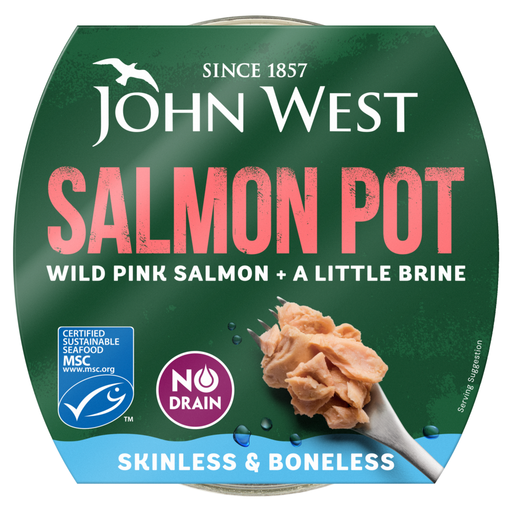 No image available
This ready-to-eat 80g pot is a smaller option when salmon is an add-on rather than the main fish element of a larger breakfast. Check the pack's bone warning and whether the amount suits your meal.
John West Red Salmon 213g is labelled ready to eat, so it can be flaked into a breakfast dish after opening. Check the instructions on a different tin or flavoured product rather than applying that label to every format.
Follow the instruction on the exact pack. The John West Red Salmon listing says to transfer unused contents to a covered non-metallic container, refrigerate and use within two days; the M&S 170g skinless-and-boneless listing specifies a non-metallic container, refrigeration and use within 24 hours.
The NHS lists salmon as oily fish and describes a fish portion as around 140g. Check the amount in the pack if portion size matters to how you plan the meal; an 80g pot is smaller than that reference portion.