Sugar-label checkers
You want to compare listed sugars on the exact salmon product you plan to pack, without mistaking a low figure for a comparative reduced-sugar claim.


For an office packed lunch, compare the current ‘of which sugars’ line and ingredients rather than assuming a plain salmon tin carries a reduced-sugar claim. An 80g–105g skinless-and-boneless tin offers a smaller portion for one lunch; a larger tin makes more sense for several servings if you can follow its leftover storage instructions. Check salt, fish allergens and bone warnings alongside sugars.
You want to compare listed sugars on the exact salmon product you plan to pack, without mistaking a low figure for a comparative reduced-sugar claim.
You want a portion that fits one salad or sandwich, with little preparation and less chance of leaving an opened tin at work.
You expect to use a larger tin across several servings and need a workable plan for storing any salmon left after opening.
For an office lunch, start with the need that will decide your choice, then compare the relevant label and pack details.
| Concern | What to check | Who this matters to |
|---|---|---|
| Listed sugars | Compare ‘of which sugars’ per 100g and the ingredients on the exact product, particularly if it is flavoured or packed in sauce. | If keeping listed sugars down decides my lunch choice, I need the figure for the salmon I will actually eat. About 36% of consumers would put that sugar-label check first. |
| Portion and preparation | Check individual tin size and any skinless-and-boneless description; still read the bone warning. | When I am packing lunch for one, a smaller portion is easier to use without leftovers. For about 29% of consumers, portion convenience would be the primary need. |
| Several servings | Compare pack weights and read the instructions for refrigerating unused contents after opening. | If one tin needs to stretch across several lunches, I need to know how I will store what remains. That would be the first concern for about 21% of consumers. |
| Allergens, bones and salt | Read the fish allergen declaration, residual-bone warning and salt value on the current label. | If a fish allergy, possible small bones or salt determines whether a product works for me, those checks come before pack size. About 14% of consumers would give them priority. |
A plain tin can list 0g or trace sugars without establishing how it compares with another product.
Use the current nutrition panel and ingredients to choose by listed sugars. If a reduced-sugar claim matters to you, check the claim and its comparison basis on the product itself.
Instructions differ: the cited M&S product says to refrigerate unused contents and eat them within 24 hours, while cited Tesco and John West products allow up to two days.
Choose a smaller portion if you do not expect leftovers, or follow the exact pack’s instructions for transferring and refrigerating them.
Small bones may remain in products described as skinless and boneless. Salmon also contains fish, an allergen identified by the Food Standards Agency.
Read both the bone warning and allergen declaration on the product you buy; a low sugar figure does not change either consideration.
Plain salmon products with little listed sugar can still have salt on their nutrition panels.
If salt affects your choice, compare its value per 100g and for the portion you intend to eat alongside the sugar figure.
Its wild red salmon tin and skinless-and-boneless wild pink salmon format offer different pack sizes for planning an office lunch.
Its 170g Skinless Boneless Wild Red Salmon is a larger plain-tin option for more than one serving.
Tesco offers own-label red and pink tinned salmon in several pack sizes, including skinless-and-boneless products.
Its 105g skinless-and-boneless wild Alaskan red salmon tin is a compact option for one lunch.
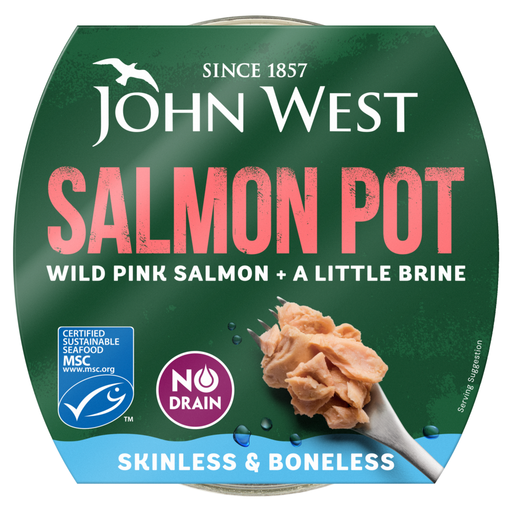
This compact salmon fridgepot is an alternative for a single office lunch, not a tinned-salmon option. Check its current label if listed sugars are your deciding factor.
 No image available
The 80g pack may suit one office lunch if you prefer a small portion, but it is a fridgepot rather than a tin. Check the current sugar line and ingredients before choosing it for a low-listed-sugar lunch, and follow the pack’s storage instructions after opening.
A low ‘of which sugars’ figure alone does not establish a comparison with another product. Check the nutrition panel and ingredients on the exact tin, particularly if you are considering a flavoured or sauce-based option.
An 80g–105g skinless-and-boneless tin offers a smaller portion for one person and may leave less unused salmon. Check the bone warning even when the product is described as boneless.
Follow the instructions on that tin. The cited M&S product says to transfer unused contents to a non-metallic container, refrigerate and eat within 24 hours; cited Tesco and John West products specify refrigeration and use within two days.