What matters when choosing
Decide first whether lunch needs to be ready to eat or can be cooked in advance. Then choose a portion and format you can handle during the lecture day.
| Concern |
What to check |
Who this matters to |
| No-cook lunch |
Look for an explicit ready-to-eat description and check whether the portion needs draining. |
If I have only a short break and no hob or oven, I need salmon I can use without cooking. About 36% of consumers put no-cook convenience first. |
| Portions and leftovers |
Check pack and drained weight, then the directions for storing any opened remainder. |
When I prepare several lunches, I want a tin size that fits those portions without leaving salmon I cannot store as directed. Portion planning is the primary concern for about 29% of consumers. |
| Skin and bones |
Read the exact product’s skinless, boneless and bone-warning descriptions. |
For a lunch eaten quickly between classes, I may prefer a format that needs less sorting before I eat it. About 21% of consumers place skin and bone preference first. |
| Cooked-fillets format |
Check refrigeration, cooking and use-by instructions for the fresh product. |
If I would rather bring a cooked fillet, I need to make time to prepare and store it according to its pack. That meal format comes first for about 14% of consumers. |
Tinned salmon on Joybuy
These options cover a small ready-to-eat pot and larger tinned pink salmon packs for planned portions. Confirm the eating and storage directions on the pack you select, particularly if lunch must need no cooking.
 No image available
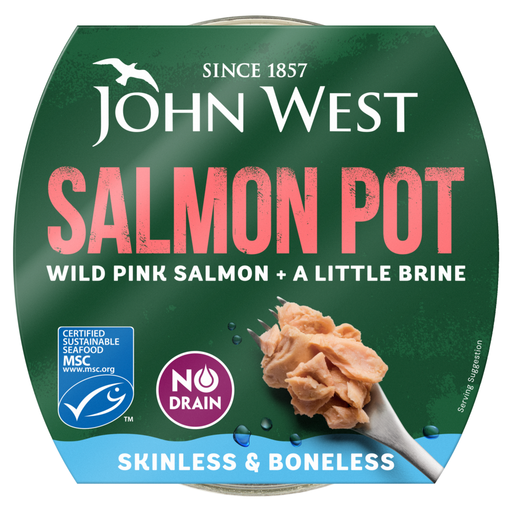
John West Pink Salmon Fridgepot 80g
For a short break without cooking, this 80g pot is described as ready to eat straight from the pot. Its listed directions say to refrigerate after opening and consume within two days; check the unopened-storage instructions before carrying it to campus. Check the pack if skinless or boneless salmon matters to you. Contains fish.
View on Joybuy
 No image available
Morrisons Pink Salmon 213g
This 213g tin is listed as two portions, making it an option when you have more than one lunch planned. Before using it for a no-cook break, confirm the exact pack’s eating directions. The listed after-opening instructions say to transfer the contents to a non-metallic container, refrigerate and consume within two days. Check the skin and bone description. Contains fish.
View on Joybuy
 No image available
Morrisons Pink Salmon 213g four-pack
This four-pack suits planning several lunches rather than choosing a single portion for one break. Each 213g can is described as two portions. Confirm the pack’s eating directions before counting on a no-cook lunch; after opening a can, the listed directions say to transfer the contents to a non-metallic container, refrigerate and consume within two days. Check the skin and bone description. Contains fish.
View on Joybuy
Common questions
Can I eat tinned salmon between lectures without cooking it?
Yes, if the exact product is described as ready to eat. John West says its salmon can be eaten straight from the can and describes its salmon pot as ready to eat straight from the pot; check other products individually rather than assuming every salmon pack has the same directions.
Can fresh salmon fillets work for a campus lunch?
They can work as a planned cooked lunch, not as a raw, no-cook substitute for tinned salmon. Tesco’s cited fresh fillets must be refrigerated and cooked according to the pack; its directions also say to consume them within one day once opened and by the use-by date.
What size tin makes sense for one lunch?
Choose a portion you expect to use, checking drained weight where stated. Tesco lists smaller 80g, 105g and 115g salmon formats as well as larger tins; if you choose a multi-portion pack, make sure you can follow its directions for the opened remainder.
What if I have a fish allergy?
Do not choose salmon. GOV.UK identifies fish as an allergen that must be clearly declared in the ingredients list when it is present in prepacked food. Check the individual pack’s ingredients and allergen information each time.
How long can I keep salmon after opening a tin?
Follow the after-opening instructions on the particular pack, including its storage directions. The Food Standards Agency advises following manufacturers’ open-life instructions rather than applying one duration to every canned food.


