Parents seeking a lower-prep filling
You want salmon for a sandwich, wrap or salad without much trimming. A skinless-and-boneless format reduces preparation, though you still need to check its bone warning.


For a school packed lunch, choose skinless-and-boneless tinned salmon if reducing preparation is the priority, or a standard tin if you can inspect and divide its contents. A smaller pot offers another pack format, but check its storage instructions; frozen fillets are a separate cook-ahead choice rather than a ready-to-use tin. With any salmon product, check the fish-allergen declaration and any bone warning.
You want salmon for a sandwich, wrap or salad without much trimming. A skinless-and-boneless format reduces preparation, though you still need to check its bone warning.
You need to check the fish declaration on the exact product and follow your child’s school allergy arrangements. Cambridge University Hospitals NHS Foundation Trust advises informing the school of a child’s food allergy and avoiding food sharing.
You need a pack size that fits the portions you will make, alongside an opened-pack instruction that fits when you plan to use any remainder.
For a school packed lunch, settle the preparation and allergy checks before choosing a pack size or ingredient list.
| Concern | What to check | Who this matters to |
|---|---|---|
| Preparation and texture | Check whether the pack says skinless and boneless, then read its warning about remaining bones. | If I am making a sandwich before school, I want salmon that takes less picking through, while still allowing me to check for bones. About 36% of consumers would put ease of preparation first. |
| Allergens and school arrangements | Read the exact pack’s fish declaration and any added ingredients; follow the child’s school allergy arrangements. | When an allergy affects lunch choices, I need the product label and the school’s arrangements to agree before I pack anything. About 29% of consumers would make allergy management their primary concern. |
| Portions and leftovers | Compare pack size with the portions needed, and check how the opened product must be stored and used. | If I am making several lunches, I want a pack I can use within its stated storage period rather than leave unfinished. Roughly 21% of consumers would prioritise portion planning. |
| Ingredients and nutrition | Read the exact ingredient list and nutrition panel, particularly when comparing plain and flavoured products. | If I want a plain filling, I need to know what is in this particular salmon product rather than assume every variety is alike. Around 14% of consumers would put ingredients and nutrition first. |
Skinless-and-boneless salmon from Sainsbury’s and M&S still carries warnings that small bones may remain. The format can reduce preparation, but it does not remove the need to check the fish.
Read the warning on the exact pack and inspect and flake the salmon before making the lunch when bone avoidance matters.
The plain salmon products described by Tesco and Sainsbury’s declare fish. That does not establish that they contain shellfish, while a flavoured or prepared product may have other ingredients to check.
Read the current ingredient and allergen information for the exact product and follow the child’s individual allergy arrangements.
A pack that makes several portions is useful only if you can use any opened contents within that product’s storage instructions. Tesco’s specified salmon product says to use refrigerated leftovers within two days; M&S gives a 24-hour instruction for its standard Wild Alaskan Red Salmon.
Check the pack size and opened-product instructions before preparing more than one lunch.
Unused salmon may go to waste if it cannot be used within the stated period.
A frozen fillet is a cook-ahead option, not the same ready-to-use cupboard format as a tin. Cooking and subsequent chilled handling need to fit the lunch-preparation plan.
Choose between the formats before shopping: use a tin for the ready-to-use route, or plan when you will cook, cool and pack a frozen fillet.
Tesco Groceries lists John West tinned salmon in plain, skinless-and-boneless multipack and flavoured formats.
Princes lists plain Wild Pacific Red Salmon in 105g and 213g sizes.
Tesco Groceries lists own-label red and pink tinned salmon, including a 170g skinless-and-boneless red salmon.
Sainsbury’s lists a 170g skinless-and-boneless Wild Pacific Red Salmon.
M&S lists 105g Wild Alaskan Red Salmon, including a skinless-and-boneless version.
These Joybuy selections cover pink salmon in standard tin formats and a smaller Fridgepot. Choose by the pack and preparation routine you need; check each product’s current label before packing it for school.
 No image available
The 213g tin is an option when you are preparing a filling to divide between lunches. Check the pack for its fish declaration, skin and bone information, and directions for storing any opened contents.
No image available
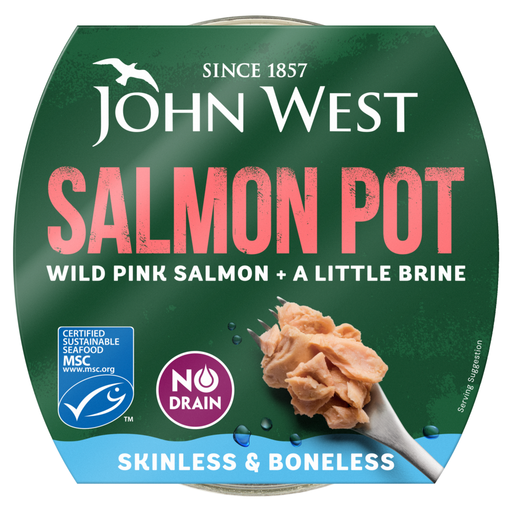
The 80g pot may suit a lunch needing a smaller quantity than a standard tin. Before packing it, check the pot’s storage and carrying instructions, fish declaration and any bone warning; do not assume it stores like an unopened tin.
 No image available
The four-pack format may suit households planning several lunches. Confirm the bundle’s exact contents and check each tin’s fish declaration, bone information and opened-content storage directions before planning portions.
Yes. The Tesco and Sainsbury’s salmon products described here declare fish. Read the current label of the exact tin or pot, including any additional ingredients in a flavoured product.
No. Sainsbury’s and M&S warn that small bones may remain in their specified skinless-and-boneless products. Check and flake the salmon before packing it if avoiding bones matters for your child.
Follow that tin’s instructions. Tesco’s specified product says to transfer unused contents to a non-metallic container, cover, refrigerate and consume within two days. M&S says to refrigerate unused contents of its standard Wild Alaskan Red Salmon in a non-metallic container and eat them within 24 hours.
Follow the child’s individual allergy arrangements rather than a general lunch suggestion. Cambridge University Hospitals NHS Foundation Trust advises informing the school of the child’s needs and says children should not share food at lunch. Do not pack salmon for a child with a fish allergy.
Yes. The NHS lists salmon as an oily fish. For a particular lunch product, use its own ingredient list and nutrition panel rather than assuming plain tins and flavoured varieties have the same composition.