Shoppers drawn to speciality recipes
M&S Collection lists tinned soups with ingredients such as beef stock and wine in its French Onion recipe. Compare the named ingredients if a particular flavour is the reason you are considering a speciality tin.


Choose a speciality tinned soup if its named ingredients appeal to you and cupboard storage suits your mornings; choose a chunky tin if the ingredients and portion format better match the breakfast you want. A premium label does not establish restaurant quality, so compare the recipe, nutrition and allergens on the individual pack, and consider chilled soup only if refrigeration fits your routine.
The useful distinction for a weekday breakfast is whether you want a particular recipe, a chunky tin or a soup that meets specific dietary requirements.
M&S Collection lists tinned soups with ingredients such as beef stock and wine in its French Onion recipe. Compare the named ingredients if a particular flavour is the reason you are considering a speciality tin.
Heinz Big Soup Beef & Vegetable and Chunky Vegetable are 400 g canned options with declared vegetable ingredients. Check the exact variety and serving information rather than assuming every chunky soup makes the same-sized breakfast.
Names alone do not establish whether a soup meets an allergy requirement or avoids an ingredient such as wine or wheat. Read the current pack’s ingredients, allergen statements and nutrition panel for the recipe you intend to eat.
Start with the recipe and storage format, then compare the amount you expect to eat with the pack’s nutrition and after-opening instructions.
| Priority | What to check | Your needs |
|---|---|---|
| Recipe and format | Read the named ingredients rather than relying on a premium label. Confirm whether the soup is a cupboard tin or a chilled product that needs refrigeration. | I want a particular flavour without mistaking a chilled soup for something I can keep in the cupboard. |
| Portion | Compare net weight and the labelled number of servings. M&S lists Collection French Onion at 550 g and Calabrian Mushroom and Truffle at 560 g; the Joybuy Heinz Big Soup Beef & Vegetable listing is 400 g. | A larger can might leave me with soup after breakfast, so I need to decide how much I will heat and what I will do with the rest. |
| Nutrition | Compare salt and saturated fat on the same per-100 g basis, then account for the portion you expect to eat. Joybuy lists Heinz Big Soup Beef & Vegetable at 0.6 g salt per 100 g; that is not the amount in a whole can. | If soup is a regular breakfast for me, the figures for the amount I actually eat matter more than a recipe’s premium or hearty description. |
| Ingredients and allergens | Check the current ingredients and allergen statements for the exact variety. M&S describes wine in Collection French Onion Soup, while Joybuy lists wheat flour in Heinz Big Soup Chunky Vegetable. | My choice needs to fit the ingredients I avoid; a vegetable or speciality name cannot answer that for me. |
| Leftovers | Read the pack’s instructions for storing soup after opening and the period given for using it. Choose a can size with those instructions in mind. | On a rushed morning, I need a plan for any soup I do not eat straight away. |
A speciality name can indicate a recipe style, but it does not establish how the finished soup compares with a restaurant meal.
Use the ingredient list to judge whether the flavour appeals to you, then check the format and nutrition panel separately.
A chilled soup needs a different storage routine from an unopened shelf-stable tin. That difference matters if breakfast shopping is intended to stock the cupboard.
Confirm the product’s format and storage directions before treating it as an alternative to tinned soup.
A recipe can include ingredients that its short name does not make obvious: M&S describes wine in its Collection French Onion Soup, and Joybuy lists wheat flour in Heinz Big Soup Chunky Vegetable.
Check the current pack’s full ingredients, emphasised allergens and any suitability statements for the exact soup.
A can that suits several portions may leave a remainder after one breakfast, and the unopened-can storage instructions no longer cover it.
Read the after-opening directions before heating the soup, and store any remainder as the pack instructs.
Choosing a can larger than you can use within its stated after-opening period may leave soup to discard.
These ranges illustrate different soup formats and recipes; a brand name alone does not establish that every soup in its range suits the same breakfast.
M&S lists Collection French Onion Soup and Calabrian Mushroom and Truffle Soup in its tinned-soup range. Eat Well is a separate range marker in the same category listing, not a description of those Collection recipes.
The Heinz Big Soup listings include 400 g Beef & Vegetable and Chunky Vegetable canned soups, with ingredients disclosed for each variety.
Tesco lists Campbell's Condensed Cream of Mushroom and Condensed Cream of Chicken soups in 295 g formats.
Tesco lists tinned and packet soups, alongside 600 g Finest soup varieties. Check the individual Finest product’s storage format before choosing one instead of a cupboard tin.
These Heinz Big Soup tins cover the chunky, meat-and-vegetable route for a weekday breakfast. Compare their named recipes and the current pack details if you are deciding between them.
 No image available
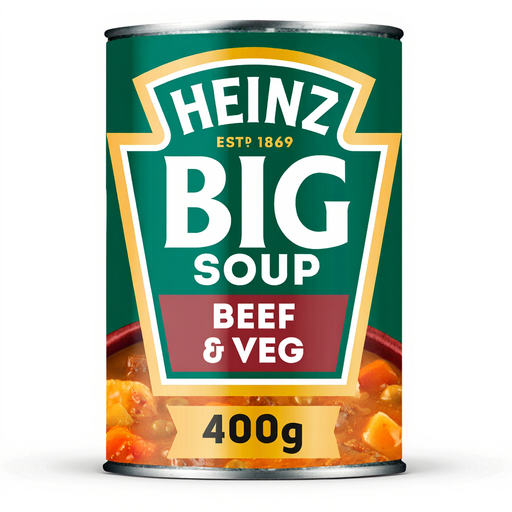
Consider this tin if beef and vegetables are the recipe you want for breakfast. Joybuy lists potatoes at 17% and beef at 10%, alongside carrots, peas and onions; its salt figure is 0.6 g per 100 g, so check the amount in the portion you plan to eat.
 No image available
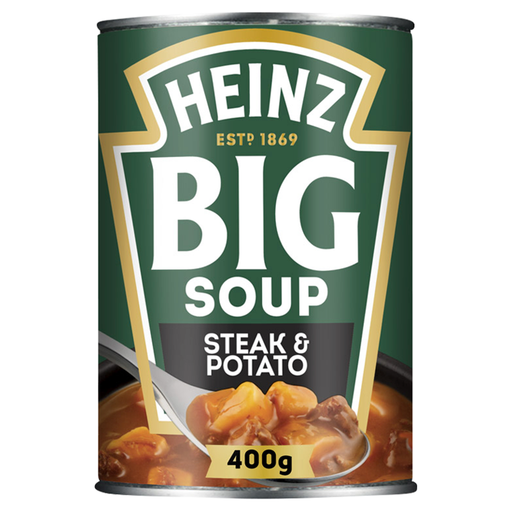
This 400 g tin offers a steak-and-potato recipe for shoppers who prefer that flavour to beef and mixed vegetables. Check the current pack’s serving, ingredient and nutrition information to decide how much suits your breakfast.
 No image available
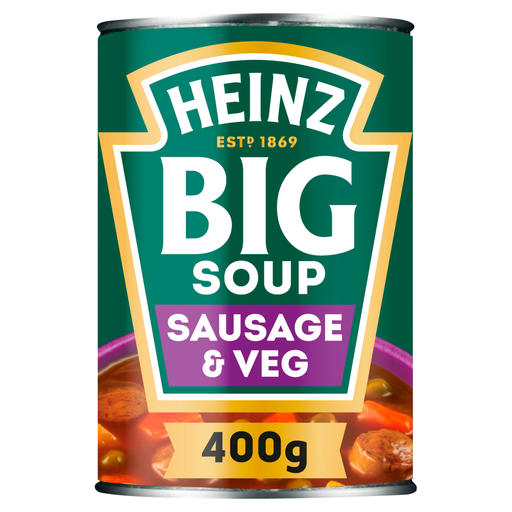
Choose this 400 g tin to consider a sausage-and-vegetable recipe rather than the beef varieties. Check its current ingredient and allergen information, portion guidance and directions for storing any soup left after breakfast.
No restaurant-quality conclusion follows from that label. Compare the particular recipe’s ingredients, nutrition and format instead: M&S, for example, describes beef stock and wine in its Collection French Onion Soup.
It can suit a morning routine with refrigeration, but it is not a cupboard-storage substitute for an unopened shelf-stable tin. Check the individual product’s storage directions and portion size before making the swap.
Compare the figures per 100 g, then work out what the portion you intend to eat means for that comparison; a whole tin may contain more than one labelled serving. UK Government guidance recommends no more than 6 g of salt per day for adults.
Follow the exact pack’s after-opening instructions for transferring, refrigerating and using the remainder. Check those directions before opening a can if you expect to eat only part of it.
Read the current pack’s ingredients, emphasised allergen information and any “not suitable for” statement for the exact variety. A flavour name or an older product listing is not a substitute for those details.