Christmas cupboard planners
If you are keeping tins for meals that do not need much planning, compare pack sizes, stated servings and storage instructions. They help you work out which tins fit the space and meals you have in mind.


For quick meals between Christmas plans, a ready-to-heat tin is the simpler choice; check its stated servings against the number of people you expect to feed. Choose condensed soup when you intend to cook with it and can follow its instructions for adding liquid. In either case, the exact tin’s ingredients, salt figures and storage instructions matter more than the soup’s name alone.
If you are keeping tins for meals that do not need much planning, compare pack sizes, stated servings and storage instructions. They help you work out which tins fit the space and meals you have in mind.
A ready-to-heat soup suits a short lunch break. Check the heating directions and whether the label describes a 400g tin as two smaller servings before deciding how many tins to use.
If soup is an ingredient in a dish, check whether it is condensed and needs added liquid. For vegetarian, vegan or allergen-related needs, use the statement and ingredients on the current tin rather than judging by its flavour name.
Start with how you will use the soup, then compare servings and the details on the exact tin.
| Priority | What to check | Your needs |
|---|---|---|
| Preparation | Read the heating directions. For condensed soup, check the stated quantity of liquid to add before heating. | For a meal between plans, I want a tin I can heat directly. If I am cooking a dish, I can use a condensed soup as an ingredient. |
| Portions | Compare the tin’s weight with its declared servings. Check whether nutrition figures refer to 100g, half a tin or another serving size. | When several people may want soup, I need to know whether one tin covers the portions I have planned. |
| Ingredients | Read the current ingredients, allergen declaration and any stated vegetarian or vegan suitability. Do not infer suitability from a tomato or vegetable flavour. | I need a soup that fits the people eating it, including anyone who must avoid a particular ingredient. |
| Salt | Compare salt figures on the same basis, such as per 100g or per half-can serving. The examined Sainsbury’s Tomato & Basil tin lists 0.85g per half can; Sainsbury’s lists 1.1g for a half can of Heinz Cream of Tomato. | If I am serving soup more than once during the holidays, I want to understand what the figure on each tin represents. |
| After opening | Check the exact tin’s container, refrigeration and use-by instructions for leftovers. Tesco Groceries lists four days after opening for its Cream of Tomato soup; Sainsbury’s lists two days for its Tomato & Basil soup. | I may use only part of a tin, so I want to know how to store the rest as directed. |
Nutrition information for the examined 400g tomato soups is presented per half can. Eating the whole tin is a different portion from the one described by that figure.
Check the servings per pack and the measurement beside each nutrition figure before comparing tins.
Recipes differ. For UK prepacked food, GOV.UK says any of the 14 regulated allergens used as ingredients must be clearly labelled in the ingredients list.
Read the ingredients and allergen declaration on the current tin, even when buying a familiar flavour again.
Instructions differ: Tesco Groceries lists four days for its Cream of Tomato soup after transfer and refrigeration, while Sainsbury’s lists two days for its Tomato & Basil soup.
Transfer leftovers and follow the container and refrigeration instructions printed on the tin you opened.
These examples show different soup formats and ranges; check the individual tin for the details that affect your meal.
Tesco’s own-label Cream of Tomato is a 400g cupboard-soup example.
Sainsbury’s lists tomato-soup recipes including Tomato & Basil and Cream of Tomato.
Heinz Cream of Tomato is a branded tomato-soup option for shoppers seeking that particular recipe.
Campbell’s UK presents condensed soup as an option for cooking with soup as an ingredient.
The M&S tinned-soup catalogue includes vegetable, minestrone and chilli-bean recipes.
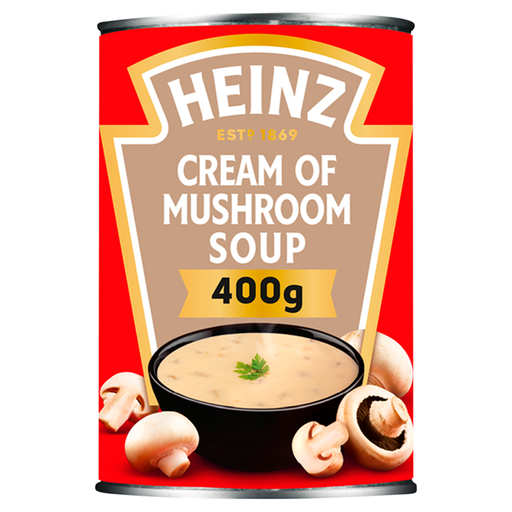
This 400g mushroom soup is an option to consider when planning tinned meals for the Christmas cupboard. Check its current label against the portions, preparation and ingredients your household needs.
 No image available
A mushroom-soup tin to consider for cupboard meals. Check its serving guidance, preparation directions and current ingredients before deciding how it fits your plans.
Check the tin rather than assuming. Sainsbury’s states that its 400g Tomato & Basil soup contains two servings, and the examined Tesco and Sainsbury’s tomato soups present nutrition per half can. You can then decide how much to serve for your meal.
It can be prepared as soup, but follow its directions first. Waitrose’s Campbell’s Condensed Chicken Soup instructions say to add one can of cold water, or a mixture of milk and water, before heating; it is not prepared like a ready-to-heat tin.
Transfer the unused soup, refrigerate it and follow the instructions on that product. Tesco Groceries specifies a non-metallic container and use within four days for its Cream of Tomato soup; Sainsbury’s specifies a non-metallic container and two days for its Tomato & Basil soup.
Check the current ingredients list on the tin. GOV.UK says that, for prepacked food, any of the 14 regulated allergens used as ingredients must be clearly labelled there. A flavour name alone cannot establish whether a soup meets your needs.
Compare figures for the same quantity of soup. Sainsbury’s lists 0.85g salt per half can for its Tomato & Basil soup and 1.1g per half can for Heinz Cream of Tomato; check the stated serving size on any other tin before making the comparison.