Hosts serving one or two guests
If soup is a small hot option at the party, check whether a tin covers two portions. The documented Heinz and Sainsbury’s 400g tomato soups use half-can servings; for one guest, plan what to do with the remainder.


For one birthday-party guest, choose by the portion you intend to serve: the documented 400g tomato tins use half-can servings, so they make more sense if two guests will share or you can refrigerate the remainder. A cup soup avoids an opened tin but needs preparing with hot water; a smaller condensed tin needs preparation too and is not automatically a single serving. Check the current pack for servings, ingredients, allergens and salt at the amount you will serve.
If soup is a small hot option at the party, check whether a tin covers two portions. The documented Heinz and Sainsbury’s 400g tomato soups use half-can servings; for one guest, plan what to do with the remainder.
A clearly labelled vegetarian soup can help you plan a meat-free option. Check its ingredients as well: the documented Heinz, Sainsbury’s and M&S cream-of-tomato soups contain milk.
Ask guests about restrictions before choosing a soup, then check the current pack. The documented cream-of-tomato products contain milk, while Campbell’s condensed cream-of-tomato soup declares milk and celery.
Choose it when: Two guests can share, or you can refrigerate an unused portion as the pack directs.
Bear in mind: The documented Heinz and Sainsbury’s tomato tins use half-can servings, so opening one for a single bowl leaves a remainder.
Choose it when: You can prepare the soup according to its pack rather than simply heating a ready-to-serve tin.
Bear in mind: A smaller can does not establish the prepared serving size. Campbell’s 295g cream-of-tomato product also declares milk and celery.
Choose it when: You want to prepare a guest’s portion without opening a tin.
Bear in mind: Preparation needs hot water; check the individual pack for its portion instructions and allergens.
Once you have chosen a format, compare the serving you will actually make with the label—not just the size printed on the front.
| Priority | What to check | Your needs |
|---|---|---|
| Portion and leftovers | Read the stated servings, not just the pack weight. For an opened tin, follow its instructions for transferring, refrigerating and using the remainder. | Will one guest eat the whole pack, or can I serve a second portion or keep it as directed? |
| Salt | Compare salt per 100g and per stated serving, then consider the amount you will serve. A condensed product’s stated portion and a ready-to-heat soup’s half-can portion are not interchangeable measures. | If the guest may have more than one labelled portion, I want the salt figure for the amount going into their bowl. |
| Ingredients and allergens | Read the current ingredient and allergen declaration. A vegetarian label does not establish that a creamy soup is dairy-free; the documented Campbell’s condensed tomato soup declares celery as well as milk. | Before serving someone with a restriction, I need to check the particular pack, not rely on its flavour or vegetarian label. |
| Preparation | Check whether the product is ready to heat, condensed or prepared with hot water. Follow its stirring and standing instructions; Food Standards Agency caterer guidance says reheated food should be thoroughly hot in the centre and reheated only once. | For a party, I need a method that works with the equipment available and lets me serve the soup hot throughout. |
The documented Heinz and Sainsbury’s 400g tomato soups use half-can serving information, and Sainsbury’s labels its tin as two servings. Opening one for a single guest can leave soup to store.
Check the servings on the tin. If you will serve only one portion, plan to share the rest, store it as directed or choose another format.
A per-100g figure and a per-serving figure answer different questions. Sainsbury’s lists 0.89g salt per half-can of its cream-of-tomato soup, while the Heinz 400g cream-of-tomato label lists 1.1g per half-can.
Use the current label to compare equivalent amounts, then check how much you intend to put in each bowl.
The documented vegetarian cream-of-tomato soups from Heinz, Sainsbury’s and M&S contain milk. Campbell’s condensed cream-of-tomato soup also declares celery.
Ask about guests’ restrictions and keep the packaging available so you can check the exact product before serving.
Food Standards Agency caterer guidance calls for thorough reheating, including checking the centre of microwaved food, and says food should be reheated only once.
Follow the pack’s stirring and standing directions, heat the amount needed for service and check that it is hot throughout.
These product-label examples show why the particular soup matters more than the brand name alone.
Its documented Cream of Tomato Soup is a 400g, ready-to-heat vegetarian example with half-can serving information.
Its documented 295g condensed cream-of-tomato soup is a smaller-can option that needs preparation.
Tesco Groceries lists own-label tinned soups and cup-soup formats alongside branded products.
Its documented 400g Cream of Tomato Soup is labelled as two vegetarian servings.
M&S lists both 400g tinned soups and smaller cup-soup formats.
These options cover sachet soups and 400g tins for a birthday-party guest. Check each product’s serving information and preparation method rather than assuming the same pack size makes the same number of bowls.
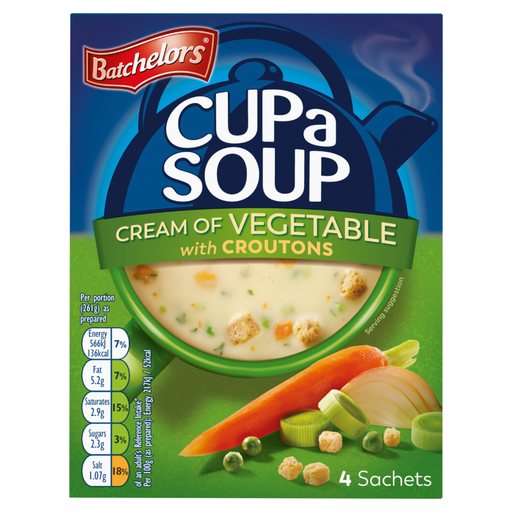 Image unavailable
A sachet format lets you prepare soup for a guest without opening a tin. This vegetarian-labelled product contains wheat, milk and barley and may contain celery and soya; check the current pack for the guest’s restrictions.
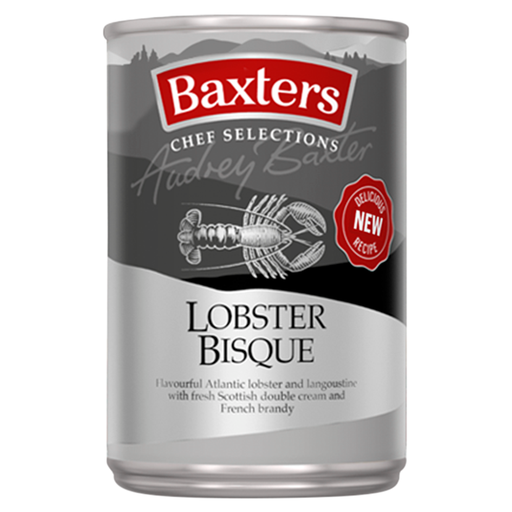 Image unavailable
The product description presents this 400g can as serving one, unlike the half-can tomato-soup examples. Its stated preparation uses a hob. It contains crustaceans, milk, sulphites and celery, so check the current pack before serving it to a guest with restrictions.
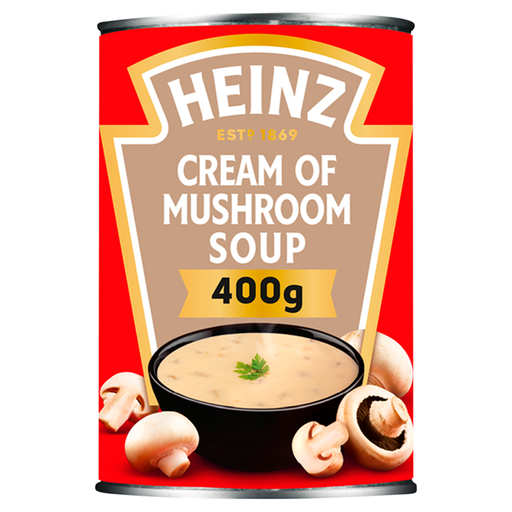 Image unavailable
This vegetarian-labelled 400g soup is presented as two servings, so it suits a shared serving or a plan for the remainder rather than an assumed single portion. It contains milk and wheat; check the current pack for allergens and opened-soup storage instructions.
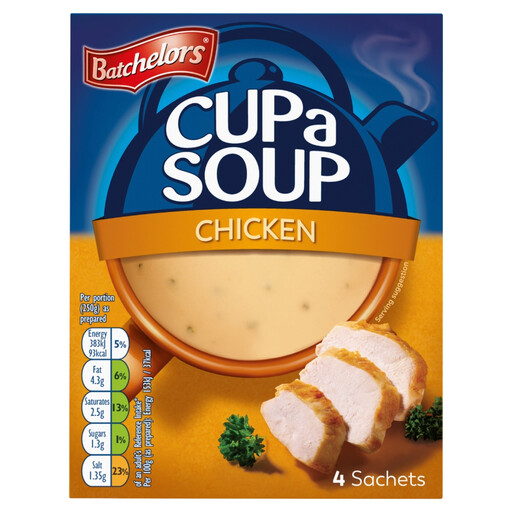 Image unavailable
This four-sachet cup soup is an add-water option when you do not want to open a tin. Check the pack’s preparation and serving instructions before making a guest’s portion. It contains chicken, milk and barley and may contain celery, soya and wheat.
Not necessarily: the documented Heinz and Sainsbury’s 400g cream-of-tomato soups use half-can serving information, and Sainsbury’s labels its tin as two servings. Check the particular pack before deciding how many bowls to serve.
Follow that tin’s storage instructions rather than leaving soup in the opened can. The Sainsbury’s cream-of-tomato label says to transfer unused soup to a non-metallic lidded container, refrigerate it and use it within two days; check your product’s own directions.
A vegetarian label does not mean dairy-free. The documented Heinz, Sainsbury’s and M&S cream-of-tomato soups contain milk or cream, so check the current ingredient and allergen declaration for the soup you serve.
Follow the product’s microwave directions, including any stirring and standing steps, and check that the soup is hot throughout. Food Standards Agency caterer guidance says microwaved food should be checked in several areas, reheated thoroughly in the centre and reheated only once.