Solo pantry stockers
If soup is a standby meal for busy days, look at the stated serving size and decide whether you would eat the whole tin or store the remainder.


For one person’s pantry, choose tinned soup by the amount you expect to eat and whether you can use any leftovers, rather than treating every 400g tin as one serving. Compare salt for that portion, check the exact recipe’s ingredients and allergens, and follow its instructions after opening.
The useful tin size and recipe depend on whether soup is an occasional cupboard meal, a regular choice or subject to dietary restrictions.
If soup is a standby meal for busy days, look at the stated serving size and decide whether you would eat the whole tin or store the remainder.
If you eat tinned soup often, compare salt per 100g and then work out the amount in the portion you normally eat.
If vegetarian or vegan suitability, or an allergen, matters to you, check the designation and ingredients on the exact tin. Recipes within a range can differ.
Start with the portion you would use, then compare nutrition and ingredients before deciding how the tin fits your cupboard routine.
| Priority | What to check | Your needs |
|---|---|---|
| Portion size | Check the tin weight, stated servings and whether nutrition is shown per 100g or per serving. Calculate values for the amount you plan to eat. | I might want the whole tin for one meal, or I might need a practical plan for the remainder. |
| Salt | Compare salt per 100g between similar soups, then calculate it for your portion. Action on Salt & Sugar’s February 2026 assessment of 481 ready-to-eat chilled and ambient soups sold by major UK retailers found values ranging from 0.1g to 1.6g per 100g. | When soup is a regular cupboard meal, I want to know how much salt is in the amount I will actually eat. |
| Ingredients | Read the current tin’s ingredients, highlighted allergens and vegetarian or vegan statement. Apply dietary claims to that recipe, not the whole brand. | A familiar vegetable flavour is not enough for me to judge whether a soup fits my dietary requirements. |
| Storage | Check the unopened storage directions and best-before date. For leftovers, follow that tin’s refrigeration and use-within instructions; the checked M&S soups specify an airtight container and use within two days. | If I open a tin for one meal, I need to be able to store and use what is left. |
Tesco Groceries shows nutrition per half-can for its listed Heinz Vegetable Soup and Heinz Big Soup. Eating the whole tin means using twice those half-can values.
Decide how much you would eat, then use the label’s serving or per-100g figures to assess that amount.
A reduced-salt claim compares one product with another; it does not tell you the salt in your full portion. Action on Salt & Sugar’s February 2026 UK soup assessment found substantial variation per 100g across the products it examined.
Compare the actual salt figures on the same basis, preferably between similar flavours, and account for how much you will eat.
Tesco Groceries lists wheat in Heinz Vegetable Soup and both wheat and milk in Heinz Big Soup Chicken & Veg. A simple-sounding flavour is not an allergen statement.
Read the ingredients, highlighted allergens and any warning statements on the current tin.
The checked M&S soup instructions require opened contents to be refrigerated in an airtight container and eaten within two days.
If you expect leftovers, check that tin’s directions and make a plan to use the remaining soup within its stated period.
These examples show different recipes and formats to check; suitability depends on the individual tin, not the brand name.
The checked 400g range includes vegetable and tomato classics alongside a chicken-and-vegetable Big Soup.
Tesco Groceries lists 295g condensed Cream of Mushroom and Cream of Chicken soups.
Tesco Groceries lists own-label 400g recipes including vegetable, minestrone, mushroom and meat-based soups.
Sainsbury’s tinned-soup category includes own-label and branded products, with dietary filters such as vegetarian and halal.
M&S lists 400g recipes including tomato, minestrone, chunky vegetable and chicken-and-vegetable soups.
These 400g tins give you a seafood recipe and a mushroom recipe to consider for one-person cupboard meals. Check the portion and label details that matter to you for each.
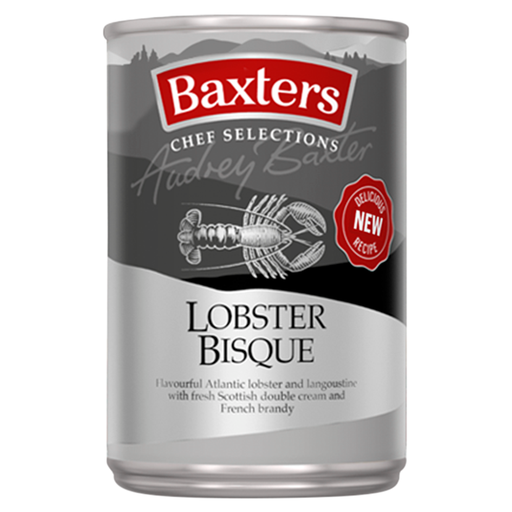 No image available
For a one-person meal, consider whether a 400g tin matches the portion you want. Check the current label for crustaceans, milk, sulphites and celery, and calculate salt for the amount you intend to eat.
 No image available
If you plan to divide a 400g tin between meals, check its serving and after-opening storage instructions. Check the current label for milk and wheat, and compare salt for the portion you expect to eat.
Not necessarily. Tesco Groceries presents nutrition per half-can for its listed 400g Heinz Vegetable Soup and Heinz Big Soup. Check the stated serving and calculate the values for the amount you would actually eat.
Follow each tin’s storage directions and put tins with nearer best-before dates where you will use them first. GOV.UK explains that best-before dates concern quality rather than safety and identifies tinned foods as products that should carry them; still check the packaging and label before use.
Follow the instructions on that tin rather than assuming every recipe keeps for the same period. The checked M&S soups direct shoppers to put opened contents in an airtight container, refrigerate them and eat them within two days.
Compare the labelled salt per 100g for similar recipes, then calculate the amount in the portion you expect to eat. A reduced-salt claim is relative to another product, so read the salt figure as well as the front-of-pack wording.
No. Use a filter to find recipes to inspect, then read the current tin’s ingredients, highlighted allergens and warning statements. Tesco Groceries lists wheat in its checked Heinz Vegetable Soup despite that recipe being suitable for vegetarians.