People eating a can on their own
If you usually finish a can, calculate fat and salt for the whole amount rather than assuming the labelled serving covers your meal. Tesco Groceries lists half a 400g can as a serving for Heinz Vegetable Soup.


For a one-person meal, compare tinned soups by total fat per 100g, then work out the amount in the portion you will eat: a label’s half-can serving may not describe your whole-can lunch. The NHS defines low-fat food as containing 3g of fat or less per 100g, but salt and ingredients need separate checks. If a healthcare professional has set you an individual fat allowance, use that plan when assessing the portion.
If you usually finish a can, calculate fat and salt for the whole amount rather than assuming the labelled serving covers your meal. Tesco Groceries lists half a 400g can as a serving for Heinz Vegetable Soup.
A vegetarian description helps narrow the choice, but the nutrition panel determines its fat content. Check the ingredients of the exact soup if you also avoid particular allergens.
If a healthcare professional has given you an individual limit, compare the fat in the portion you intend to eat with that plan. Oxford University Hospitals NHS Foundation Trust distinguishes its guidance for a medically advised minimal-fat diet from general food-label guidance.
Start with comparable per-100g figures, then calculate what your own portion contains; check salt and ingredients separately from fat.
| Priority | What to check | Your needs |
|---|---|---|
| Fat in your portion | Compare total fat per 100g with the NHS low-fat threshold of 3g or less per 100g. Use the can weight or labelled serving size to calculate the amount you will eat. | If I finish the can, I want the whole-can figure, not just the figure for half a can. |
| Salt | Compare salt per 100g on the same basis between soups, then calculate your portion. The NHS defines low salt as 0.3g or less per 100g; a low-fat soup need not meet that separate threshold. | A soup may fit my fat criteria while its salt figure calls for a closer look, particularly if I eat the whole can. |
| Ingredients | Read the current ingredients and allergen information for the exact flavour. Check vegetarian suitability separately from allergens such as wheat, barley, milk or celery. | I want a recipe that fits the ingredients I avoid, without assuming that a vegetable soup is free from other allergens. |
| Preparation and leftovers | Check whether the soup is ready to heat or condensed, how it is prepared, and the pack’s instructions for any unused portion. Tesco Groceries says Campbell’s Low Fat Mushroom Condensed Soup requires a full can of cold water to be added. | For a meal on my own, I need to know whether I will prepare the whole can or store some for later. |
Tesco Groceries gives nutrition for half a can of Heinz Vegetable Soup. Eating the full can means consuming two of those stated servings.
Check the serving size against what you will eat, then calculate fat and salt from the per-serving or per-100g values.
The NHS says “lower fat”, “reduced fat”, “lite” and “light” describe a reduction of at least 30% against a similar product. That comparison does not, by itself, establish whether the soup meets the NHS low-fat threshold of 3g per 100g.
Use the total-fat figure per 100g rather than a recipe name or range badge as your deciding check.
Marks & Spencer lists 0.4g fat and 0.50g salt per 100g for its Chunky Vegetable Soup. The fat figure meets the NHS low-fat threshold; the salt figure does not meet its separate low-salt threshold of 0.3g per 100g.
Compare both figures and calculate each for the amount you expect to eat.
Ingredients differ between recipes. Marks & Spencer lists celery and pearl barley containing gluten in its Chunky Chicken and Vegetable Soup, while the Tesco Groceries listing for Heinz Vegetable Soup includes wheat pasta and wheat flour.
For an allergy, intolerance or coeliac disease, read the current can’s ingredients and allergen information for the exact flavour before eating.
A brand or range name can help you locate a recipe, but use the individual can’s nutrition panel and ingredients to decide whether it fits your meal.
Tesco Groceries lists own-label Low Fat Tomato Soup and Low Fat Lentil & Vegetable Soup in 400g cans.
Marks & Spencer lists 400g tinned soups in its Eat Well range, including Chunky Vegetable Soup and Minestrone.
Heinz Vegetable Soup is a 400g option listed by Tesco Groceries with values per 100g and per half-can.
Tesco Groceries lists Campbell’s Low Fat Mushroom Condensed Soup in a 295g can.
These cans offer different pack sizes and recipes for a one-person soup meal. Compare the current nutrition panel for the portion you plan to eat; their position here is not a ranking by fat content.
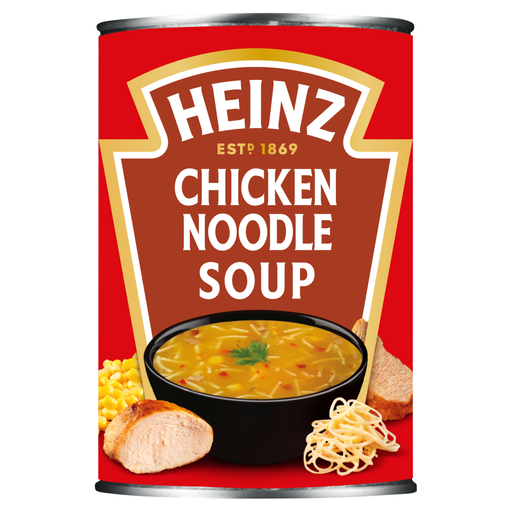 Image unavailable
For a whole-can meal, use the current 400g can’s panel to calculate fat and salt for the amount eaten. Check the ingredients for celery, egg and wheat if you avoid them.
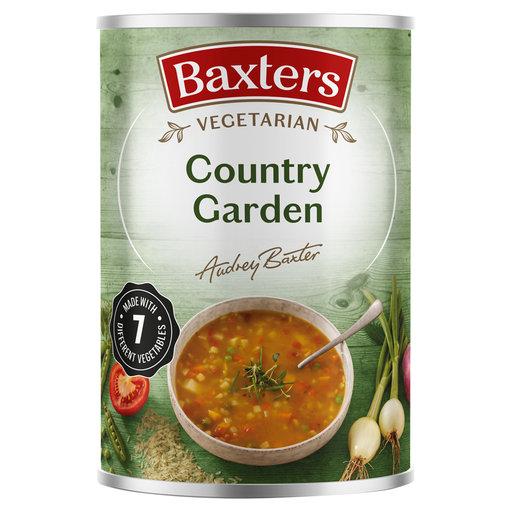 Image unavailable
This vegetarian-labelled 400g soup is an option to assess for a whole-can or smaller meal. Calculate fat and salt for your portion from the current label, and check for milk if you avoid it.
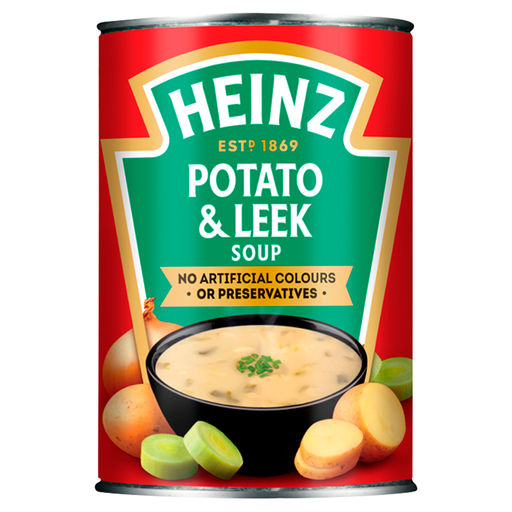 Image unavailable
If you eat half or all of this 400g can, compare the nutrition figures for the amount you choose rather than the recipe name alone. Check the current ingredients for milk if relevant.
 Image unavailable
The 185g can is a smaller-pack option than the 400g soups here. Read the current can’s nutrition panel, particularly its salt figure, before assessing your portion; also check the ingredients for milk.
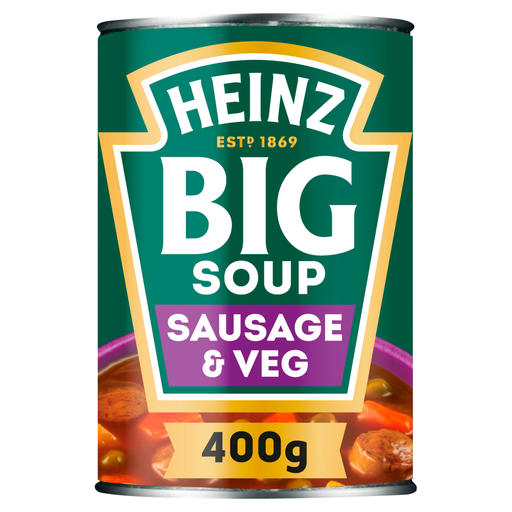 Image unavailable
For this 400g sausage-and-vegetable soup, check the current fat and salt figures against the portion you intend to eat. The recipe includes pork sausage; check the ingredients for wheat if you avoid gluten.
The NHS defines low-fat food as containing 3g of total fat or less per 100g. Compare soups on that basis, then calculate the fat in the amount you expect to eat.
If you eat the whole can, use two half-can servings when calculating its labelled values. For example, Tesco Groceries lists 1.7g fat and 1.2g salt per half-can of Heinz Vegetable Soup 400g; two stated servings give 3.4g fat and 2.4g salt. Per-100g calculations may differ slightly because of label rounding.
No. The NHS says “reduced fat”, “lower fat”, “lite” and “light” mean at least 30% less fat than a similar product. Check the resulting soup’s total fat per 100g against the separate low-fat threshold.
Read the current can’s ingredients and allergen information for the exact recipe before eating. UK government guidance requires food businesses to provide information when specified allergens are ingredients; a vegetable or low-fat description does not establish that a soup is free from wheat, barley, milk, celery or other allergens.
Use the allowance and portion guidance given by your healthcare professional rather than relying on a general low-fat label alone. Oxford University Hospitals NHS Foundation Trust describes its minimal-fat-diet guidance as intended for people advised by a healthcare professional to follow that restriction.