Lunch planners comparing pack sizes
If you keep tins for quick weekday lunches, check how many portions a can provides and whether that portion meets your lunch needs. A smaller tin and a 400g tin are not necessarily equivalent meals.


Choose tinned soup for lunch by looking at the portion you will eat, its salt information and its ingredients, rather than relying on a brand or front-of-pack claim. An own-label tomato soup, a reduced-salt recipe and a pulse-based soup meet different needs; check the exact tin’s nutrition and allergen label before deciding which suits yours.
If you keep tins for quick weekday lunches, check how many portions a can provides and whether that portion meets your lunch needs. A smaller tin and a 400g tin are not necessarily equivalent meals.
Compare salt for the amount you intend to eat, not just the figure per 100g. The NHS advises adults to have no more than 6g of salt a day, including salt in packaged food.
Look for the vegetables or pulses you want in the individual recipe, then read its ingredients and allergen advice. A dietary description alone cannot establish suitability for a particular allergy.
Compare nutrition per 100g across recipes, then use the serving information to judge the portion you will actually eat.
| Priority | What to check | Your needs |
|---|---|---|
| Salt per portion | Read salt per 100g and per serving. Check the number of servings in the tin, particularly if you expect to eat it all. | I want to know how much salt my lunch portion contains, not just how two recipes compare per 100g. The NHS advises adults to have no more than 6g of salt a day. |
| Pack and serving size | Check the tin size, stated servings and preparation instructions. For condensed soup, check how the prepared portion is defined. | A tin needs to provide a practical lunch portion for me; a serving on the label might be only part of the pack. |
| Vegetables and pulses | Read the ingredient list for named vegetables, lentils or beans. Compare fibre and protein figures on the same per-100g or per-serving basis. | If I want lentils or beans in my lunch, I’ll check that they are ingredients in this particular soup rather than judging by its flavour name. |
| Dietary suitability | Read the current ingredients and allergen advice for the exact recipe. Do not use a vegetarian or vegan description as an allergy check. | I need to know whether this tin contains an ingredient I must avoid, even if other soups in the same range have different recipes. |
A five-a-day statement describes a fruit-and-vegetable contribution; it does not describe every part of the meal. Sainsbury’s Cream of Tomato Soup, for example, states that half a can counts as one portion of five a day and lists 0.89g salt for that half-can serving.
Read the serving-size nutrition panel and ingredients as well as the claim, then consider what else you plan to eat.
A condensed soup, a ready-to-heat 400g tin and a cup soup can have different preparation and serving instructions. Comparing the unopened packs alone can obscure the amount you would prepare for lunch.
Check preparation directions and servings, then compare portions you would use in the same way.
Heinz’s 25% less salt claim for its No Added Sugar Cream of Tomato Soup compares it with standard Heinz Cream of Tomato Soup. It does not establish the salt content of the portion you will eat or a comparison with every other soup.
Check the current tin’s nutrition panel and serving size before making a salt comparison.
A soup’s dietary category does not identify every allergen relevant to an individual shopper. M&S Spiced Lentil and Tomato Soup, for example, lists celery among its ingredients.
Read the complete current ingredients and allergen advice for the specific tin.
These examples illustrate different soup recipes and ranges; judge the individual tin rather than applying one product’s label to a whole brand.
Its tomato range includes a No Added Sugar Cream of Tomato Soup alongside the standard recipe.
The Plant Chef range includes a 400g Lentil & Pepper Soup for shoppers considering a pulse-based recipe.
Its own-label examples include tomato, bean and lentil soups as well as Cream of Tomato Soup.
Its tinned-soup range includes cream-of-tomato and spiced lentil and tomato recipes.
The Tesco Groceries listing includes Campbell’s condensed Cream of Mushroom and Cream of Chicken soups in 295g tins.
These Joybuy options cover Scotch broth, vegetable, bean and pea soups. Use their pack descriptions to shortlist a format, then check the current tin for serving and allergen details.
 No image available
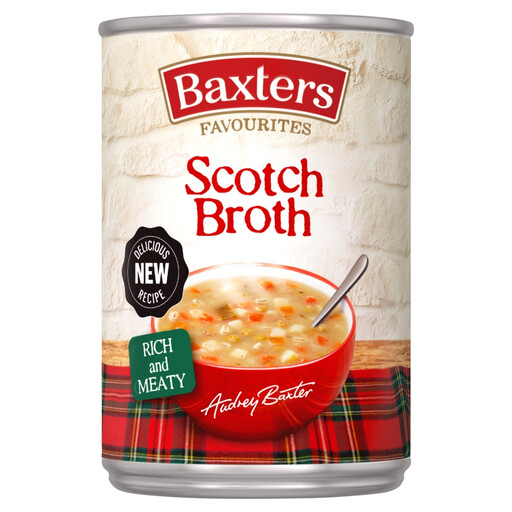
Consider this broth-style soup if that is the format you want for lunch. Check the portion’s salt information and the current allergen label; the product information identifies barley.
 No image available
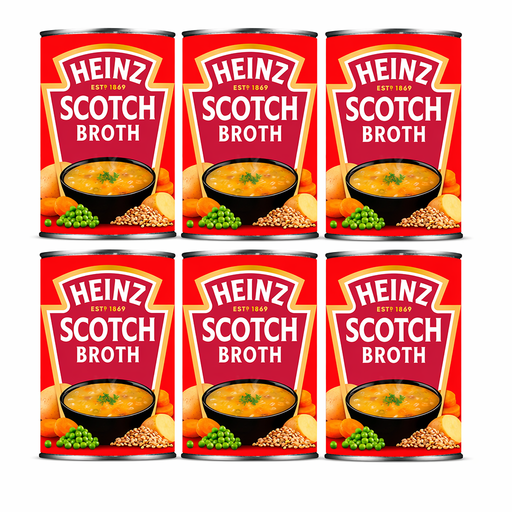
The six-tin pack is an option if you want several Scotch broth lunches. Each tin is 400g; check how its stated half-can serving relates to the portion you eat. The product information identifies barley and wheat allergens.
 No image available
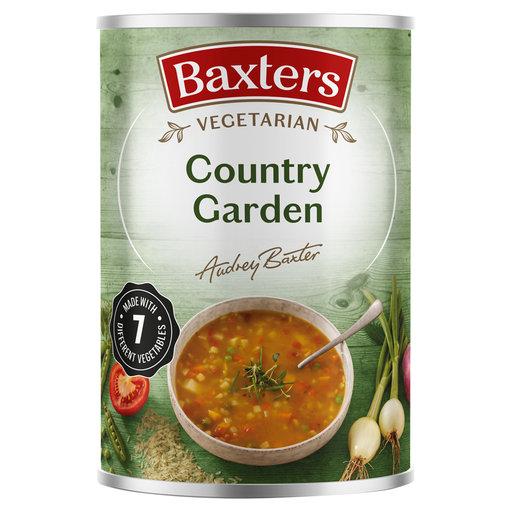
Consider this vegetable soup if you prefer a vegetarian recipe to Scotch broth. Check the salt figure against the portion you intend to eat, and read the current allergen label: the product information identifies milk.
 No image available
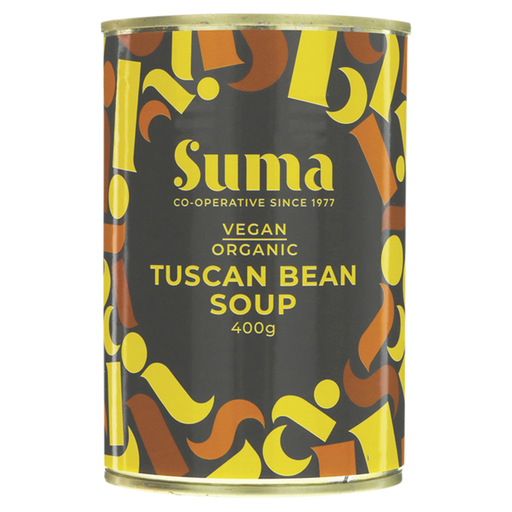
This is a bean-soup option for a lunch centred on pulses. Check the tin’s serving size when using its nutrition information, and read the allergen advice: the product information identifies celery.
 No image available
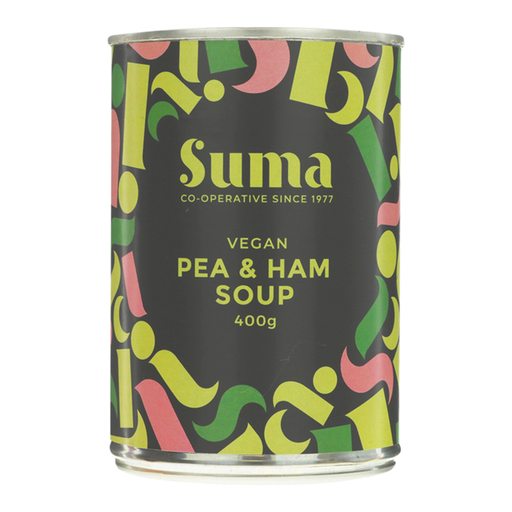
Consider this pea soup if you want that style of recipe, but do not rely on “vegan” in the name to decide dietary suitability. The product information conflicts with that wording by identifying milk, soya and wheat allergens; check the current ingredients and allergen label before choosing it.
Not necessarily. Check the portion size, ingredients and nutrition for the particular tin, then consider what else you intend to eat. A five-a-day statement describes a fruit-and-vegetable contribution, not the whole lunch.
Check how much salt is listed for the portion you will actually eat. The NHS advises adults to have no more than 6g of salt a day from all foods, so the soup is one part of that total.
Use both figures for different purposes: per 100g gives a consistent basis for comparing recipes, while per serving describes the labelled portion. Check the servings per tin; Sainsbury’s 400g Cream of Tomato Soup, for example, lists two.
Check the current tin’s ingredients and allergen advice instead. GOV.UK says food businesses must identify any of the 14 regulated allergens when they are ingredients, and the individual recipe matters more than a range-level filter.
Follow the storage directions on that tin. For its Cream of Tomato Soup, M&S instructs shoppers to put leftovers in an airtight container, refrigerate them and eat them within two days; other products may give different instructions.