Choose tinned soup as a cupboard backup or part of a meal, not as a replacement for a delivered-meal service: GOV.UK says councils and local organisations may deliver meals to eligible people, while Meals on Wheels UK describes services offering hot, chilled or frozen meals. For family sharing, check the stated servings, nutrition per portion, allergens, texture and preparation steps; a two-serving label alone does not establish that a tin makes a complete meal for two adults.
Who is this for?
Families supporting an older relative at home
A cupboard soup may help with an occasional lunch between prepared meals. Choose for the person eating it: the stated portion, ingredients, texture and heating steps matter more than whether the tin suits the rest of the family.
People who use Meals on Wheels
Tinned soup can be kept for occasions between deliveries. It does not arrange or deliver a prepared meal; Meals on Wheels UK says services differ in how often they deliver and whether meals arrive hot, chilled or frozen.
Carers planning a shared lunch
If one pack is intended for two people, or for a meal now and another later, check its serving count and instructions for storing any opened soup.
What should you check?
Start with who will prepare and eat the soup, then compare portions and labels on the exact products you are considering. A ready-to-heat soup takes fewer preparation steps than a condensed soup, while a delivered meal addresses a different need from stocking the cupboard.
| Priority |
What to check |
Your needs |
| Portions |
Read the stated serving count and nutrition per serving. If comparing different pack sizes, also check the figures per 100g. |
If we are sharing one tin, will its stated portions work for both people? If it is only part of lunch, what else will be served? |
| Salt |
Compare salt per 100g and in the portion actually served. Sainsbury’s lists 0.95g salt per half-can serving of its 400g Tomato & Three Bean Soup. |
I want to know how much salt is in the bowl, particularly if soup is eaten regularly or the recipient has individual dietary advice. |
| Preparation |
Check whether the soup is ready to heat or condensed, which appliances the instructions cover, and whether the person can manage the required steps. |
Could the person preparing lunch safely serve this soup, or would a prepared meal delivered to the home address the need better? |
| Ingredients and texture |
Read the current ingredient and allergen declaration. Check whether the soup is smooth or contains pieces, and use a vegetarian or vegan designation only when the product states it. |
Someone eating with us may need to avoid an ingredient or may have difficulty managing pieces. A texture description cannot replace individual swallowing advice. |
| Leftovers |
Follow the pack’s instructions for opened soup, including its container, refrigeration and use period. Check heating directions for the portion being served. |
If one portion is for another day, I need a way to store it and heat it without repeatedly reheating the whole pack. |
Common buying mistakes
-
Assuming a two-serving tin is a complete meal for two
A serving count tells you how the pack is divided, not whether those portions meet each person’s needs. Sainsbury’s lists 6.8g protein and 4.4g fibre per half-can serving of its Tomato & Three Bean Soup; other recipes have different nutrition figures.
Decide whether the soup is lunch, a starter or one part of a meal before choosing a pack. Consider accompaniments only if they suit the person eating them.
-
Judging salt by the soup’s name
Ingredients such as beans or vegetables do not establish a soup’s salt content. Asda lists 1.1g salt per half can of Heinz Beef & Vegetable Chunky Big Soup, while Sainsbury’s lists 0.95g per half can of its Tomato & Three Bean Soup.
Compare the current tins per 100g, then check the salt in the portion that will actually be eaten. Follow individual dietary advice where it applies.
-
Treating cupboard food as the same service as Meals on Wheels
A tin supplies food for someone to prepare. GOV.UK says councils or local organisations may deliver meals to eligible people, and Meals on Wheels UK describes services with different delivery frequencies and meal formats.
If getting a prepared meal to the home is the main difficulty, check what local delivered-meal services offer rather than relying on a cupboard tin alone.
-
Heating the whole pack when only one portion is needed
Repeated heating complicates plans to keep the remainder for another meal. GOV.UK’s cooking guidance for food businesses says reheated food should be steaming hot throughout and reheated only once.
Separate the portion needed before heating where practical. Refrigerate the remainder as the product label directs and observe its stated use period.
Brand and retailer references
These examples show why the exact variety and its label matter more than a familiar name; they do not indicate which products a particular shop has in stock.
Heinz
Heinz has both smooth soups and Big Soup varieties among the products described in UK listings.
- The 400g Big Soup Chicken & Vegetable listing provides a named chunky option to compare with smoother soups.
- Check the exact variety’s allergens, serving size and salt; details from one Heinz soup do not apply to the whole range.
Campbell’s
Campbell’s Condensed Cream of Tomato is listed in a 295g format that can be served as soup or used in cooking.
- The condensed format offers a choice between preparing soup and using it as an ingredient.
- Check its preparation directions before choosing it for someone who needs minimal steps at lunchtime.
Tesco
Tesco lists Campbell’s Condensed Cream of Tomato Soup 295g.
- Its listing gives shoppers a specific condensed product to compare with ready-to-heat options.
- A product listing does not establish stock for a particular store or delivery area.
Sainsbury’s
Sainsbury’s labels its 400g Tomato & Three Bean Soup as two servings.
- The listing gives figures per half can: 6.8g protein, 4.4g fibre and 0.95g salt.
- Those figures describe this product and serving, not other bean soups or an entire meal.
Asda
Asda lists Heinz Beef & Vegetable Chunky Big Soup 400g.
- Its listing states 6.5g protein and 1.1g salt per half can, making the serving-level figures available for comparison.
- Check the current listing or tin for the variety and portion you intend to serve.
M&S
M&S lists a vegetarian Cream of Tomato Soup in a 400g pack.
- Its product information includes nutrition per 100g and says to refrigerate opened soup in an airtight container and eat it within two days.
- Vegetarian labelling alone does not answer questions about allergens or an individual’s dietary needs.
Joybuy soup options
These 400g soups are options to consider for a cupboard lunch. Before planning a shared serving, check each pack’s portions and confirm that its packaging and preparation directions suit the household.
 No image available
Heinz Cream of Mushroom Soup 400g
For a shared lunch or a portion saved for later, check the labelled serving size before relying on this 400g pack. Confirm the packaging is a tin and check the current milk and wheat allergen information against the eater’s needs.
View on Joybuy
 No image available
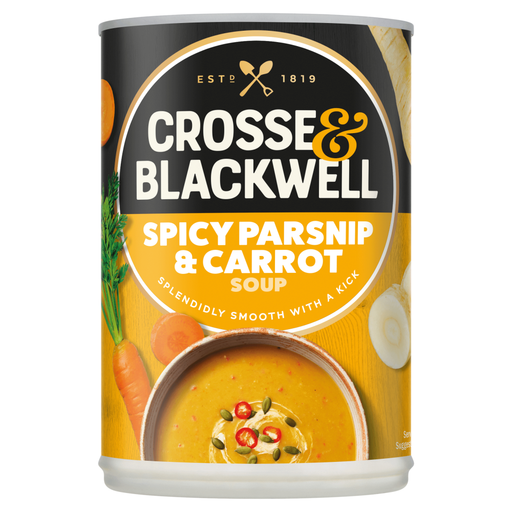
Crosse & Blackwell Best of British Spicy Parsnip & Carrot Soup 400g
Consider whether a spicy parsnip and carrot soup suits the intended eater. Before planning portions or leftovers, check the serving count, opened-pack storage directions and whether the packaging is a tin; check the current celery, milk and wheat allergen information too.
View on Joybuy
Frequently asked questions
Can tinned soup replace Meals on Wheels?
A tin can provide a cupboard meal option, but it does not replace delivery of a prepared meal. GOV.UK says councils or local organisations may deliver meals to eligible people, and Meals on Wheels UK says services vary in delivery frequency and whether meals are hot, chilled or frozen.
How do I choose a soup for two people?
Start with the pack’s stated servings, then read the nutrition for each portion rather than assuming half a tin is a complete meal. Sainsbury’s labels its 400g Tomato & Three Bean Soup as two servings and lists 6.8g protein, 4.4g fibre and 0.95g salt per half can.
Which salt figure is useful when comparing tins?
Use salt per 100g to compare products on the same basis, then check the amount in the portion being served. Northern Ireland’s nidirect guidance advises adults to aim for less than 6g salt a day on average; individual dietary advice may call for a different approach.
What should I do with soup left after opening?
Follow that product’s container, refrigeration and use-by-opening instructions. M&S directs shoppers to put its opened Cream of Tomato Soup in an airtight container, refrigerate it and eat it within two days. When reheating cooked food, GOV.UK’s guidance for food businesses says it should be steaming hot throughout and reheated only once.
Is a vegetarian tomato or vegetable soup suitable for every diet?
No. A vegetarian designation answers only that particular question; it does not establish allergen suitability or whether the soup fits someone’s individual dietary requirements. Read the current ingredients and allergen declaration for the exact variety before serving it.


