Hosts keeping food ready for arriving guests
Separately sealed tins let guests open only what they need. Check the date and unopened-storage directions on each pack before putting it in the cottage cupboard.


Choose a multipack of separately sealed tins when you expect to use several portions of the same soup and have suitable cupboard space. Individual tins give you more flexibility for different flavours and dietary needs. Check each product’s allergens, nutrition and opened-can instructions rather than assuming one creamy tomato soup will suit every guest.
Separately sealed tins let guests open only what they need. Check the date and unopened-storage directions on each pack before putting it in the cottage cupboard.
A vegetarian cream-of-tomato soup may still contain milk. Keeping a separately labelled vegan option can widen the choice, but its own ingredients and allergen warnings still need checking.
A multipack suits repeat use of one flavour; individual tins allow a smaller or more varied selection. Consider how many cans are likely to be used before stocking several of the same soup.
Start with the number and size of the tins, then check whether their labels suit the guests and kitchen facilities.
| Priority | What to check | Your needs |
|---|---|---|
| Portion format | Count the separately sealed cans and check their individual weight. Tesco lists Heinz Cream of Tomato as four 400g cans, totalling 1.6kg; its label uses half a can as a serving. | I want guests to open one tin at a time, without opening the rest of the stock. |
| Ingredients and allergens | Read the current ingredient and allergen panels, even when a soup is labelled vegetarian or vegan. Tesco lists milk in Heinz Cream of Tomato; M&S lists celery in its vegan Spiced Lentil and Tomato Soup. | Guests may have different dietary requirements, so I need clearly identifiable options rather than relying on a flavour name. |
| Salt information | Compare salt per 100g and for the amount likely to be served. Tesco lists 1.1g salt per labelled half-can serving of standard Heinz Cream of Tomato and describes its No Added Sugar variant as having 25% less salt than the standard soup. | If salt content matters to a guest, I want to compare the actual tins and serving amounts, not assume a particular brand or pack format answers the question. |
| Storage after opening | Check each can’s instructions and provide a suitable lidded container. M&S tells customers to refrigerate leftovers from its listed tomato and lentil soups in an airtight container and eat them within two days. | Someone may use only part of a tin, so the kitchen needs a practical way to store the remainder as its label directs. |
| Range and availability | Confirm the exact pack and its current availability before ordering. Decide whether several cans of one flavour or a mixture of individual tins better fits expected use. | I would rather keep a choice of flavours than stock a full multipack that guests are unlikely to finish. |
The Heinz and M&S cream-of-tomato products listed by Tesco and M&S contain milk. Vegetarian labelling does not make those products suitable for vegan guests or guests avoiding milk.
Consider a separately labelled alternative and keep the current ingredient and allergen information accessible for each soup you supply.
Salt values differ between products and serving sizes. Action on Salt’s 2026 analysis of 481 UK chilled and ambient soups found that 23% exceeded the Government’s voluntary maximum salt target; that finding does not identify the salt content of a tin in your cupboard.
Compare the nutrition panels of the exact products you plan to stock, using both per-100g figures and the intended portion.
A multipack commits cupboard space to one soup, while individual tins make it easier to offer different flavours. A variant shown in a listing may also be unavailable when you order.
Check the exact pack’s availability and can count, then choose a mix that fits expected guest use.
The listed M&S soups require leftovers to be put in an airtight container, refrigerated and eaten within two days. Instructions can differ between products.
Provide a lidded container and ask guests to follow the directions on the can they open.
These examples show differences worth checking on individual labels; a brand name alone does not establish dietary suitability or pack format.
Its Cream of Tomato range includes a four-can multipack and a separately listed No Added Sugar variant.
Its listed own-label 400g Cream of Tomato tin provides a single-can format to consider alongside multipacks.
Tesco lists Campbell's Condensed Cream of Tomato Soup in a 295g tin.
Its listed 400g tins include vegetarian Cream of Tomato and vegan Spiced Lentil and Tomato Soup.
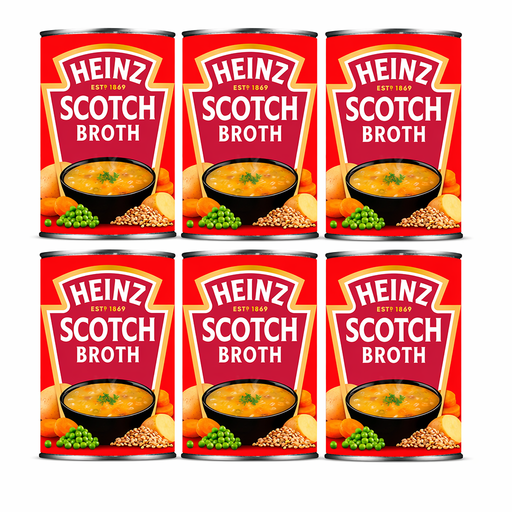
This six-pack is an option for stocking several tins of one soup in a self-catering cottage. Its Scotch Broth flavour is a different choice from the cream-of-tomato products discussed above.
 No image available
Six 400g tins suit a cupboard where guests are likely to use several portions of Scotch Broth. Check the current ingredient and allergen label, along with the storage and preparation instructions, before supplying it to guests.
Yes, when the unopened tins can be kept as their labels direct. Check their dates during cottage changeovers: GOV.UK explains that a best-before date concerns quality, whereas a use-by date concerns safety.
Follow that product’s opened-storage instructions. M&S directs customers to transfer leftovers from its listed soups to an airtight container, refrigerate them and eat them within two days; the Joybuy listing for Heinz Cream of Tomato gives a similar two-day instruction for that product.
Do not assume it is. The Heinz and M&S cream-of-tomato products listed by Tesco and M&S contain milk. If you choose a separately labelled vegan soup, check its full ingredients and allergen warnings too; M&S lists celery in its vegan Spiced Lentil and Tomato Soup.
No. Tesco describes its Heinz No Added Sugar Cream of Tomato multipack as having 25% less salt than standard Heinz Cream of Tomato, but the variant still contains milk. Compare the exact tins’ nutrition panels and the amount likely to be served.