TV-dinner shoppers avoiding added sugar
You want a convenient tin and need to distinguish a no-added-sugar recipe from a soup with a lower total-sugars figure.


Choose a no-added-sugar soup if avoiding added sugar is the priority; choose by the total-sugars figure if you want to compare how much sugar different tins contain. Neither approach settles the whole TV-dinner decision: compare values per 100g and for the portion you will eat, then check salt, ingredients and whether the soup needs diluting.
You want a convenient tin and need to distinguish a no-added-sugar recipe from a soup with a lower total-sugars figure.
You want to compare sugars and salt on the same per-100g basis, then work out what the portion you plan to eat means for dinner.
You need to know whether the soup requires dilution and whether its ingredients and allergens suit your requirements.
Start with what the sugar wording describes, compare the nutrition panels on the same basis, and then consider the bowl you will actually serve.
| Priority | What to check | Your needs |
|---|---|---|
| Sugar wording | Check whether the tin says no added sugar, low sugar or reduced sugars. No added sugar concerns the recipe; reduced sugars compares it with a similar product. Read the total-sugars figure as well. | I want to know whether I am avoiding added sugar, comparing total sugars, or both; those aims need not point to the same tin. |
| Comparable figures | Compare sugars and salt per 100g before looking at serving figures. The NHS describes 5g sugars or less per 100g as low for a food; check how much of the tin you intend to eat. | A whole tin may be my dinner, so a half-tin serving figure would not describe my full portion. In a survey of 611 Northern Ireland adults interviewed from September to November 2024, 49% said they actively used traffic-light labelling when shopping for food, according to the Food Standards Agency and Ipsos Northern Ireland. That figure describes label use, not soup preferences. |
| Preparation | Check whether the soup is ready to heat or condensed. For condensed soup, follow the dilution instructions and consider what you add when assessing the finished bowl. | If I need a straightforward dinner, I want to know whether the tin needs water or milk before heating. |
| Ingredients | Read the current ingredient and allergen information, especially for creamy or condensed recipes. Tesco lists milk and wheat for Campbell's Condensed Cream of Mushroom Soup; M&S lists milk ingredients for its Cream of Tomato Soup. | Before serving soup as dinner, I need to check ingredients that matter to me rather than relying on its flavour or vegetarian description. |
No added sugar does not mean zero total sugars. A reduced-sugars claim makes a comparison with a similar food, while a low-sugar description concerns the sugar content of the food itself.
Decide which distinction matters to you, then check total sugars per 100g and the ingredients alongside the claim.
A condensed soup's per-100g figure may describe it as sold, before liquid is added. It is not automatically a like-for-like figure for a finished bowl of ready-to-heat soup.
Follow the preparation instructions and take account of the water, milk or other liquid used when comparing portions.
A per-serving figure may cover less than the amount you eat, and a sugar claim says nothing by itself about salt or allergens.
Compare sugars and salt per 100g, check the serving basis, and read the current allergen information before buying.
These named soups illustrate different claims and preparations; a detail about one recipe should not be assumed to apply across a brand's range.
Its tomato soup listings offer a comparison between a no-added-sugar recipe and a standard ready-to-heat recipe.
Its UK range includes condensed soups, which need a different serving comparison from ready-to-heat tins.
Its listings include the Heinz no-added-sugar tomato soup and a Sainsbury's own-label Cream of Tomato Soup.
Its Cream of Tomato Soup provides a creamy tomato option with published per-100g figures.
Its soup listings provide product-specific nutrition and preparation information to check against the pack.
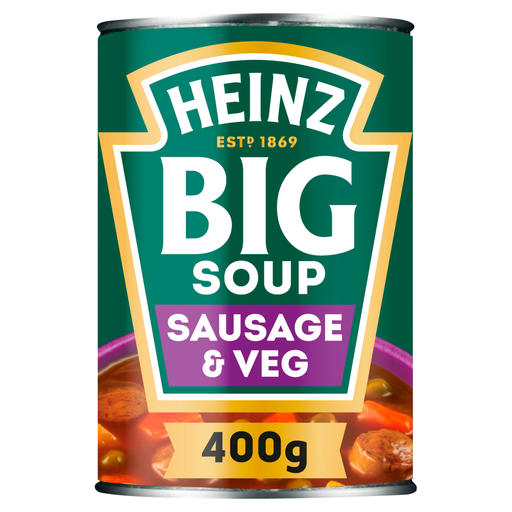
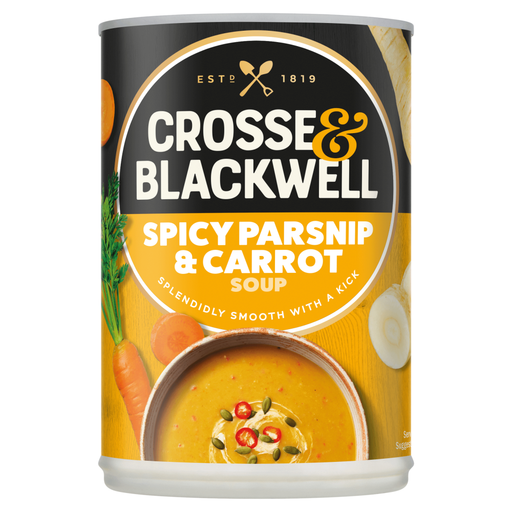
These 400g tins offer a sausage-and-vegetable soup and a spicy parsnip-and-carrot soup for the TV-dinner scenario. Compare their current sugar claims and nutrition labels before treating either as a no-added-sugar or reduced-sugars choice.
 No image available
For a sausage-and-vegetable soup dinner, compare the current pack's sugars and salt per 100g, then check the serving and preparation instructions. If avoiding added sugar matters to you, check the claim and ingredients rather than assuming it from a sugar figure.
 No image available
If you prefer a spicy parsnip-and-carrot soup for dinner, use the current label to compare sugars and salt per 100g and check the portion you plan to serve. Read the ingredients and allergen information, and confirm any sugar claim that matters to your choice.
No. The NHS explains that naturally occurring sugars can still appear in the total-sugars figure on a food label. If total sugar matters to your choice, compare the per-100g figures and check the ingredients for sweeteners.
Start with sugars and salt per 100g, then check the labelled serving size against the amount you expect to eat. This avoids comparing a half-tin serving with a whole-tin dinner.
Follow the instructions for the particular soup. Tesco's listing for Campbell's Condensed Cream of Mushroom Soup says to mix it with a can of water or milk and heat it; the liquid chosen affects the finished bowl's nutrition.
No. Vegetarian suitability does not tell you whether a soup contains those ingredients. Check the current allergen declaration: Tesco lists milk and wheat for Campbell's Condensed Cream of Mushroom Soup, while M&S lists milk ingredients in its Cream of Tomato Soup.