Hosts looking for a no-added-sugar claim
If the wording of the claim matters, Heinz No Added Sugar Cream of Tomato offers an explicitly labelled, ready-to-heat tomato soup. Check its milk ingredients against guests’ requirements.


For a birthday-party soup with an explicit no-added-sugar claim, Heinz No Added Sugar Cream of Tomato is a ready-to-heat vegetarian option, though it contains milk. Campbell’s Condensed Cream of Mushroom suits a dish or diluted soup you can prepare and heat; Campbell’s lists 0.7g sugars per 100g as consumed, but sugar appears in its ingredients. M&S Tomato and Basil is vegan-labelled rather than reduced-sugar-labelled, and M&S says it is unsuitable for guests with milk or egg allergy, so check the current label of every tin before serving.
If the wording of the claim matters, Heinz No Added Sugar Cream of Tomato offers an explicitly labelled, ready-to-heat tomato soup. Check its milk ingredients against guests’ requirements.
Campbell’s condensed soup can be used as a cooking base or diluted for bowls. Allow for the added liquid and heating, and check the allergens in the finished dish.
Compare the current ingredient and allergen statements on each tin. A vegetarian or vegan label does not, by itself, establish suitability for a guest with a food allergy.
Start with the sugar claim and nutrition basis, then check whether the soup fits your serving plan and your guests’ dietary requirements.
| Priority | What to check | Your needs |
|---|---|---|
| Sugar wording | Check both the ingredient list and sugars per 100g. Sainsbury’s lists Heinz No Added Sugar Cream of Tomato at 2.6g sugars per 100g; Campbell’s lists 0.7g per 100g as consumed for its condensed Cream of Mushroom, which contains sugar as an ingredient. | I may need an explicit no-added-sugar claim, rather than simply choosing the smaller number on a nutrition panel. For condensed soup, I also need to account for how the finished dish is prepared. |
| Allergens | Read the current label of each exact tin. The checked Heinz tomato soup contains milk ingredients; Campbell’s Cream of Mushroom contains wheat and milk; M&S says its Tomato and Basil Soup is unsuitable for people with milk or egg allergy. | When guests have food allergies, I need to keep each tin’s packaging available and check suitability before serving, regardless of vegetarian or vegan wording. |
| Preparation | Check whether the soup is ready to heat or condensed. The checked Campbell’s Cream of Mushroom directions call for one can of water or milk per can of soup, followed by heating. | For straightforward bowl service, I want to know how many tins to heat. If soup is going into a larger dish, I need a recipe and a plan for the added liquid. |
| Salt and portions | Compare salt per 100g and the amount planned for each bowl. Campbell’s lists 0.96g salt per 100g as consumed for its condensed Cream of Mushroom; a sugar-related claim does not describe its salt content. | I want to compare the amount guests are likely to eat, not assume that the suggested serving size matches the bowls I will use. |
Sainsbury’s lists 2.6g sugars per 100g for Heinz No Added Sugar Cream of Tomato. Conversely, Campbell’s Cream of Mushroom has a lower listed figure of 0.7g per 100g as consumed but includes sugar in its ingredients.
Decide whether the menu calls for an explicit no-added-sugar claim or a comparison of total sugars, then read both parts of the current tin label.
M&S labels its Tomato and Basil Soup vegan and vegetarian while stating that it is unsuitable for people with milk or egg allergy. The checked Heinz tomato and Campbell’s mushroom soups contain milk ingredients.
Ask guests about relevant restrictions before choosing the menu, and keep the packaging so the exact ingredients can be checked before serving.
In its 2026 analysis of 481 chilled and ambient soups, Action on Salt found that 23% exceeded the government’s voluntary maximum salt target. Its reported suggested serving sizes ranged from 147.5g to 500g.
Read salt per 100g on the tins you are considering and account for the bowl size you intend to serve.
Heinz No Added Sugar Cream of Tomato is a 400g ready-to-heat option with an explicit no-added-sugar claim.
The checked condensed soups suit a menu that allows for dilution and heating, including dishes made with soup as an ingredient.
M&S Tomato and Basil Soup is a 400g vegan- and vegetarian-labelled option, not an explicitly reduced-sugar one.
Tesco’s UK tinned-and-packet soup listing includes the checked Heinz and Campbell’s varieties alongside Tesco Plant Chef soups.
These 400g Heinz tins are options to consider for hot soup service. Check each current label if an explicit reduced-sugar or no-added-sugar claim is essential to your party menu.
 Image unavailable
A 400g tin to consider when planning heated soup for party bowls. Check the current label for sugar in the ingredients and for milk and wheat before serving guests; a sugar figure alone does not establish a reduced-sugar claim.
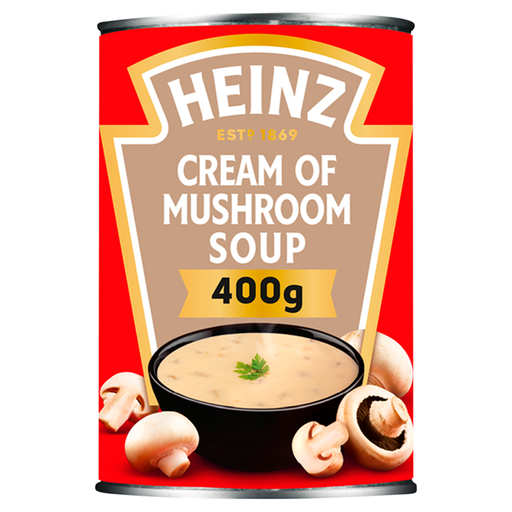 Image unavailable
A 400g mushroom soup tin to consider for hot bowl service. Check the current label for sugar in the ingredients and for milk and wheat; do not treat its nutrition panel alone as an explicit reduced-sugar claim.
No. Sainsbury’s lists 2.6g sugars per 100g for Heinz No Added Sugar Cream of Tomato. If the total sugar amount matters to your menu, read the nutrition panel as well as the claim.
No. The checked Campbell’s Cream of Mushroom directions call for mixing one can of soup with one can of water or milk, then heating it until piping hot throughout. Account for that preparation and for the ingredients in any added liquid.
Read the current packaging for every exact tin and keep it available when serving. The checked Heinz tomato soup contains milk ingredients, Campbell’s Cream of Mushroom contains wheat and milk, and M&S says its Tomato and Basil Soup is unsuitable for people with milk or egg allergy.
No; compare salt separately per 100g and for your planned bowl size. In a 2026 analysis of 481 chilled and ambient soups, Action on Salt found that 23% exceeded the government’s voluntary maximum salt target; that finding does not determine the salt content of a particular tin.