Two people sharing a small side
A tin explicitly labelled as two servings offers a straightforward way to serve a small bowl each alongside, rather than instead of, a cooked breakfast.


A 400g tin labelled as two servings can provide two small bowls alongside a Full English breakfast, but do not assume it will replace the cooked meal. Compare a pulse-based soup with a smooth tomato soup if protein and fibre matter to the choice, then check the salt, ingredients and serving yield on the exact tin.
A tin explicitly labelled as two servings offers a straightforward way to serve a small bowl each alongside, rather than instead of, a cooked breakfast.
A vegetarian suitability statement helps narrow the choice, but the ingredient and allergen list still matters: some vegetarian creamy tomato soups contain milk.
When breakfast also includes bacon, sausages or sauces, the soup’s salt per serving is worth checking alongside those other foods.
Decide whether the soup is a small accompaniment or needs to contribute more to the meal. Then compare labelled portions and per-serving information on that basis.
| Priority | What to check | Your needs |
|---|---|---|
| Portions for two | Check the stated number of servings and the preparation directions. Sainsbury’s labels its reviewed 400g tomato soups as two servings. | I want a small bowl for each person without assuming that every tin of the same size gives the same prepared yield. |
| Role in the meal | Compare protein and fibre per serving if the soup needs to contribute more than warmth and flavour. Sainsbury’s lists 6.8g protein and 4.4g fibre per serving for its reviewed tomato-and-three-bean soup. | For a light side, I might choose a smooth tomato soup; if the soup has a larger role, I want to compare it with a pulse-based recipe. |
| Salt per serving | Read grams of salt per serving, not just the flavour name or front-of-pack description. Sainsbury’s lists 0.95g for a serving of its reviewed tomato-and-three-bean soup; the NHS advises adults to have no more than 6g of salt a day. | With other salty foods on the plate, I want to account for what each bowl of soup adds. |
| Ingredients and allergens | Check the exact tin’s vegetarian statement, ingredients and highlighted allergens. A vegetarian label does not establish that a creamy soup is milk-free or vegan. | If I’m preparing a vegetarian breakfast or avoiding milk, I need the current label to answer those separate questions. |
A two-serving label establishes how the maker divides the tin, not whether each serving will take the place of a cooked breakfast.
For a small side, check the stated serving size. If the soup has a larger role, compare protein and fibre per serving across the recipes you are considering.
Salt in the soup adds to that in any bacon, sausages or sauces served with it. The NHS advises adults to have no more than 6g of salt a day.
Compare the tins’ salt figures on a per-serving basis and check the other foods you plan to serve.
The reviewed creamy tomato recipes include milk ingredients despite their vegetarian suitability statements.
For a milk-free or vegan meal, check the current ingredients and allergen declaration on the exact product rather than relying on its vegetarian label.
Tesco lists Campbell’s Condensed Cream of Tomato in a 295g tin alongside 400g tomato soups. Tin size alone does not tell you the prepared yield.
Check whether preparation requires adding anything and how many servings the prepared soup makes before planning two bowls.
These examples show formats and label details to compare; each recipe and tin still needs its own serving and ingredient check.
Heinz Cream of Tomato is a 400g option. The reviewed product is labelled suitable for vegetarians.
The reviewed own-label 400g tomato, tomato-and-basil and tomato-and-three-bean soups are labelled as two servings.
Tesco’s tomato-soup category lists own-label and branded products in different formats, including 400g tins and Campbell’s 295g condensed soup.
Tesco lists Campbell’s Condensed Cream of Tomato in a 295g tin.
The reviewed M&S Cream of Tomato Soup is a 400g product labelled suitable for vegetarians.
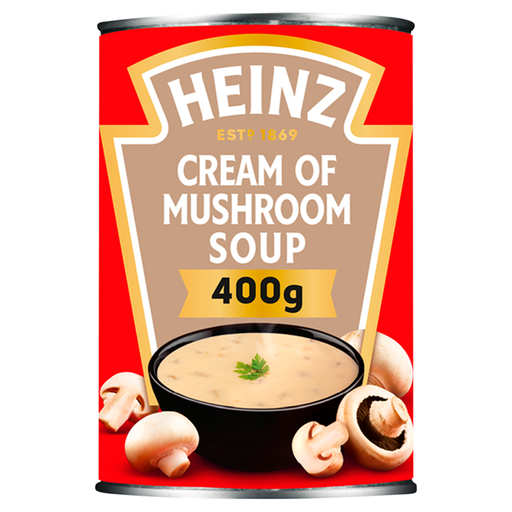
This 400g mushroom soup is an option to consider for small bowls alongside breakfast. Check its serving directions and ingredients against the meal you are planning.
 No image available
For two small bowls alongside breakfast, check the tin’s serving yield rather than judging portions by its 400g weight alone. If avoiding milk or wheat, check the current allergen label before serving.
It can make two small servings when the label says it serves two. The reviewed Sainsbury’s 400g tomato soups use that serving basis; check the exact tin if you need a particular portion size or prepared yield.
A tin labelled as two servings does not by itself establish that the soup will replace the cooked meal. If it is intended as more than a small course, compare protein, fibre and serving size on the labels; a pulse-based recipe is worth comparing with smooth tomato soup.
Follow the exact tin’s heating and storage instructions. For the reviewed Sainsbury’s soups, transfer unused contents to a non-metallic container, refrigerate them and use them within two days; other products may give different directions.
Not necessarily. The reviewed Heinz, Sainsbury’s and M&S creamy tomato recipes contain milk ingredients, so check the current ingredient and allergen statement if the meal needs to be milk-free or vegan.
Compare salt per serving of soup, then consider the other foods in the meal. Sainsbury’s lists 0.95g salt per serving for its reviewed tomato-and-three-bean soup, while the NHS advises adults to have no more than 6g of salt a day from all foods.