Shoppers counting the whole meal
If you plan to eat an entire can, use its number of servings or its calories per 100g to calculate the soup’s total. Add bread, butter or toppings separately when checking whether the meal stays below 500 calories.


Several tinned soups in the named UK product examples come in below 500 calories for the whole can, but a figure printed per half-can does not cover the entire meal. Choose a chunky vegetable or meat-and-vegetable style if you want pieces in the bowl, or consider a smooth tomato or French onion soup if that texture suits you; in either case, count accompaniments separately and check whole-can salt and allergens.
If you plan to eat an entire can, use its number of servings or its calories per 100g to calculate the soup’s total. Add bread, butter or toppings separately when checking whether the meal stays below 500 calories.
Vegetable, chicken-and-vegetable and beef-and-vegetable soups offer different ingredients and textures. Compare the exact can’s nutrition and allergens rather than assuming that a chunky style meets every dietary need.
Check dietary suitability and the current ingredients list for each soup. A vegetable or tomato name alone does not establish whether the product contains wheat, milk, celery or another relevant allergen.
Start with the amount of soup you intend to eat, then compare salt, ingredients and preparation instructions for that same can.
| Priority | What to check | Your needs |
|---|---|---|
| Whole-meal calories | Check calories per serving and servings per can, or use the per-100g figure with the net weight. Count bread and toppings separately. | I may eat the whole can, not the half-can portion shown on the label, and want the finished meal below 500 calories. |
| Salt | Compare salt for the amount you will eat, not just per 100g. For example, ASDA Groceries lists 1g salt per half-can of its 400g Hearty Vegetable Soup, making 2g for the can. | A soup can meet my calorie limit while still adding a substantial amount of salt to the meal. |
| Ingredients and suitability | Check the exact product’s vegetarian statement, ingredients and emphasised allergens. The Food Standards Agency says allergens present in UK prepacked food must be emphasised in its ingredients list. | If I avoid particular ingredients, I cannot rely on words such as “vegetable” or “tomato” alone. |
| Preparation and leftovers | Follow the can’s heating method and any stirring instructions. Check its directions for transferring, refrigerating and using leftover soup. | I want a warming meal now and clear instructions for any portion I keep for later. |
A 400g can may contain two stated servings. Heinz Big Soup Chunky Vegetable, for example, is listed at 120 kcal per half-can by ASDA Groceries, or 240 kcal for the soup in the full can.
Calculate the amount you will serve, then include any bread, butter, cheese or croutons in your meal total.
ASDA Groceries lists Heinz French Onion Soup at 46 kcal and 1g salt per half-can: the full can gives 92 kcal and 2g salt. The NHS advises adults to have no more than 6g salt a day.
Read both measures for the portion you intend to eat rather than using the calorie figure as a shortcut for salt.
Ingredients vary between products. Tesco Groceries lists milk and celery in Campbell's Condensed Cream of Tomato Soup, while vegetable-soup examples may contain wheat.
Check the current can’s ingredients, emphasised allergens and dietary-suitability statement for the exact variety.
Tesco Groceries notes that food products can be reformulated, changing ingredients, nutrition and allergen information.
Use a listing to narrow your options, then check the can you receive before preparing it, particularly if an ingredient or calorie figure is important to your choice.
These examples show why the exact variety matters: can size, stated servings, ingredients and salt differ even within the same soup category.
Heinz has smooth and chunky tinned-soup varieties, including vegetable and French onion examples.
Campbell's Condensed Cream of Tomato Soup is a 295g tomato option that can be served as soup or used in cooking.
Tesco lists own-label tomato soups alongside branded and other own-label tinned varieties.
Sainsbury's lists own-label chunky chicken-and-vegetable and beef-and-vegetable soups in 400g cans.
Asda offers own-label vegetable and cream soups as well as branded varieties.
M&S lists tomato, vegetable and other tinned-soup styles.
These options include meat-and-vegetable soups and a cream of mushroom soup for a warming meal. Check each can’s whole-can calories and salt before deciding how it fits alongside any bread or toppings.
 No image available
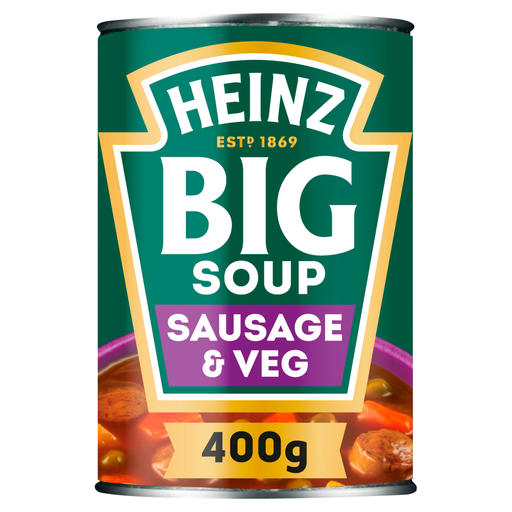
A sausage-and-vegetable choice if you want meat and vegetables in the same soup. Check the full-can calorie and salt figures, and the current ingredients if you avoid particular meats or allergens.
 No image available
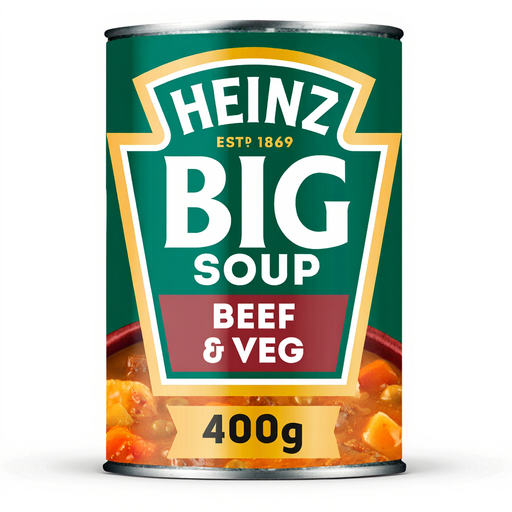
Beef and vegetables offer another meat-based option for a winter bowl. It is not a vegetarian choice; read the can for current allergen information, whole-can calories and salt.
 No image available
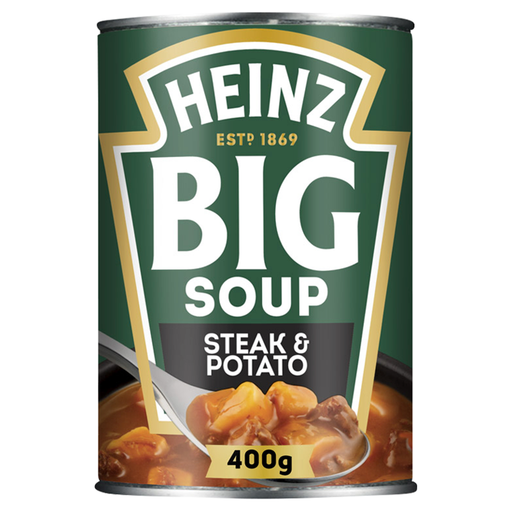
Choose this beef-and-potato variety if those ingredients appeal more than a vegetable-led soup. It is not vegetarian; follow the can’s heating instructions and check its nutrition for the portion you plan to eat.
 No image available
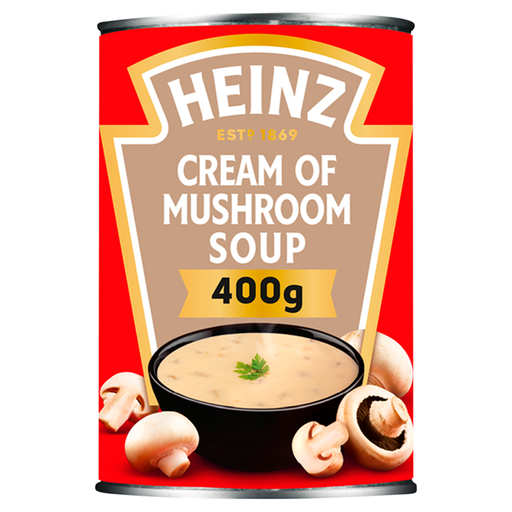
A cream of mushroom alternative to the meat-and-vegetable varieties. Check its current vegetarian statement and ingredients if dietary suitability matters; a vegetarian cream soup is not necessarily vegan or free from milk.
Check the amount you intend to eat: a per-serving figure may cover only half a can. ASDA Groceries lists Heinz Big Soup Chunky Vegetable at 120 kcal per half-can and two servings per 400g can, making 240 kcal for the soup in the whole can. Count accompaniments separately.
Yes. ASDA Groceries lists Heinz French Onion Soup at 46 kcal and 1g salt per half-can, equivalent to 92 kcal and 2g salt for the full can. The NHS advises adults to have no more than 6g salt a day, so check salt for the amount you will eat as well as calories.
Read the current can’s ingredients, emphasised allergens and any dietary-suitability statement for the exact variety. The Food Standards Agency says UK prepacked foods must have an ingredients list and emphasise allergens present in it. A vegetable or tomato soup name alone cannot confirm suitability.
Follow that product’s storage instructions. The ASDA and Heinz examples direct shoppers to transfer unused soup to a covered non-metal container and refrigerate it; check the can for its own use-by period after opening rather than applying another variety’s instructions.