People with diabetes planning quick lunches
A convenient can of soup may fit a lunch plan, but the carbohydrate and salt in the portion eaten matter alongside its calories. Diabetes UK notes that there is no separate 'diabetic' diet category.


A tinned soup under 500 kcal is not automatically suitable for someone managing diabetes: compare carbohydrate and salt for the portion you will eat, including anything served with it. Vegetable-and-pulse recipes can provide fibre, while a no-added-sugar label does not tell you the total carbohydrate; check the current can against your individual meal plan.
A convenient can of soup may fit a lunch plan, but the carbohydrate and salt in the portion eaten matter alongside its calories. Diabetes UK notes that there is no separate 'diabetic' diet category.
If the limit applies to your whole meal, allow for bread, toppings and drinks as well as the soup. Vegetable or pulse ingredients and the fibre figure can help distinguish recipes with similar calorie counts.
A no-added-sugar or reduced-salt claim is a starting point, not a substitute for the carbohydrate and salt figures on the exact variant you intend to eat.
Decide how much soup will be in your bowl before comparing labels: a half-can serving and a whole can give different meal totals.
| Priority | What to check | Your needs |
|---|---|---|
| Portion and calories | Check the stated serving size and servings per can. Calculate calories for the amount you will eat, then include any bread or toppings in a whole-meal limit. | If I plan to eat the whole can, I need its whole-can total rather than the figure for half a can. |
| Carbohydrate and sugars | Compare total carbohydrate and sugars for your portion. Check the figures even when the front of the can says 'no added sugar'. | I want to account for the soup and anything served with it in my carbohydrate plan, not choose by calories alone. |
| Salt | Compare salt per 100g across recipes and salt for the portion you will eat. Diabetes UK cautions that convenient soups can be high in salt. | A low-calorie soup may still contribute substantial salt, so I want to see the amount in my bowl. |
| Ingredients and fibre | Read the ingredient list and fibre figure for the exact recipe. Compare per-100g figures when can sizes differ. | I may prefer a soup containing vegetables or pulses, but I still want to check its carbohydrate and salt. |
| Allergens and storage | Check the current can for allergens, the date mark and instructions for storage after opening. Do not assume another flavour or variant has the same ingredients. | If I avoid a particular ingredient or expect leftovers, the instructions on the can I buy need to work for me. |
Calories alone do not describe the soup's carbohydrate, salt or portion size. Diabetes UK says there is no separate 'diabetic' diet category.
Use 500 kcal as a limit if it matters to your meal, then check carbohydrate and salt for the amount you will actually eat.
Sainsbury's lists 0.89g salt for half its 400g Cream of Tomato Soup can; eating the whole can would provide 1.78g salt.
Check how many servings the can contains and scale all relevant label figures to your portion.
Marks & Spencer lists 0.50g salt per 100g for its Chunky Vegetable Soup, equivalent to 2.0g in a 400g can. A front-of-pack description cannot replace the salt figure.
Compare salt per 100g, then calculate it for the portion you expect to eat.
Ingredients and nutrition can change, and different soup variants can contain different allergens.
Check the can you buy for its nutrition panel, ingredients, allergen declaration, date mark and storage instructions.
These examples illustrate different label checks; a brand name alone does not determine whether a particular soup fits your meal.
Its standard Cream of Tomato Soup and separate No Added Sugar variant need to be compared as distinct recipes.
Tesco Low Fat Tomato Soup provides a 200g half-can serving figure for its 400g can.
Its 400g Cream of Tomato Soup is labelled as two servings.
Chunky Vegetable Soup is a vegetable-and-pulse option containing split peas.
Condensed Cream of Tomato Soup can be considered either as soup or as a cooking ingredient; use the label's as-consumed serving basis when comparing it.
This 400g parsnip-and-carrot soup is an option to consider if you want to check a whole can against a 500-calorie meal limit. Use the current label to assess the portion, carbohydrate, salt and ingredients alongside the rest of your meal.
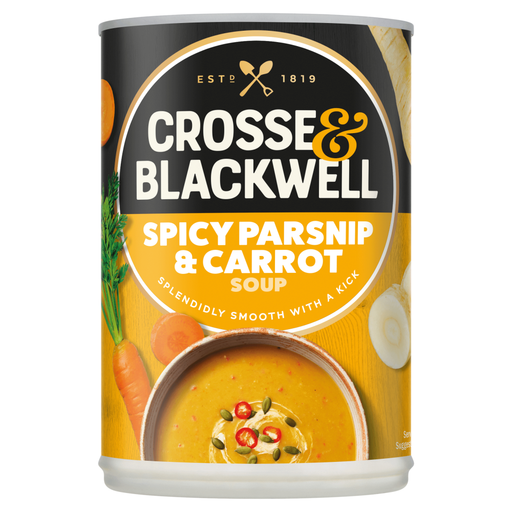 Image unavailable
The 400g can offers a clear portion size for planning; check its current nutrition and allergen label before deciding how much to serve.
No. Diabetes UK says there is no separate 'diabetic' diet category. Compare carbohydrate, salt, ingredients and the portion you will eat as well as calories, in line with your individual meal plan.
Use per 100g to compare recipes, then work out the figures for your actual portion. Tesco lists 61 kcal per 200g half-can for its 400g Low Fat Tomato Soup, so a whole can contains 122 kcal before any additions.
A low calorie count does not establish a low salt content. Marks & Spencer lists 0.50g salt per 100g for Chunky Vegetable Soup, which amounts to 2.0g for its 400g can; the NHS advises adults to have no more than 6g of salt a day.
Follow the storage instructions on the can you buy, including any directions for transferring, refrigerating and using leftovers. Check the date mark and instructions before preparing it.
Check the ingredient and allergen declaration on the can you buy instead. Recipes and label information can change, and one flavour or variant need not contain the same ingredients as another.