Regular batch cooks
If you make sauces, soups or stews often, several 400g tins may suit your cooking routine. Compare the current fat, saturates and salt figures per 100g as well as the number of tins you will use.


For a low-fat diet, compare plain tinned tomatoes by fat and saturates per 100g before choosing a multipack: the NHS defines a low-fat food as containing no more than 3g fat per 100g. Napolina Chopped Tomatoes 4 × 400g lists 0.2g fat per 100g, while Sainsbury's Italian Chopped Tomatoes 4 × 400g lists less than 0.5g; pack size, opened-can storage and the other ingredients in your meal still affect the choice.
If you make sauces, soups or stews often, several 400g tins may suit your cooking routine. Compare the current fat, saturates and salt figures per 100g as well as the number of tins you will use.
A tomato tin's nutrition panel is only part of the meal calculation. Oxford University Hospitals NHS Foundation Trust advises people following a prescribed minimal-fat diet to check food labels; follow the instructions given by your clinical team for your own diet.
A multipack is useful only if the tins fit your cooking plans. Check each product's instructions for transferring, refrigerating and using tomatoes left after a tin is opened.
Start with the nutrition panel and ingredients, then choose a pack size and tomato form that fit the dishes you make.
| Priority | What to check | Your needs |
|---|---|---|
| Fat and saturates | Compare both figures per 100g. The NHS defines low fat as 3g fat or less, and low saturated fat as 1.5g saturates or less, per 100g. | I want a tin that fits the way I plan my meals, without assuming the finished sauce has the same fat content once other ingredients are added. |
| Salt and ingredients | Read salt per 100g alongside the ingredients list. The NHS defines low salt as 0.3g or less per 100g; check whether oil or seasoning has been added. | If I season the dish myself, I want to know what is already in the tomatoes. |
| Pack size and form | Check the number and size of tins, and whether the tomatoes are chopped or whole peeled. Choose a quantity you expect to use. | For regular sauces, several tins make sense; if my recipe calls for chopped tomatoes, whole peeled ones would need chopping. |
| After opening | Read the individual tin's refrigeration and use-by instructions after opening. Food Standards Scotland advises checking the label because these directions vary. | I may use only part of a tin, so I need a plan for the remainder before opening it. |
Oil, cheese, cream or meat added during cooking changes the fat content of the meal, even when the tomatoes meet the NHS low-fat definition per 100g.
Check the other ingredients and the amounts used, particularly if you follow an individual dietary plan.
More tins require cupboard space, and opening a tin starts its product-specific storage period.
Match the number of tins to the recipes you expect to make and check the label before storing leftovers.
Fat and salt are separate label measures. The NHS uses 0.3g salt or less per 100g as its low-salt definition.
Compare salt on the same per-100g basis as fat, and read the ingredients if you want to add your own seasoning.
Tesco's instructions for Napolina chopped tomatoes say to refrigerate the contents and use them within two days; Marks & Spencer specifies three days for its Italian Tomatoes 400g tin.
Follow the instructions on the tin you actually open, including how to transfer and cover any leftovers.
These product-line examples help distinguish tin formats and label details; a brand name alone does not establish the nutrition of every variant.
Napolina lists chopped tomatoes in a 4 × 400g pack for everyday cooking.
Tesco describes Mutti Polpa 4 × 400g as finely chopped Italian tomatoes with tomato juice.
Tesco lists an own-label Italian Chopped Tomatoes 4 × 400g pack.
Sainsbury's Italian Chopped Tomatoes come in a 4 × 400g pack.
Marks & Spencer lists Italian Tomatoes as an individual 400g tin rather than a multipack.
These Joybuy options include chopped tomatoes and whole peeled plum tomatoes in packs of four, six or twelve tins. Choose the tomato form your recipe needs, then check the current nutrition label and pack instructions.
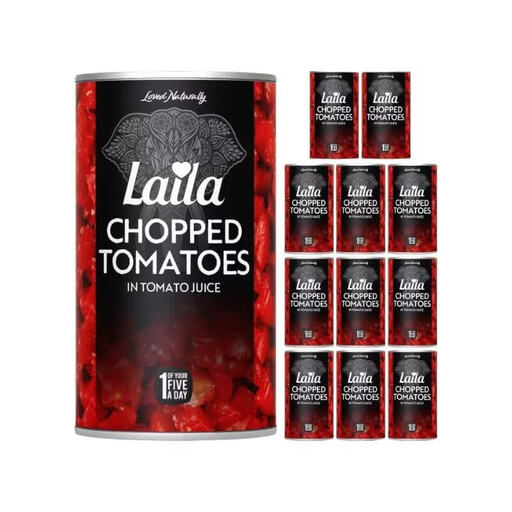 No image available
The twelve-tin pack is an option if you use chopped tomatoes regularly. Check the current nutrition label and opened-tin instructions before use.
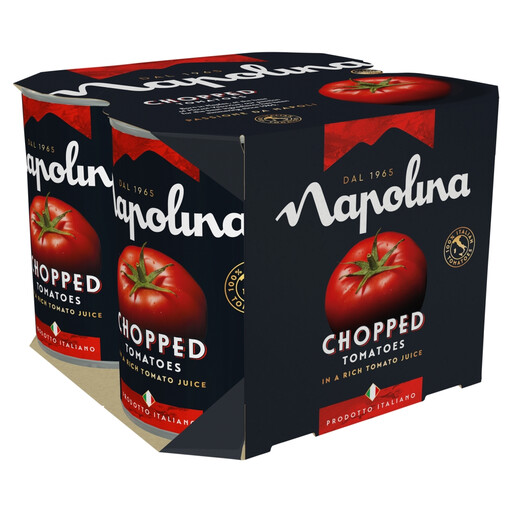 No image available
This four-tin chopped-tomato pack suits recipes that call for a ready-chopped texture. Napolina lists 0.2g fat, 0g saturates and 0.10g salt per 100g; check the current tin if exact values matter.
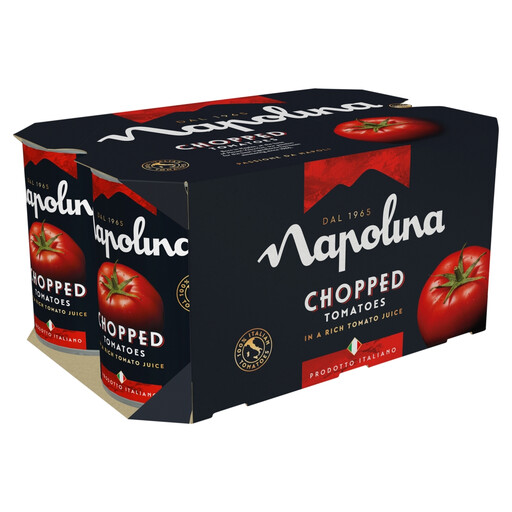 No image available
The six-tin format gives regular users more chopped tomatoes to store than a four-pack. Allow cupboard space and check the current nutrition and after-opening directions on the tins.
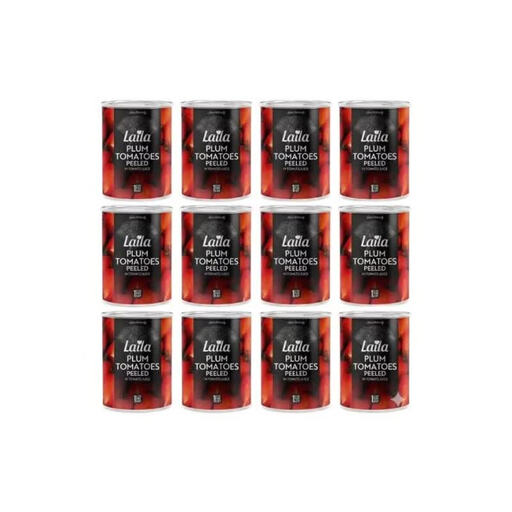 No image available
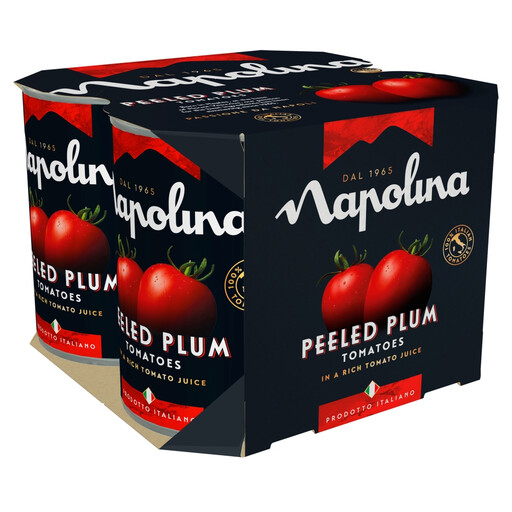
This twelve-tin pack suits repeated cooking with plum tomatoes. They are not ready-chopped, so chop them if your recipe needs that texture; check the current nutrition panel for your dietary requirements.
 No image available
This four-tin option is for recipes using peeled plum tomatoes. Chop the tomatoes if you need a chopped texture, and check the current tin for nutrition values and storage directions.
Check the current fat and saturates figures per 100g. The NHS defines low fat as 3g fat or less per 100g; Napolina lists 0.2g fat per 100g for its chopped tomatoes and Sainsbury's lists less than 0.5g for its Italian Chopped Tomatoes four-pack. Added ingredients determine the fat content of the finished meal.
Use the current tin label as part of the meal information and follow your clinician's or dietitian's individual instructions. Oxford University Hospitals NHS Foundation Trust advises checking nutrition labels for its clinician-advised minimal-fat diet; a general low-fat label description does not assess your whole meal or daily intake.
Yes, if salt is relevant to your choice: it is a separate figure on the nutrition panel. The NHS defines low salt as 0.3g or less per 100g; Sainsbury's Italian Chopped Tomatoes four-pack lists 0.07g and Napolina Chopped Tomatoes lists 0.10g salt per 100g. Compare the current labels on the same per-100g basis.
Follow that product's label for transferring, covering, refrigerating and using the remainder. Tesco's Napolina chopped-tomato instructions specify use within two days after opening, while Marks & Spencer specifies three days for its Italian Tomatoes 400g tin. Food Standards Scotland advises checking the label because instructions differ.
Check the label on the tin you receive before using it for an exact ingredient or nutrition limit. Sainsbury's advises that product ingredients can change, so an online listing is useful for comparing options but should not replace the current label.