Shoppers avoiding added sugar
If you want a quick winter soup without sugar added as an ingredient, check both the claim and the total-sugars figure. “No added sugar” does not mean sugar-free.


If avoiding sugar added as an ingredient matters most, Heinz No Added Sugar Cream of Tomato Soup is a ready-to-heat option, but Sainsbury’s lists 2.6g total sugars per 100g and milk ingredients. Tesco Low Fat Tomato Soup lists sugar as an ingredient; Campbell’s condensed tomato soup serves a different cooking need and declares nutrition as consumed, so its figures are not a like-for-like comparison with ready-to-heat tins.
If you want a quick winter soup without sugar added as an ingredient, check both the claim and the total-sugars figure. “No added sugar” does not mean sugar-free.
Compare the sugars and salt declarations alongside the ingredients list. A name such as “Low Fat” does not tell you whether sugar is an ingredient.
Condensed tomato soup may fit a recipe, but its preparation and nutrition basis need checking before you compare it with a ready-to-heat tin.
For a quick winter meal, establish whether the soup is ready to heat, then compare its ingredients and nutrition on a consistent basis.
| Priority | What to check | Your needs |
|---|---|---|
| Added and total sugars | Read the ingredients for added sugar and the “of which sugars” value per 100g. Sainsbury’s lists 2.6g for Heinz No Added Sugar Cream of Tomato Soup; Tesco lists 3.9g for its Low Fat Tomato Soup and 4.8g for standard Heinz Cream of Tomato Soup, each per 100g. | I want to avoid sugar added as an ingredient, rather than assume a no-added-sugar claim means the soup contains no sugars. |
| Salt and portion | Compare salt per 100g, then check the amount you expect to eat. Tesco lists 0.35g salt per 100g for its Low Fat Tomato Soup; the NHS notes that a manufacturer’s stated portion may differ from yours. | A smaller sugar figure is not my only consideration; I also want to know what the salt declaration means for my bowl. |
| Preparation | Check whether the soup is ready to heat or needs preparing. Campbell’s declares nutrition for its condensed Cream of Tomato Soup “as consumed”, so compare prepared values only on a matching basis. | For a quick bowl, I want a ready-to-heat tin; for a recipe, a condensed soup may suit the way I plan to use it. |
| Ingredients and allergens | Read the current pack before use. The Sainsbury’s listing for Heinz No Added Sugar Cream of Tomato Soup includes milk ingredients; Campbell’s Cream of Tomato Condensed Soup contains milk and celery. | If an ingredient or allergen matters to me, I need the declaration for the specific soup I am buying. |
A no-added-sugar claim and the total-sugars declaration answer different questions. Sainsbury’s lists 2.6g sugars per 100g for Heinz No Added Sugar Cream of Tomato Soup.
Check the “of which sugars” line as well as the ingredients list when choosing a ready-to-heat tin.
Sugar claims do not describe a soup’s salt content. In its February 2026 assessment of 481 chilled and ambient soups, Action on Salt reported that 23% exceeded the Government’s voluntary maximum salt target.
Compare salt per 100g and for the amount you plan to eat; do not use “Low Fat” or “No Added Sugar” as a substitute for the salt declaration.
Campbell’s declares its condensed Cream of Tomato Soup nutrition “as consumed”, after preparation. That is a different basis from the ready-to-heat product declarations.
Check the preparation directions and compare figures reported on the same basis before drawing a nutrition conclusion.
The listed cream-of-tomato products have different ingredient declarations: Heinz No Added Sugar contains milk ingredients, while Campbell’s condensed soup contains milk and celery.
Read the current pack before use, particularly when an allergen or dietary restriction affects your choice.
The No Added Sugar and standard Cream of Tomato tins illustrate why a claim should be read alongside the nutrition panel and ingredients.
Tesco Low Fat Tomato Soup is an own-label ready-to-heat option to compare with branded tomato tins.
Campbell’s Cream of Tomato Condensed Soup is a cooking option as well as a soup to prepare and serve.
Sainsbury’s product listing provides an ingredients and nutrition reference for Heinz No Added Sugar Cream of Tomato Soup.
This Joybuy option is a 400g parsnip-and-carrot soup rather than one of the tomato tins compared above. If you need a tinned, ready-to-heat winter meal, check its container and preparation directions before choosing it.
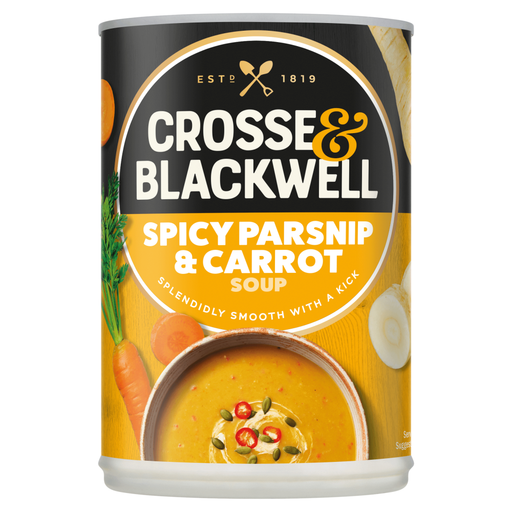 No image available
For a winter soup with parsnip and carrot, check the pack’s per-100g sugars and salt alongside its ingredients before comparing it with tomato options. Confirm the container and preparation directions if you need a tin you can heat straight away. The listing flags celery, milk and wheat allergens; check the current packaging if these matter to you.
No. A no-added-sugar soup can still have sugars in its nutrition declaration: Sainsbury’s lists 2.6g per 100g for Heinz No Added Sugar Cream of Tomato Soup. Check both the “of which sugars” line and the ingredients.
Start with per 100g when comparing like-for-like ready-to-heat soups, then consider how much you will eat. The NHS notes that a manufacturer’s portion may differ from your own.
No. Check salt separately on each soup’s nutrition panel. Tesco lists 3.9g sugars and 0.35g salt per 100g for Low Fat Tomato Soup, while Sainsbury’s lists 2.6g sugars and less than 0.5g salt per 100g for Heinz No Added Sugar Cream of Tomato Soup.
Do not assume it is milk-free. The listings for Heinz No Added Sugar Cream of Tomato Soup and Campbell’s Cream of Tomato Condensed Soup identify milk ingredients; Campbell’s also identifies celery. Check the current pack for the specific product.
Only when the nutrition figures use a matching preparation basis. Campbell’s states its condensed Cream of Tomato Soup values “as consumed”, so check how it is prepared before comparing those values with a ready-to-heat soup’s panel.