Lunch planners comparing labels
You want to compare the sugars declared on different tins without treating a ‘reduced sugar’ claim as a ranking of every available product.


Do not choose tinned tomatoes by a ‘reduced sugar’ phrase alone: compare sugars and salt per 100g on the exact tin, then choose a texture that suits your lunch. Marks & Spencer lists 2.7g sugars per 100g for its Italian Cherry Tomatoes, Mutti lists 2.8g for Polpa, and Napolina lists 3.6g for its chopped tomatoes; these are examples from three product labels, not a comparison of every tin.
You want to compare the sugars declared on different tins without treating a ‘reduced sugar’ claim as a ranking of every available product.
You need a tomato format that suits the dish: finely chopped tomatoes provide a pulpy base, while standard chopped tomatoes leave more visible pieces.
You want a tin or multipack you can use sensibly, with a plan for refrigerating and using any contents left after opening.
Start with the per-100g label, then choose the tomato format and pack size for the lunches you plan to make.
| Priority | What to check | Your needs |
|---|---|---|
| Sugars and salt | Compare sugars and salt per 100g on the exact products, alongside their ingredients. A ‘reduced sugar’ claim is comparative; it does not identify the lowest figure across all tins. | I want to understand the label rather than rely on wording on the front of the tin. In a 2024 Northern Ireland survey of 611 adults by the Food Standards Agency and Ipsos Northern Ireland, 49% said they actively used traffic-light labelling when shopping for food; that figure does not measure tinned-tomato choices. |
| Tomato texture | Check whether the tin contains whole, finely chopped or standard chopped tomatoes. Consider whether your sauce needs crushing or blending, or whether visible pieces suit the dish. | For a quick, more uniform sauce, I would choose a finely chopped format; for a soup or pasta dish with pieces of tomato, I would look at chopped tomatoes. |
| Pack and portion | Use per-100g figures to compare different tin sizes, then check how much tomato the recipe uses. Read the chosen tin’s instructions for contents left after opening. | If I am making one lunch rather than several, I want a pack size I can use and a clear plan for any leftovers. |
The phrase describes a comparison, not how a tin ranks against every other tomato product.
Compare the current per-100g sugars and salt declarations on the tins you are considering, and read their ingredients.
A figure for a whole tin does not provide the same comparison basis when tin sizes differ.
Compare nutrition values per 100g first, then consider how much you expect to use in the lunch.
Whole tomatoes may need crushing for a smooth sauce, while finely chopped and chunkier products give different results in soups and sauces.
Choose the format for the dish as well as checking its nutrition label.
Instructions can differ between products. Marks & Spencer directs shoppers to transfer its Italian Plum Tomatoes to a non-metallic container, refrigerate them and eat them within three days of opening.
Follow the instructions on your exact tin and consider how soon you will use the remaining contents.
A pack containing more tomatoes than you can use within its stated period may lead to waste.
These product ranges illustrate different formats and label figures; compare the exact tin rather than applying one product’s figures to an entire brand.
Its standard chopped tomatoes offer a chunky format for dishes where visible pieces are wanted.
Polpa is a finely chopped option for a pulpy sauce base.
The Italian Cherry Tomatoes and Italian Plum Tomatoes provide two whole-tomato label examples.
Tesco Groceries lists standard, finely chopped and garlic-flavoured chopped-tomato options.
Sainsbury’s lists own-label chopped-tomato formats alongside Mutti and Napolina products.
These finely chopped and chopped tomato options suit lunch sauces, soups and similar dishes; the pack sizes also give you different quantities to plan around. Check each current tin for its nutrition declaration and storage directions.
 No image available
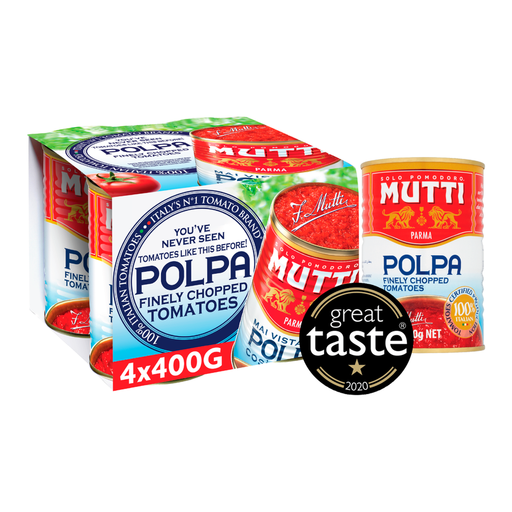
Consider this finely chopped format when you want a pulpy base for a lunch sauce or soup. The pack contains four 400g tins; check the exact label for nutrition and after-opening directions.
 No image available
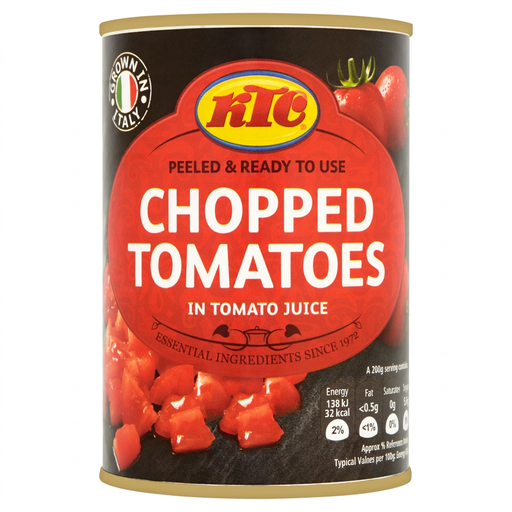
A single 400g tin is an option when a lunch recipe calls for chopped tomatoes. Check the tin for its precise texture, per-100g figures and instructions after opening.
 No image available
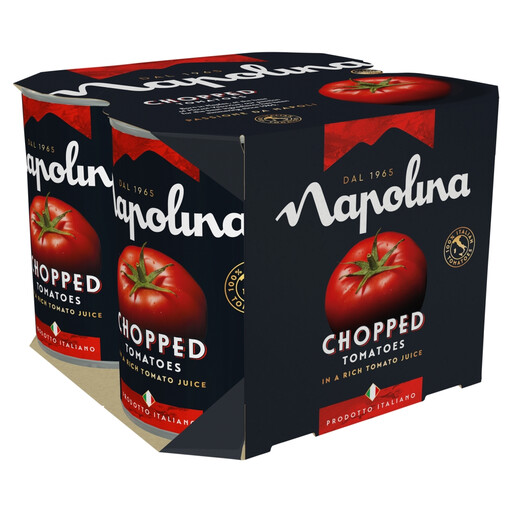
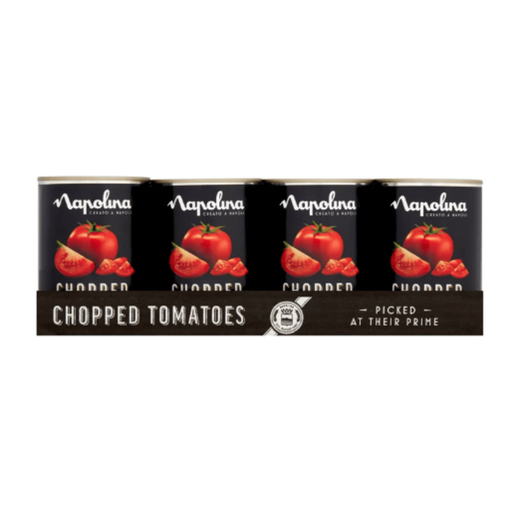
The chopped format suits a sauce or soup where you want visible tomato pieces. This four-tin pack contains 400g per tin; Napolina’s standard chopped-tomato label declares 3.6g sugars and 0.10g salt per 100g, so check the current pack label when comparing it with another product.
 No image available
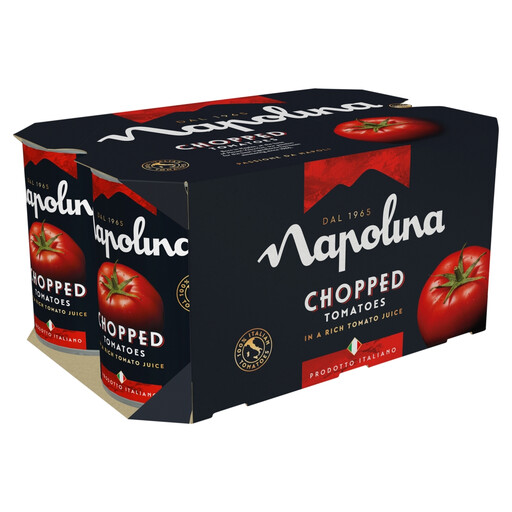
This six-tin pack may suit lunches planned across several meals if chopped tomatoes are the format you need. Each tin is 400g; check the pack’s own nutrition panel and after-opening directions.
 No image available
Consider this 24-tin pack only if you plan to use chopped tomatoes regularly and have space to store it. Each tin is 400g; use the current pack label for nutrition and instructions for opened contents.
No: that wording alone does not tell you which of the tins you are considering has the lowest declared sugars. Compare sugars and salt per 100g, check the ingredients, and choose a tomato format that works in your dish.
Start with the per-100g nutrition values rather than a figure for the whole tin. The NHS explains that nutrition information is given per 100g or 100ml and sometimes per portion; after comparing labels, consider how much tomato your recipe uses.
Choose finely chopped tomatoes if you want a pulpy, more uniform base, or standard chopped tomatoes if you want visible pieces. Mutti describes Polpa as finely chopped, while Napolina describes its standard chopped tomatoes as chunky and suited to thick sauces.
Follow the instructions on the exact tin. Marks & Spencer says to transfer its Italian Plum Tomatoes to a non-metallic container, refrigerate them and eat them within three days of opening; do not assume the same period applies to another product.
You can try adjusting the recipe instead of adding sugar. Napolina’s cooking guidance suggests slow cooking or ingredients such as carrot or onion to balance sharpness; the result will depend on the tomatoes and the dish.