Salt-conscious savoury bakers
If the tuna is going into a biscuit dough, filling or topping, compare its labelled salt with other tins on a like-for-like drained basis. Allow for the tuna when deciding how much salt to add elsewhere in the recipe.


For a savoury biscuit bake, choose tinned tuna by comparing salt figures on the same basis, preferably per 100g drained, rather than assuming that spring water or a no-drain format means less salt. Conventional chunks let you drain and flake the tuna before mixing; a no-drain product saves that step, but its labelled salt and usable quantity still need to fit the recipe.
If the tuna is going into a biscuit dough, filling or topping, compare its labelled salt with other tins on a like-for-like drained basis. Allow for the tuna when deciding how much salt to add elsewhere in the recipe.
When you need tuna distributed through a mixture without excess packing liquid, conventional chunks in water give you the option to drain and flake them before use.
Ready-to-use tuna cuts out a draining step. Check the particular product's salt declaration as well as its format: Sainsbury's lists 0.80g salt per 100g for a Princes ready-to-use steak, while John West lists 0.90g per 100g for its no-drain spring-water steak pot.
For a savoury biscuit bake, start with a comparable salt declaration, then choose how much control you need over the tuna's moisture and preparation.
| Concern | What to check | Who this matters to |
|---|---|---|
| Salt contribution | Compare salt per 100g on the same drained basis, then check the drained amount the recipe uses. | If I am limiting the salt added to a biscuit filling, I need a tuna figure I can compare with other tins. About 42% of consumers put comparable salt values first. |
| Moisture and texture | Check whether the chunks can be drained and whether the piece size suits the mixture. | When tuna is mixed through dough or a filling, I want to control the liquid and flake the pieces evenly. For about 33% of consumers, that texture control is the primary need. |
| Preparation and quantity | Check whether draining is needed and how much tuna the pack provides for the batch. | If preparation time is tight, I want a usable quantity without an extra draining step. Around 17% of consumers chiefly prioritise convenience and batch quantity. |
| Ingredients and allergies | Read the ingredients and allergen information on the exact pack; check the other recipe ingredients separately. | Where someone eating the bake has an allergy, I need to establish whether every ingredient is suitable before serving it. This is the first concern for about 8% of consumers. |
Spring-water tuna products can have different salt declarations. Sainsbury's lists 0.70g per 100g drained for its own-label chunks, while Princes lists 0.85g per 100g drained for its chunks.
Compare the current packs on the same drained basis and account for the amount of tuna going into the bake.
The tuna is not the only possible source of salt in a savoury bake; cheese, stock, sauces and seasoning can also contribute. The NHS advises adults to have no more than 6g of salt a day from food and salt added during cooking or at the table.
Consider the whole recipe before adding salt. Herbs, spices or lemon can provide flavour without assuming that the tuna needs extra seasoning.
A no-drain format describes preparation, not its salt level. John West lists 0.90g salt per 100g for its no-drain spring-water steak pot; Sainsbury's lists 0.70g per 100g drained for its conventional spring-water chunks. Those figures are not on an identical drained basis.
Choose the convenient format if it suits your preparation, but check its own label and portion quantity before planning the recipe's salt.
Ingredients and nutrition information can change. M&S advises shoppers to read the product label rather than rely solely on its website information.
Check the current can before cooking, particularly when salt or allergen information affects the choice.
Offers conventional tuna and no-drain formats, including products in spring water.
Offers spring-water chunks as well as ready-to-use spring-water steak.
Its tinned-tuna category includes products in spring water, brine and oil, alongside steak and drained formats.
Its own-label spring-water tuna chunks include a 4 x 145g pack.
Asda Groceries lists a John West tuna-chunks product with a little spring water.
Offers own-label spring-water tuna chunks and steak options.
These spring-water tuna chunks include conventional tins for draining and flaking, plus a no-drain format when avoiding that step matters. Compare the current packs' salt declarations before choosing one for a savoury biscuit bake.
 Image unavailable
For a bake in which you can drain and flake tuna, these spring-water chunks come in a 4 x 125g pack. Check salt per 100g drained on the current can before working out the recipe's salt contribution.
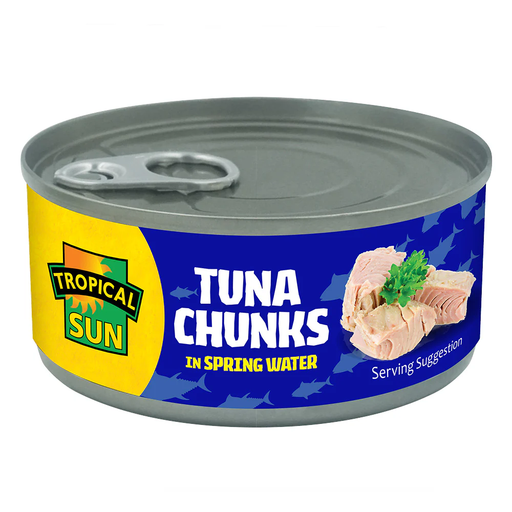 Image unavailable
If you want a single 160g pack of spring-water chunks to prepare for a savoury mixture, check how much drained tuna the recipe calls for. Read the current can for the salt figure and its measurement basis before comparing it with other tins.
 Image unavailable
When avoiding a draining step matters, this no-drain spring-water chunk format comes in a 3 x 100g pack. Check the can's salt value and its stated basis before comparing it with conventional drained tuna.
 Image unavailable
For batches that call for several tins, this pack contains six 145g cans of spring-water chunks. Plan the amount used from the can labels, and compare their salt declaration on the same basis as any alternative.
 Image unavailable
For a smaller batch using a single tin, this option is a 145g can of spring-water chunks. Check its drained quantity and current salt declaration against the recipe before deciding how much to use.
No. Spring water identifies the packing medium, not a particular salt value. For example, Sainsbury's lists 0.70g salt per 100g drained for its spring-water chunks and Princes lists 0.85g per 100g drained for its chunks; compare the exact packs on the same basis.
Use the label's salt figure and the amount of tuna going into the recipe, then consider other ingredients such as cheese, stock, sauces and seasoning. The NHS advises adults to have no more than 6g of salt a day from all food and salt added during or after cooking.
Drain a conventional tin if the biscuit mixture needs controlled moisture, then flake the tuna before mixing. A no-drain product avoids that preparation step, but still needs to match the recipe quantity and your salt comparison.
Follow the storage instructions on the exact pack. Sainsbury's directs shoppers to transfer leftovers from its spring-water chunks to a non-metallic container, refrigerate them and use them within one day; M&S gives a two-day refrigerated limit for its spring-water chunks after transfer to a non-metallic container.
No, not if it contains tuna: tuna is fish. GOV.UK identifies fish as an allergen that must be declared when present as an ingredient in prepacked food. Check the exact tuna pack and assess the other ingredients in the biscuit recipe separately.