Crowd-feeding shoppers
If you are making several salads, wraps or sandwich fillings, the number of tins and their drained weights help you plan how much usable tuna to buy.


Choose a multipack if you expect to open several tins for BBQ salads, wraps or sandwich fillings; check the drained weight to plan how much tuna you can use. A clearly labelled no-drain tin suits quicker assembly, while the specified Sainsbury’s and M&S products are worth examining if their stated catch method or sourcing information matters to you. Check the exact pack before relying on its format or sourcing statement.
If you are making several salads, wraps or sandwich fillings, the number of tins and their drained weights help you plan how much usable tuna to buy.
If catch method or certification guides your choice, look for a statement that applies to the exact pack rather than assuming it covers every tin from the same retailer.
If you are assembling cold dishes shortly before serving, an explicitly labelled no-drain format may remove a preparation step. Check the individual tin size when planning several dishes.
Start with the quantity you expect to use, then decide whether preparation format, sourcing information or the exact label is more important for your spread.
| Concern | What to check | Who this matters to |
|---|---|---|
| Usable quantity | Check the tin count and stated drained weight when planning several dishes. | If I am feeding a crowd, I want enough tuna for each filling without opening tins I will not use. About 36% of consumers put usable quantity first. |
| Sourcing information | Check whether a catch-method or certification statement applies to the exact pack. | When choosing between similar packs, I want to see how the tuna was caught or sourced. That is the primary concern for about 29% of consumers. |
| Preparation speed | Look for an explicit no-drain description and check the size of each tin. | If I am assembling salads or wraps just before serving, skipping the draining step matters most; about 21% of consumers share that priority. |
| Labels and leftovers | Read the ingredients and fish-allergen declaration, and follow the pack’s instructions after opening. | When guests have different food requirements or a tin may be partly unused, I need clear labels and storage directions. For about 14% of consumers, those checks come first. |
A single tin and a four-pack answer different preparation needs, but tin count does not tell you how much drained tuna each provides.
Use the stated drained weight to plan your dishes, then choose a pack count that fits what you expect to open.
John West sells a product explicitly labelled No Drain, but that description should not be applied to every John West tuna pack.
Check the name and directions on the exact tin if you are counting on using it without draining.
The checked ASDA and M&S product instructions call for unused contents to be transferred to a non-metallic container, refrigerated and used within two days.
Plan how many tins to open and follow the storage instructions on the pack you buy.
Salt values can differ between products. Tuna also contains fish, which UK government allergen guidance lists as an allergen.
Read the exact pack’s ingredients, allergen declaration and nutrition panel before preparing food for guests.
Tesco lists its own-brand skipjack tuna chunks in brine as single tins and 4 × 145g packs, alongside a Stockwell & Co single tin.
Sainsbury’s describes its 4 × 145g chunks in brine as pole-and-line caught and sourced from fisheries independently certified to the MSC standard.
Asda’s own-brand chunks in brine come in a 4 × 145g pack suited to plans involving several tins.
Princes offers branded tuna chunks in brine in a 4 × 145g pack.
John West’s specified No Drain Tuna Chunks with a Little Brine come in a 3 × 100g format.
M&S lists spring-water tuna in 160g single cans and a 640g four-pack, with stated pole-and-line sourcing for the specified products.
These packs cover no-drain options for quick cold dishes and multipacks for preparing several BBQ fillings. Check each pack’s quantity and directions against your plans.
 Image unavailable
The stated no-drain format suits salads or sandwiches assembled shortly before serving. The pack contains three 100g tins; check its fish-allergen information before serving guests.
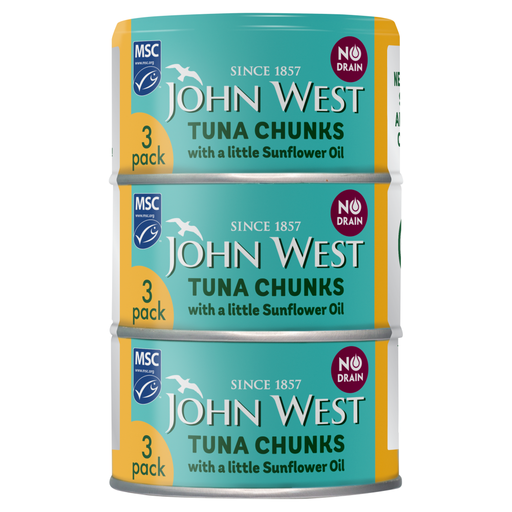 Image unavailable
For quickly assembled salads or sandwiches, this is another explicitly described no-drain format. It contains three 100g tins packed in sunflower oil rather than springwater; check the exact label for guest allergens.
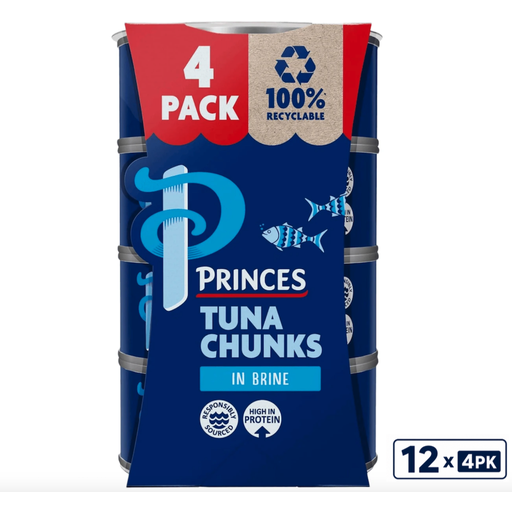 Image unavailable
Brine-packed chunks can be planned across salads, sandwiches or wraps. The title lists twelve four-tin packs, but the quantity description specifies one 4 × 145g pack; confirm the total bundle quantity before planning a crowd-sized spread.
 Image unavailable
Four separate tins can be opened as you prepare multiple BBQ dishes. This variant is packed in sunflower oil; follow its directions for storing any contents left after opening.
 Image unavailable
The four-tin pack can be divided between salads and sandwich fillings. Each tin is listed as 125g; check this exact variant’s directions before treating it as a no-drain product.
Choose by how many tins you expect to open and how much drained tuna the dishes need. A multipack keeps separate tins available for several fillings; a single tin may suit one smaller dish.
Follow the exact pack’s directions. The checked ASDA and M&S products instruct shoppers to move unused tuna to a suitable non-metallic container, refrigerate it and use it within two days.
No. The NHS states that fresh and canned tuna do not count as oily fish; that classification does not replace advice applicable to particular guests or circumstances.
Yes. Fish is among the allergens listed in UK government guidance, so identify which dishes contain tuna and check the ingredients of other components in each finished dish.