Shared-dish BBQ planners
If you are making tuna salads, sandwich fillings or pasta dishes for several people, work out how much drained tuna the dishes need and whether separate tins would help you manage leftovers.


For several BBQ dishes, separate tins let you open tuna as needed; consider a larger tin if most of it will go into one dish, or a no-drain multipack when quicker assembly matters more than pack size. Compare declared drained weights rather than can weights alone, choose the packing medium for your recipe, and follow the exact pack’s allergen and after-opening instructions.
If you are making tuna salads, sandwich fillings or pasta dishes for several people, work out how much drained tuna the dishes need and whether separate tins would help you manage leftovers.
If the tuna will be used across more than one meal, compare declared drained weights and can sizes. A larger pack is useful only if its contents fit the dishes you plan to make.
If you are assembling cold dishes shortly before guests arrive, a no-drain format removes a preparation step. Check its total pack size against the amount your menu needs.
Start with the amount of tuna your dishes will use, then decide whether separate tins, a particular packing medium or fewer preparation steps matter most.
| Concern | What to check | Who this matters to |
|---|---|---|
| Enough tuna for shared dishes | Plan the dishes, then check the declared drained weight and number of cans. | If I am making several tuna dishes, I need enough fish after draining, not just a large weight on the front of the pack; about 36% of consumers put usable quantity first. |
| Choosing a workable pack format | Compare drained weights across formats and consider how much of an opened tin you will use. | When I expect to make dishes on different occasions, I want a pack I can open in stages without leaving more than I need; roughly 29% of consumers prioritise that pack-format decision. |
| Quick preparation | Check whether the pack is no-drain and whether its total quantity covers the dish. | With a cold dish to assemble before guests arrive, I would rather skip draining if the smaller pack still supplies enough tuna; around 21% of consumers place preparation speed first. |
| Recipe and sourcing fit | Read the exact variant’s ingredients and nutrition panel; check any sourcing claim on that product. | If my dressing calls for a particular packing medium, or a sourcing label matters to me, I need to choose the exact variant accordingly; about 14% of consumers make that fit their primary concern. |
Packing liquid contributes to the stated can weight. Tesco Groceries lists its 4 x 145g tuna chunks in brine at 4 x 10²g drained weight, which is the more useful figure when the liquid will not go into the dish.
Check the chosen pack’s declared drained weight before working out how much tuna your salads or fillings will contain.
The packing media change the ingredients you add to a recipe. Tesco Groceries lists tuna and spring water for its spring-water variant; its brine variant includes salt.
Choose the medium for the dish, then read that variant’s ingredients and per 100g nutrition panel rather than applying one pack’s details to another.
After-opening instructions are product-specific. Marks & Spencer instructs shoppers to move unused spring-water tuna to a non-metallic container, refrigerate it and eat it within two days.
Follow the exact pack’s instructions when preparing dishes ahead, and plan how you will use any remainder.
Certification and catch-method wording may differ between products and variants. A statement on one tin does not establish the same status for another size or packing medium.
If sourcing influences your choice, check the label of the exact pack you intend to buy.
Tesco Groceries lists own-label tuna chunks in both brine and spring water as 4 x 145g multipacks.
Princes lists tuna chunks in several packing media. Its spring-water range includes 4 x 145g and 8 x 145g formats.
John West offers No Drain tuna chunks in a 3 x 100g format for dishes where draining would be inconvenient.
Marks & Spencer lists spring-water tuna chunks in a 160g tin and a 640g format.
These multipacks offer separate tins for BBQ salads, pasta dishes and sandwich fillings, including spring-water, brine, oil-packed and no-drain options. Check each chosen pack’s drained weight when planning the usable quantity.
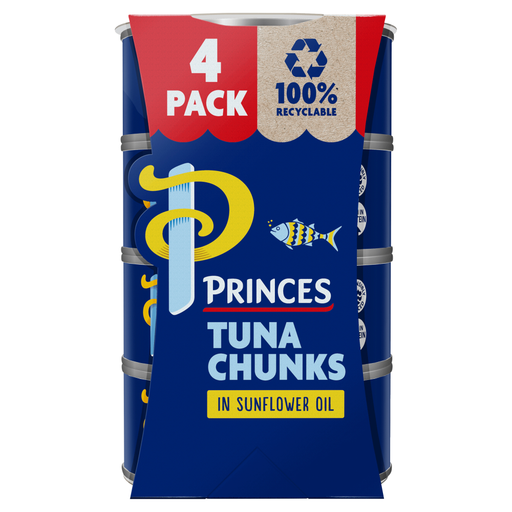 Image unavailable
Consider this four-tin format when making tuna dishes on more than one occasion and sunflower oil suits the recipe. Check the pack’s drained weight for portion planning and its fish allergen statement for anyone you are serving.
 Image unavailable
Four separate tins can be opened across several BBQ dishes. This variant is packed in brine; read its salt information and declared drained weight before deciding how it fits the menu.
 Image unavailable
These four tins offer a spring-water option for dressed salads or sandwich fillings. Their stated can size differs from the 145g four-packs, so compare declared drained weights rather than treating the formats as equal quantities; check the exact ingredients if salt matters to the dish.
 Image unavailable
The no-drain format suits a smaller cold dish when you want to skip draining. It contains three 100g tins, so check that the stated quantity will cover the dish rather than assuming it replaces a four-tin family pack.
 Image unavailable
The named six-pack may suit a plan involving several tuna dishes. Confirm the exact pack contents and declared drained weight on the product label before using it to plan portions.
Work from the dishes you plan to make and the chosen packs’ declared drained weights. For a concrete comparison, Tesco Groceries lists its 4 x 145g brine multipack at 4 x 10²g drained weight; another pack may yield a different amount.
Choose the medium that fits the dressing and flavour you intend to use, then check the exact ingredients and nutrition panel. Tesco Groceries lists tuna and spring water in its spring-water variant, while its brine variant includes salt; an oil-packed product has a different ingredient combination again.
Follow that product’s after-opening instructions. Marks & Spencer says to transfer unused contents of its spring-water tuna chunks to a non-metallic container, refrigerate them and eat them within two days; do not apply that period to every variant.
GOV.UK distinguishes a best-before date, which concerns quality, from a use-by date, which concerns safety. Store the tin as its label directs and check the can and its instructions before preparing food.
Tuna is fish, so check the exact product’s allergen label before preparing or serving it. Do not assume that a different pack or variant has identical labelling.