Breakfast cooks planning several portions
A larger tin or multipack may suit several breakfasts, provided you can use opened tuna within the pack’s storage instructions. Check drained weight as well as the stated tin size.


For an occasional tuna addition to a Full English-style breakfast, choose a tin size you can finish or store as directed rather than assuming a larger pack offers better value. Spring-water and brine versions can differ in salt, while no-drain tuna reduces preparation; check the particular pack before choosing between them.
A larger tin or multipack may suit several breakfasts, provided you can use opened tuna within the pack’s storage instructions. Check drained weight as well as the stated tin size.
A no-drain format removes the draining step. For a small portion, a separate tin may also be easier to plan around than opening a large can.
Compare the nutrition panels of the particular spring-water and brine tins you are considering. The NHS says fish advice may differ during pregnancy, so its current guidance matters if that applies to you.
Start with the amount you expect to use, then consider packing liquid, preparation and storage instructions.
| Priority | What to check | Your needs |
|---|---|---|
| Usable quantity | Compare declared drained weight, not just tin size. Check how many separate tins are in a multipack and how much you expect to use after opening one. | I want enough tuna for breakfast without opening more than I can use or store. |
| Packing liquid and salt | Read the ingredients and salt value per 100g drained. Sainsbury’s product panels list 0.12g for its spring-water 4x145g tuna and 0.42g for the corresponding brine version. | Spring water suits me if I want the lower-salt option within that Sainsbury’s pair; otherwise I can choose the packing liquid I prefer after checking its label. |
| Preparation | Check whether the exact variant needs draining. No-drain describes John West’s named range, but does not establish that every John West multipack uses that format. | On a rushed morning, I would rather open a no-drain tin than add a draining step. |
| Opened-tin storage | Follow the specific pack’s transfer, refrigeration and use-by-opening instructions. Tesco’s 400g spring-water tin says to use transferred leftovers within two days; Sainsbury’s spring-water 4x145g pack says within one day. | If I only want a little tuna today, I need a plan for anything left after opening the tin. |
| Nutrition panel | Compare values on the same drained-weight basis. Tesco lists 24.9g protein per 100g drained for its 400g spring-water tin; Sainsbury’s lists 26.1g for its spring-water 4x145g tuna. | I want to know what the tuna portion contributes without treating the whole breakfast as nutritionally interchangeable. |
| Sourcing statement | Look for a statement on the particular pack and note who makes it. M&S describes its 160g spring-water chunks as pole-and-line caught under its Forever Fish policy. | A stated fishing method matters to me, so I will check the product I actually buy rather than assume it applies across a brand. |
Packing liquid is included in the stated tin size. Tesco’s 400g spring-water tin, for example, declares 280g drained weight.
Check drained weight when comparing formats, then match the amount to the breakfasts you have planned.
Opened tuna needs prompt storage and has a product-specific limit: Tesco directs users of its 400g tin to transfer and refrigerate leftovers and use them within two days.
Choose a tin you can finish, or plan another use for the remainder and follow its label instructions.
Sainsbury’s comparable 4x145g products list 0.42g salt per 100g drained for brine and 0.12g for spring water.
Read the nutrition panel of the variant you are buying, especially when salt is a factor in your choice.
John West describes its named No Drain product as ready to use, but that description does not identify the draining instructions for a differently named spring-water multipack.
Check the exact pack if avoiding draining is important for your breakfast.
Tesco’s 400g spring-water tin is a large-can option for breakfasts where the tuna can be shared or the remainder planned for another meal.
Sainsbury’s lists comparable 4x145g tuna chunks in spring water and brine.
A Princes 4x145g spring-water multipack appears in Tesco’s tuna listings and provides a branded format to compare with other multipacks.
John West offers a named No Drain range for shoppers who want to skip draining.
M&S lists spring-water tuna chunks in 160g and 640g formats for shoppers considering different amounts.
These tins offer single-can, multipack, spring-water, brine and no-drain formats to consider for an occasional tuna addition to breakfast. Check the exact pack’s drained weight and instructions when deciding which format fits your portions.
 No image available
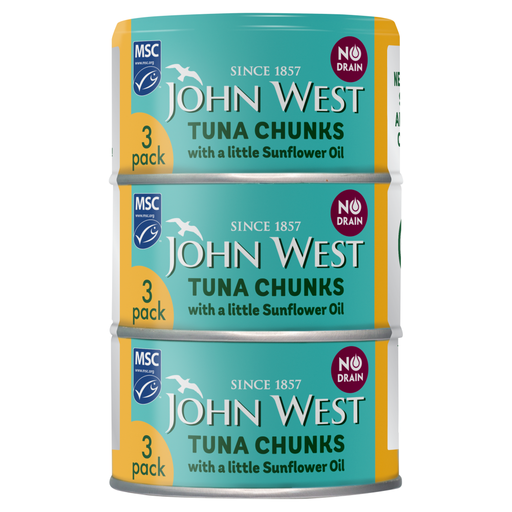
The no-drain format removes a preparation step for a quick breakfast. This three-tin variant is packed in sunflower oil rather than spring water; consider whether that suits the dish.
 No image available
Six separate spring-water tins offer a format for breakfasts on different days. Check the drained weight of a tin when deciding how much tuna each opening provides.
 No image available
This four-tin pack is an option if you want tuna in brine for several breakfasts. Check its own salt panel when comparing it with spring-water products; the values for a different brand’s brine tin do not describe this one.
 No image available
A single spring-water tin may fit an occasional tuna breakfast better than buying several cans at once. Check its drained weight to judge the amount available after draining.
 No image available
Four separate spring-water tins offer portions for breakfasts on different days. If avoiding preparation matters, confirm the draining instructions on this exact variant rather than assuming it belongs to the No Drain range.
No. Check its drained weight and whether you can use the opened contents within the pack’s storage instructions. Tesco’s 400g spring-water tin declares 280g drained weight and directs shoppers to refrigerate transferred leftovers and use them within two days.
Check the salt panel as well as your preference for the packing liquid. In Sainsbury’s comparable 4x145g products, spring-water tuna lists 0.12g salt per 100g drained and brine tuna lists 0.42g; those figures should not be assumed for other brands.
No. The NHS says fresh and canned tuna do not count as oily fish, so a tuna breakfast does not fulfil the oily-fish part of its general fish guidance.
Follow the instructions on the tin you opened. Tesco’s 400g spring-water product and M&S’s 160g product direct shoppers to transfer leftovers to a non-metallic container, refrigerate and use them within two days; Sainsbury’s spring-water 4x145g product specifies one day.
It can be. The NHS says its advice on fish may differ during pregnancy; check its current guidance rather than applying the general advice to that situation.