What should you check?
Start with the sugar declaration and ingredients, then compare usable yield and the way each format fits breakfast service.
| Priority | What to check | Your needs |
|---|
| Sugars and ingredients |
Read sugars per 100g and the ingredients list on the exact tin. Plain spring-water products from Tesco and M&S declare 0g sugars per 100g; the Princes eight-pack declares less than 0.1g per 100g drained, according to their product information. |
I want to know whether plain tuna meets the sugar brief without relying on a front-of-pack claim. |
| Drained yield |
Compare drained weight, not just net weight. Tesco lists 280g drained tuna from its 400g can; the Princes eight-pack lists 102g drained tuna per 145g can. |
Portions need to be planned around the tuna available after draining, not the weight of tuna and water together. |
| Salt and packing liquid |
Compare nutrition on the same stated basis and check the packing liquid. Tesco lists 0.90g salt per 100g for its spring-water can and 1.00g per 100g for its brine product; both declare 0g sugars. |
Sugar is not my only menu consideration, so I need to check salt and the chosen packing liquid too. |
| Service format |
Check cans per pack, drained weight per can and the label’s instructions for unused contents. Match the number opened at each replenishment to expected demand. |
Smaller batches may suit a variable breakfast turnout; a larger can may suit a predictable service. |
| Buffet controls |
Keep the current fish-allergen information available for the dish. Follow the hotel’s food-safety procedures for storage, opening, replenishment and cleaning; Food Standards Agency guidance calls for HACCP-based procedures. |
Guests need accurate allergen information, and staff need a clear process once tuna leaves the tin. |
Spring-water tuna options on Joybuy
These spring-water tuna cans and multipacks are options to consider for staged hotel breakfast service. Compare their stated sugar figures and pack sizes, then check the delivered labels and usable yield before setting portions.
 No image available
John West Tuna Chunks in Springwater, 4 × 125g
Four separate cans allow tuna to be opened in stages. The listing declares 0g sugars, 25g protein and 0.80g salt per 100g drained; check the drained weight per can before planning portions.
View on Joybuy
 No image available
John West No Drain Tuna Chunks in Springwater, 3 × 100g
The no-drain format is an option where draining during service is a consideration. The listing declares 0g sugars and 0.80g salt per 100g; check its nutrition basis and usable yield against the delivered label.
View on Joybuy
 No image available
Morrisons Fad Free Tuna Chunks in Spring Water, 6 × 145g
Six separate cans offer a format for staged replenishment. The listing declares 0g sugars, 24.9g protein and 1.0g salt per 100g drained; confirm drained weight per can for portion planning.
View on Joybuy
 No image available
Morrisons Fad Free Tuna Chunks in Spring Water, 145g
This single can can be considered when a smaller unit suits replenishment. The listing declares 0g sugars, 24.9g protein and 1.0g salt per 100g drained; check its drained weight before assigning portions.
View on Joybuy
 No image available
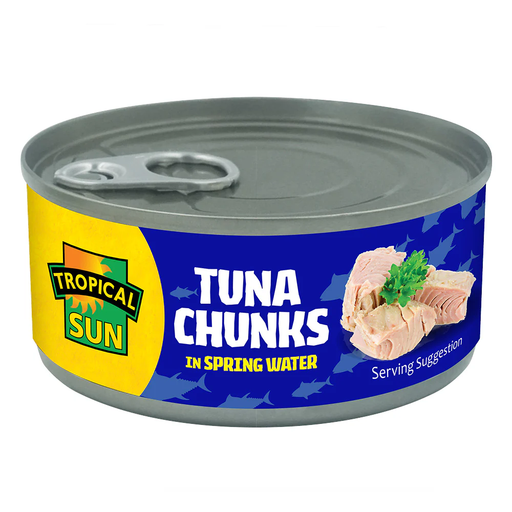
Topical Sun Tuna Chunks in Springwater, 160g
This 160g can is another single-unit spring-water option. The listing declares 0g sugars per 100g, but does not establish a drained basis for its nutrition figures; check the label and drained yield. Its listing also warns of possible traces of soybeans and wheat, which need checking against the hotel’s allergen information.
View on Joybuy
Frequently asked questions
Does a hotel buffet need specially labelled reduced-sugar tuna?
Usually not if a plain product meets the hotel’s requirement. Tesco and M&S spring-water examples declare 0g sugars per 100g, and the cited Princes product declares less than 0.1g per 100g drained; check the label on the exact product ordered.
Should portions be planned from net or drained weight?
Use drained weight to plan the amount of tuna available for portions. Tesco lists 280g drained from its 400g spring-water can, while Princes lists 102g drained from each 145g can in its cited eight-pack.
Does a tuna buffet need fish-allergen information?
Yes. Food Standards Agency guidance for England, Wales and Northern Ireland calls for allergen information for non-prepacked food, and fish is a listed allergen. Food Standards Scotland likewise says allergen information must be available to customers before purchase; keep the information for the tuna actually served accessible to guests and staff.
What should the hotel plan for once tins are opened?
Cover storage, opening, replenishment, cleaning and allergen communication in the hotel’s food-safety procedures. Food Standards Agency guidance calls for procedures based on hazard analysis and critical control point (HACCP) principles; Food Standards Scotland provides HACCP-based CookSafe guidance for catering businesses.
How should unused tuna be handled?
Follow the exact product label and the hotel’s approved food-safety procedure. The cited Tesco, Princes and M&S product instructions say to put unused contents in a non-metallic container, refrigerate them and consume them within two days.


