Low-fat meal planners
If you use tinned tuna in regular meals, compare the packing liquid, fat and salt figures, and how much tuna remains after draining. These details are more useful than assuming every spring-water tin has the same nutrition.


Start with spring-water tuna carrying the blue MSC label on the exact tin if independently assessed sourcing and a lower-fat meal are both priorities. Compare fat and salt per 100g on the same labelled basis, then check the drained quantity: water packing does not tell you the salt content, and a retailer sourcing promise does not establish an individual tin's certification.
If you use tinned tuna in regular meals, compare the packing liquid, fat and salt figures, and how much tuna remains after draining. These details are more useful than assuming every spring-water tin has the same nutrition.
If an independently assessed sourcing signal matters to you, check the exact product for the blue MSC label. The Marine Stewardship Council says the label identifies wild-caught seafood from fisheries independently assessed against its standard.
If you usually choose supermarket own-label tuna, compare the individual tins rather than relying on a retailer-wide sourcing statement. Packing medium, nutrition and certification markings still need checking product by product.
Check the sourcing mark on the tin first, then compare nutrition on a like-for-like labelled basis and choose a pack size you can use.
| Concern | What to check | Who this matters to |
|---|---|---|
| Verified sourcing | Look for the blue MSC label on the exact tin or multipack, rather than inferring certification from its packing liquid or the retailer's name. | If I want an independently assessed fishing standard, a broad sourcing promise will not answer my question. About 40% of consumers put product-level certification first. |
| Fat content | Compare fat per 100g and check whether each figure refers to drained tuna or the product as sold. | For regular lower-fat meals, I need to compare the tuna I will eat, not just choose a tin labelled spring water. Around 30% of consumers make fat content their primary concern. |
| Salt and ingredients | Read salt per 100g on a comparable basis, alongside the ingredients and fish-allergen information. | If I am watching salt or avoiding an ingredient, two water-packed tins may still call for different choices. About 20% of consumers prioritise salt and ingredient checks. |
| Portions and preparation | Check drained weight, the number of tins, whether draining is needed and the instructions for leftovers. | When I am preparing one meal at a time, a usable portion and little preparation matter more than a larger pack. Roughly 10% of consumers put pack convenience first. |
A brand or retailer policy can describe its wider approach without establishing the status of the variant in your basket. The Marine Stewardship Council's blue label is a product-level signal of an independently assessed wild-caught fishery.
If independent certification is essential to your choice, look for that label on the exact tin or multipack.
The checked Sainsbury's spring-water product lists 0.12g salt per 100g drained, while the checked Asda product lists 0.90g on the same basis. The packing liquid alone does not settle a salt comparison.
Compare the current salt figures per 100g, making sure the labelled bases match.
The amount you can serve depends on usable tuna, not just the weight printed prominently on the pack. A partly used tin also needs to fit the product's storage instructions.
Check the drained weight and choose a tin size that suits the portions you plan to prepare.
A larger pack may leave you with tuna to refrigerate and use within the period stated on its label.
Choosing a tuna with a lower fat figure does not change guidance about how much tuna to eat during pregnancy.
The NHS advises pregnant people not to eat more than four cans of tuna or two tuna steaks a week. Keep track of tuna across meals, whatever packing liquid or sourcing label you choose.
These examples show why the individual product label matters even when a brand or retailer has a wider sourcing policy.
Its range includes a No Drain spring-water multipack listed by ASDA Groceries with an MSC-certified-fishery statement.
Princes describes its tuna sourcing through its own Caught With Care programme.
Tesco PLC says it met its commitment to source MSC-certified tuna across Tesco UK and Booker by the end of 2025.
Its checked 4 x 145g spring-water tuna states that it comes from MSC-certified fisheries and is pole-and-line caught.
The checked 4 x 145g own-label spring-water product carries an MSC statement.
Marks & Spencer describes its checked 160g spring-water tuna as pole-and-line caught and responsibly sourced under its Forever Fish policy.
These spring-water tins offer different single-can, multipack and no-drain formats for lower-fat meal planning. Check each current nutrition panel before comparing fat or salt, and look for the blue MSC label on the exact pack before treating it as independently certified.
 Image unavailable
The no-drain format may suit a meal you want to prepare without emptying packing liquid. The pack contains three 100g cans; check whether the current nutrition figures are stated for drained tuna or the product as sold before comparing them with another tin.
 Image unavailable
Four separate 125g cans may suit meals prepared on different days. Use the current pack's drained-weight nutrition figures when comparing fat and salt, and inspect it for the MSC label if certification matters to you.
 Image unavailable
This six-can pack offers separate portions for meals prepared at different times. Compare the current drained-weight fat and salt figures with other spring-water tins, and check the individual pack for an MSC mark.
 Image unavailable
The single 145g can is an alternative if you do not want the six-can pack. Read its current drained-weight nutrition panel, particularly the salt figure, and check the can for the MSC label if required.
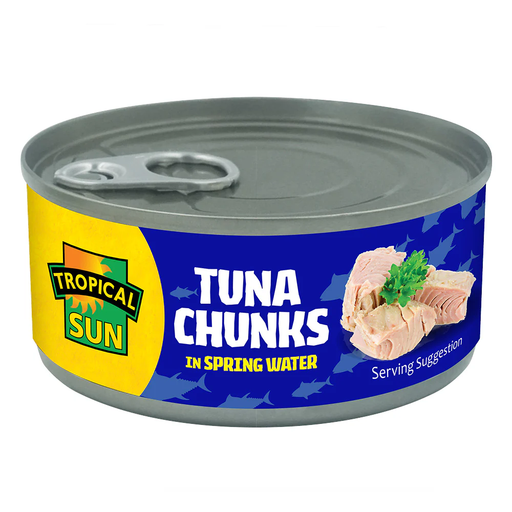 Image unavailable
This 160g can is another spring-water format to assess for a planned portion. Check the current pack for comparable drained-weight nutrition and an MSC mark; also read its allergen information if possible traces of soybeans or wheat matter to you.
Look for the blue MSC label on the exact tin or multipack. The Marine Stewardship Council says it identifies wild-caught seafood from fisheries independently assessed against its standard; general responsibly sourced wording is not the same product-level check.
Spring water is a useful starting point, but compare the exact products rather than deciding from packing liquid alone. The checked Sainsbury's and Asda spring-water tins list less than 0.5g and 1.0g fat per 100g drained respectively.
Use per-100g figures stated on the same basis to compare tins, preferably drained weight where both labels provide it. Then check the drained quantity or serving information to see how much you would use in a meal.
Follow the storage and use-by-opening instructions on that product's pack. If you regularly need less than a whole tin, check those instructions alongside the portion size before choosing a format.
No. NHS pregnancy guidance advises no more than four cans of tuna or two tuna steaks a week. That limit concerns total tuna consumption, regardless of its packing liquid or sourcing label.