What to check when buying
Start with the nutrition basis and packing medium, then compare usable quantity, handling and the label details that matter to you.
| Concern |
What to check |
Who this matters to |
| Energy and protein |
Compare calories, fat and protein per 100g on the same stated basis; note whether the tuna is packed in water, brine or oil. Marks & Spencer lists 99 kcal and 0.6g fat per 100g for its spring-water chunks, against 189 kcal and 9.0g fat per 100g for its sunflower-oil chunks. |
When the rest of my meal already includes a dressing or other additions, I want to know what the tuna contributes before choosing a tin. About 34% of consumers put that energy comparison first. |
| Usable quantity |
Check the labelled drained weight rather than relying on gross tin size or tin count. Tesco Groceries lists four 102g drained portions in its 4 x 145g spring-water pack. |
If I prepare tuna lunches regularly, I need to know how much fish a pack will give me, not just how large its tins look. Roughly 33% of consumers make usable quantity their primary concern. |
| Preparation and leftovers |
Check whether a product is labelled no-drain or ready to eat, and follow its particular after-opening storage instructions. |
For a quick lunch, avoiding draining and having a workable plan for leftovers matters more to me than the tin format. Around 20% of consumers chiefly want easier preparation and handling. |
| Pack details |
Read salt and allergen information on the current pack, along with any warning about bones and its storage directions. |
If I need to check salt or a fish-allergen or bone warning, a broad front-of-pack description will not answer my question. About 13% of consumers put these label checks first. |
Brands to compare
These brands provide useful examples of different packing media and formats; compare the particular product and pack, not the brand name alone.
Tesco
Tesco’s own-label spring-water four-pack is an example for comparing drained portions in a routine-use multipack.
- Tesco Groceries lists four 102g drained portions, with 109 kcal and 24.9g protein per 100g drained.
- The listing gives 0.90g salt per 100g drained and instructs shoppers to transfer unused contents to a non-metallic container, refrigerate them and use them within two days.
Asda
Asda’s own-label spring-water chunks offer another four-pack whose nutrition is stated on a drained basis.
- ASDA Groceries lists 109 kcal and 25g protein per 100g drained for its 4 x 145g pack.
- The product information lists 0.90g salt per 100g drained and warns that some bones may remain.
Princes
Princes appears in spring-water chunks and ready-to-use steak formats, so texture and handling are worth checking at product level.
- For the Princes 4 x 145g spring-water chunks, Tesco Groceries lists 99 kcal and 23.5g protein per 100g drained.
- That four-pack lists 0.85g salt per 100g drained; a ready-to-use steak product is a different format and should be compared on its own label.
John West
John West offers both standard spring-water chunks and a no-drain pot for shoppers who prefer less preparation.
- Sainsbury’s lists the John West No Drain Fridge Pot Tuna Steak with a Little Spring Water 110g as ready to eat, with 120 kcal and 28g protein per 100g.
- The pot’s figures describe that product, not every John West tin; check the format and nutrition basis of the pack you choose.
M&S
M&S provides a same-brand example of how the packing medium can change the labelled nutrition.
- Marks & Spencer lists 99 kcal, 0.6g fat and 23.5g protein per 100g for its spring-water chunks.
- Its sunflower-oil chunks list 189 kcal, 9.0g fat and 27.1g protein per 100g, so the two products should not be treated as nutritionally interchangeable.
Sainsbury's
Sainsbury’s carries branded no-drain and ready-to-use tuna formats that illustrate different ways to handle a quick meal.
- Its John West no-drain pot listing identifies a ready-to-eat format.
- Read the current product’s own nutrition and storage instructions rather than transferring details from a different tuna format.
Tinned tuna selections on Joybuy
These selections cover spring-water and brine chunks for regular meals, plus a no-drain spring-water option for less preparation. Compare each product’s label on its own basis before deciding which suits your portion and handling needs.
 Image unavailable
Morrisons Fad Free Tuna Chunks in Spring Water 145g, six-pack
A spring-water multipack to consider if you prepare tuna meals regularly. The title specifies six 145g tins; check the pack’s drained weight and nutrition basis when planning portions.
View on Joybuy
 Image unavailable
John West Tuna Chunks in Springwater 4 x 125g
A four-tin spring-water pack for repeat lunches. Joybuy lists 106 kcal and 25g protein per 100g drained for this product; use the labelled drained quantity to work out your actual portion.
View on Joybuy
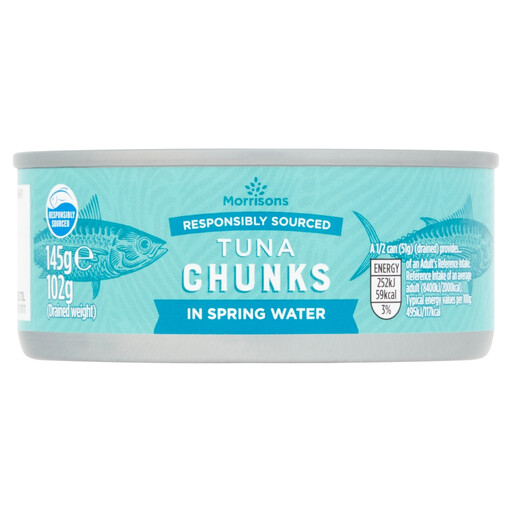 Image unavailable
Morrisons Fad Free Tuna Chunks in Spring Water 145g
A single spring-water tin to consider when a multipack does not fit how often you use tuna. Check its drained weight and the amount you expect to eat rather than treating the 145g tin weight as a drained portion.
View on Joybuy
 Image unavailable
Princes Tuna Chunks in Brine 4 x 145g
A four-tin chunks option if brine is your preferred packing medium. It is not the same product as Princes spring-water chunks, so compare the current label and drained portion rather than carrying figures across from that pack.
View on Joybuy
 Image unavailable
John West No Drain Tuna Chunks in Springwater 3 x 100g
The no-drain format suits a lunch where skipping the draining step matters. The title specifies three 100g tins; check the nutrition label’s stated basis before comparing it with figures given per 100g drained for standard chunks.
View on Joybuy
Frequently asked questions
Is spring-water tuna always the right choice for a weight-management meal?
No single packing medium decides how a whole meal fits your plans. If you want to control the tuna component’s calories, compare labels: Marks & Spencer lists 99 kcal and 0.6g fat per 100g for its spring-water chunks, versus 189 kcal and 9.0g fat per 100g for its sunflower-oil chunks.
How do I compare tins with different pack sizes?
Check the total drained weight to compare the quantity of tuna, then use nutrition figures stated on the same basis. Tesco Groceries lists four 102g drained portions for its 4 x 145g spring-water pack, so the gross tin weight is not the drained portion size.
Can I keep tuna left after opening a tin?
Follow the instructions on the particular pack. Tesco’s cited spring-water tins instruct shoppers to transfer unused contents to a non-metallic container, refrigerate them and use them within two days; a resealable pot may have different handling instructions.
What if I need to check fish allergens or bones?
Read the current pack’s allergen statement and any bone warning, rather than relying on the product name. The cited ASDA Groceries spring-water tuna information warns that some bones may remain.
Should I compare nutrition per tin or per 100g?
Use figures on the same per-100g basis to compare products, then apply them to the amount you will eat. NHS food-label guidance notes that nutrition information is given per 100g or 100ml and sometimes per portion; a labelled portion may differ from yours.


