Families without reliable cooling
If meals are spread across several days, separate cans help you avoid opening more tuna than the family will eat at once. Marks & Spencer instructs shoppers to refrigerate unused tuna after opening its tuna chunks.


For family festival meals spread across a trip, separately sealed tuna cans let you open only what you expect to eat. A larger shared tin makes sense when the group will finish it in one meal; smaller no-drain portions suit meals where disposing of liquid and washing equipment would be awkward. Check the quantity in each can, the packing medium and the instructions for any leftovers before you pack.
If meals are spread across several days, separate cans help you avoid opening more tuna than the family will eat at once. Marks & Spencer instructs shoppers to refrigerate unused tuna after opening its tuna chunks.
No-drain portions suit wraps, crackers and other quick meals when draining liquid would be inconvenient. Tesco lists John West No Drain Tuna Chunks in a 3 x 100g pack; check whether that quantity covers your meals.
A group that will use a whole tin at once can consider a larger format. Marks & Spencer lists 640g tuna chunks and 800g tuna steaks, but an opened tin is less practical if the group cannot refrigerate leftovers.
Start with how much tuna the family will use each time a can is opened, then consider serving equipment and the information on the pack.
| Concern | What to check | Who this matters to |
|---|---|---|
| Opened-can leftovers | Match the amount in each can to one meal. Read its after-opening storage instructions. | If I have no dependable refrigeration, I want to open only the tuna we can finish at a meal; about 29% of consumers would put avoiding opened-can storage first. |
| Meal quantity | Compare can count and drained weight with the servings you plan. Tesco and Sainsbury's list 4 x 145g packs; Marks & Spencer lists larger single tins. | For a shared meal, I need enough tuna without opening tins we cannot finish. Meal quantity would be the primary concern for about 36% of consumers. |
| Serving with little equipment | Look for an explicit no-drain label, and check whether you will need a can opener. | If washing-up is difficult at the campsite, I would rather avoid draining liquid before making lunch; roughly 21% of consumers would prioritise simpler serving. |
| Label and dietary checks | Read the current ingredients and fish-allergen declaration. Compare the packing medium and, where relevant, account for NHS pregnancy guidance on weekly tuna intake. | When serving someone with an allergy or planning tuna meals during pregnancy, I need to check the label and the week's other meals. About 14% of consumers would make these checks their primary concern. |
An unopened tin and leftover tuna need different storage. Marks & Spencer instructs shoppers to transfer unused contents from its tuna tin to a non-metallic container, refrigerate them and eat them within 2 days.
Without dependable cooling, choose cans the family can finish at one meal, or plan a shared meal that uses the whole large tin.
A large tin also calls for a suitable container and refrigerated space if anything is left over.
Four 125g cans and four 145g cans are different pack quantities, and the drained amount may differ from the stated can weight.
Check the can size and drained weight on the packs against the meals you have planned.
Tesco lists John West No Drain portions as a distinct 3 x 100g format. Standard tuna in spring water, brine or oil may involve liquid you do not want in a particular meal.
Choose a pack explicitly labelled no-drain if that feature matters, or plan how you will use or drain the liquid.
GOV.UK identifies fish as an allergen that food businesses must declare when it is an ingredient. The NHS also advises people who are pregnant or trying for a baby not to eat more than four cans of tuna or two tuna steaks in a week.
Read each pack's current ingredients and allergen information. If the NHS guidance applies to you, count festival meals alongside tuna eaten elsewhere that week.
Tesco lists own-label tuna chunks in 4 x 145g packs, with spring-water, brine and sunflower-oil options, as well as a 400g spring-water tin.
Sainsbury's lists own-label 4 x 145g tuna chunks in spring water and brine; its range also includes olive-oil and sunflower-oil options.
Princes lists 4 x 145g tuna-chunk formats in brine, spring water and sunflower oil on its product pages.
Tesco lists John West No Drain Tuna Chunks in a 3 x 100g pack, while Sainsbury's lists John West tuna chunks in 4 x 125g formats.
Marks & Spencer lists 640g tuna chunks and 800g tuna steaks among its larger tinned-fish formats.
These separately packed tuna portions suit meals spread across a camping trip. The selection includes different can sizes, packing media and one explicitly labelled no-drain option; match the quantity to each planned meal.
 Image unavailable
Six separately packed cans suit meals spread across a trip. The tuna is packed in spring water; finish an opened can at the meal if you cannot refrigerate leftovers. Check the label for fish-allergen information and whether a can opener is needed.
 Image unavailable
Four separately packed cans allow you to open one for a meal. The product is in brine and its instructions call for draining before use, so plan for that at the campsite. Check the fish-allergen label and can-opening method.
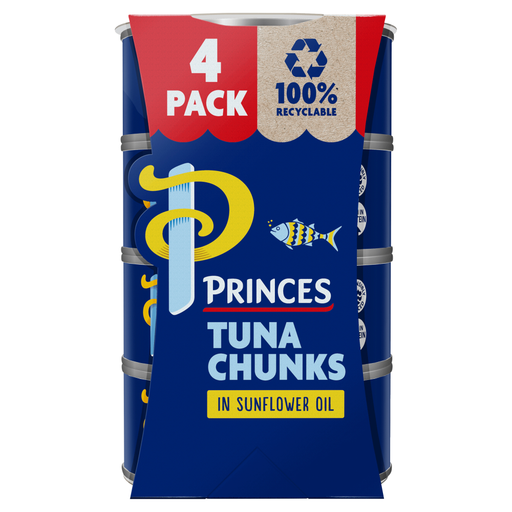 Image unavailable
This four-can pack offers separate portions when meals are spread across the trip. Its tuna is packed in sunflower oil; check that the medium suits your planned dish, along with the fish-allergen information and can-opening method. Refrigerate any leftovers as the pack directs.
 Image unavailable
Four separate 125g cans may suit smaller planned portions; they are not the same can size as a 4 x 145g pack. Check the pack for draining and opening instructions rather than assuming this product is no-drain. Refrigerate leftovers according to its label.
 Image unavailable
The explicitly labelled no-drain format suits quick meals when dealing with packing liquid is inconvenient. This pack contains three 100g cans, so check that it covers the meals you have planned. Read the fish-allergen and opening information on the pack.
Follow the individual pack's storage instructions and best-before date. Marks & Spencer, for example, says to store its tuna chunks in a cool, dry place; an opened tin has different storage requirements.
Follow that product's label. Marks & Spencer instructs shoppers to transfer unused tuna to a non-metallic container, refrigerate it and eat it within 2 days. If you cannot reliably refrigerate leftovers, plan to finish each can when you open it.
Yes. GOV.UK identifies fish as an allergen that food businesses must declare when it is an ingredient. Check each pack's current ingredients and allergen information, especially when preparing food for a group.
Yes. The NHS advises people who are pregnant or trying for a baby not to eat more than four cans of tuna or two tuna steaks a week. Include festival meals when considering tuna eaten during the rest of that week.
Choose a large tin when the group expects to use its full contents in one meal. Marks & Spencer lists 640g and 800g tuna formats, but any leftovers must be handled according to the particular product's refrigerated-storage instructions.