What to check when buying
For plain tinned tuna in a single meal, confirm the sugar value first, then choose a workable portion and compare the other label details that matter to you.
| Concern | Buying check | Who this matters to |
|---|
| Sugars |
Read “of which sugars” on the exact tin, per 100g and, where stated, per drained portion. Do not extend plain-tuna values to dressed or flavoured products. |
I want to know whether the tuna for my meal has the sugar value I am looking for, rather than relying on a phrase on the pack. About 36% of consumers put that confirmation first. |
| Portion and leftovers |
Check stated servings, drained weight and storage instructions; consider whether a no-drain format would be useful. |
If I will not finish a tin, I need a plan for the rest rather than assuming one can means one serving. Finishing or storing a practical portion comes first for about 29% of consumers. |
| Salt and energy |
Compare salt, energy and fat per 100g on the same drained or as-sold basis, then consider the amount you will use. |
Once I have checked sugars, the packing liquid's effect on my meal's label values matters more to me. Roughly 21% of consumers make salt or energy their primary buying concern. |
| Suitability and safety |
Check the fish allergen declaration and any bone warning. If pregnant or trying for a baby, account for total weekly tuna consumption under NHS guidance. |
I need to establish whether tuna is suitable for me before choosing a tin by its nutrition panel. About 14% of consumers put allergy, bone warnings or pregnancy-related guidance first. |
Brands to consider
These examples help you compare named product lines; their label values should not be assumed to apply to every tuna product from the same brand.
John West
Its No Drain Tuna Chunks in Spring Water format is relevant when avoiding the draining step matters for a quick meal.
- John West lists 0g sugars and 27g protein per 100g for the named no-drain spring-water product.
- Check the particular pack's serving information; the no-drain format does not establish that all John West tuna has the same nutrition.
Princes
Its plain brine chunks and Sandwich Tuna in Spring Water give shoppers two named formats to compare.
- Princes Food & Drinks lists 0.0g sugars per 100g drained for both cited products.
- Their listed salt values differ: 0.90g per 100g drained for brine chunks and 0.85g for Sandwich Tuna in Spring Water.
Tesco
Its 145g brine and sunflower-oil chunks provide a direct comparison between two named own-brand products.
- Tesco Groceries lists 0g sugars per 100g drained for both.
- Per 100g drained, oil lists 159kcal and 6.4g fat against brine's 109kcal and 1.0g fat; brine lists 1.00g salt against oil's 0.90g.
Sainsbury's
Its 145g spring-water chunks illustrate why a tin's serving count matters to a single-meal plan.
- Sainsbury's lists less than 0.5g sugars and 0.12g salt per 100g drained for this product.
- The pack states two servings, so check whether you would use both at once or store some for another meal.
Asda
Its spring-water four-pack is relevant if you prefer separate tins for several meals.
- Asda Groceries lists less than 0.5g sugars and 0.90g salt per 100g drained for its 4 × 145g product.
- A multipack does not establish that each can is the portion you want; check its serving information.
M&S
Its 160g Tuna Chunks in Spring Water is another named plain-tuna option for label comparison.
- Marks & Spencer lists 0.0g sugars and 0.75g salt per 100g for this product.
- Its product information warns that bones may remain and says to refrigerate unused contents and eat them within two days.
Joybuy tuna selections
These plain spring-water and sunflower-oil selections include no-drain packs, separate cans in multipacks and a single tin. Choose by the format you would use for a meal, then check the exact pack's nutrition and serving information.
 No image available
John West No Drain Tuna Chunks in Springwater, 3 × 100g
Consider this when you want separate 100g cans and do not want to drain the tuna. Check the current pack's sugars, serving information and opened-pack instructions before treating a can as one meal.
View on Joybuy
 No image available
John West Tuna Chunks in Springwater, 4 × 125g
The four separate cans may suit meals planned across several days. Check the stated servings and drained weight if you need to know whether one 125g can matches your intended portion.
View on Joybuy
 No image available
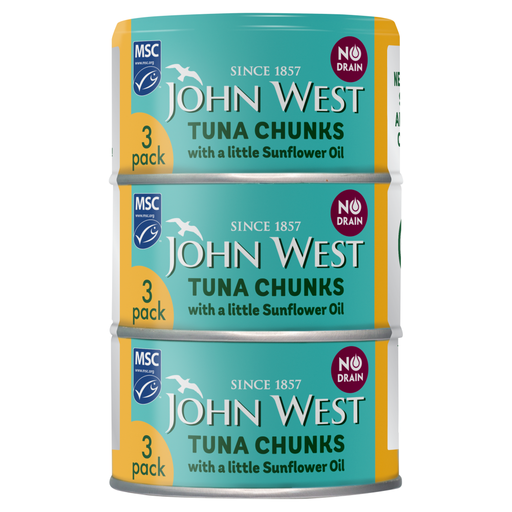
John West No Drain Tuna Chunks in Sunflower Oil, 3 × 100g
This is an oil-packed no-drain choice in separate 100g cans. If energy and fat matter to your choice, compare its current nutrition panel with a spring-water or brine product on the same basis; no-drain describes handling, not its sugar value.
View on Joybuy
 No image available
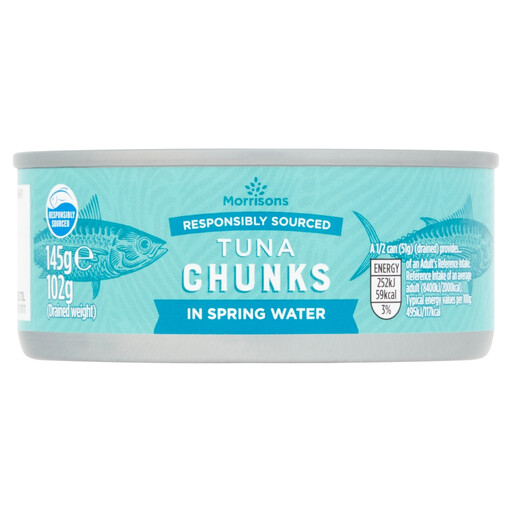
Morrisons Fad Free Tuna Chunks in Spring Water, 145g
Consider the single tin if you do not want a multipack. Its 145g pack size alone does not establish a one-person serving, so check the portion and drained-weight information for your meal.
View on Joybuy
 No image available
Morrisons Fad Free Tuna Chunks in Spring Water, 145g (6-pack)
The listing identifies a six-pack for planning several meals. Confirm the quantity in each can and the stated servings before relying on the 145g wording to plan individual portions.
View on Joybuy
Questions about tinned tuna
Is “reduced sugar” useful when choosing plain tinned tuna?
Not usually as the only deciding detail. The cited plain spring-water, brine and sunflower-oil products list 0g or less than 0.5g sugars per 100g. Check the exact product's “of which sugars” line, particularly if it is dressed or flavoured, then compare its portion and other label values.
Should I choose spring water, brine or oil for one meal?
Choose by the exact product's label values and the packing liquid you want, not by assuming one has less sugar. Tesco Groceries lists 0g sugars for both its brine and sunflower-oil chunks, while its oil product has more energy and fat per 100g drained. Compare salt too: the brine product lists 1.00g per 100g drained against 0.90g for oil.
Can I keep half a tin for another meal?
Follow the storage directions on that tin. The cited retailer product information instructs shoppers to transfer unused tuna to a suitable container, refrigerate it and use it within the product's stated period, which varies between one and two days in the cited examples.
Is tinned tuna suitable if I have a fish allergy?
No. The Food Standards Agency identifies fish as an allergen, and tuna is fish. Avoid tuna if you have a fish allergy, and check the current pack's allergen information.
How much tuna does the NHS advise during pregnancy?
For people who are pregnant or trying for a baby, the NHS advises no more than four cans of tuna or two tuna steaks a week. That guidance concerns total tuna consumption; a lower sugar value does not change it.


