Post-ride meal planners
Cyclists assembling a meal after a longer or harder ride can use tuna as one ingredient and add a carbohydrate food. British Cycling describes its tuna macaroni cheese as a meal for before a big ride or after riding.


For a meal around a substantial ride, use tinned tuna as a protein ingredient alongside a carbohydrate food such as pasta, rice, potatoes, bread or wraps, rather than relying on a tin alone. Standard spring-water tins suit meals you can prepare at home; no-drain portions remove a preparation step, while oil-packed tuna is an option when the oil suits your recipe. Check the exact pack’s label and usable quantity before choosing.
Cyclists assembling a meal after a longer or harder ride can use tuna as one ingredient and add a carbohydrate food. British Cycling describes its tuna macaroni cheese as a meal for before a big ride or after riding.
When preparing food after a commute or at work, a no-drain portion removes the draining step. John West offers this format in its tuna range.
For several planned meals, the amount of tuna available after draining matters more than the net weight alone. Tesco, for example, lists a 400g spring-water tin with a 280g drained weight.
Decide how the tuna will fit into the meal, then choose a format and portion size that suit where you will prepare it.
| Concern | What to check | Who this matters to |
|---|---|---|
| Building a ride-related meal | Read the nutrition panel for the exact tin and plan a carbohydrate food alongside it. | If I am making a meal before a big ride or afterwards, I need more than a tin of tuna on its own. About 31% of consumers put meal composition first. |
| Quick preparation | Check whether the pack is no-drain and whether its portion size fits the meal. | After commuting or when preparing food at work, I may want to skip draining a tin. Preparation convenience is the primary need for about 25% of consumers. |
| Usable portions | Compare drained weight, can count and whether opened leftovers will be needed. | When I am planning several meals at home, I want to know how much usable tuna each pack provides. About 25% of consumers prioritise portion planning. |
| Ingredients and dietary checks | Read the fish allergen declaration and salt value on the exact pack; check relevant NHS guidance on tuna frequency during pregnancy. | If an allergen, salt intake or pregnancy guidance affects my choice, I need to assess the label before making tuna a regular ingredient. These checks come first for about 19% of consumers. |
The Princes and Tesco spring-water examples list little or no carbohydrate. British Cycling’s tuna macaroni cheese instead combines tuna with pasta for a meal before a big ride or after riding.
Keep a carbohydrate food such as pasta, rice, potatoes, bread or wraps available when planning a ride-related meal.
Liquid is included in a tin’s net weight. Tesco lists its 400g spring-water tin at 280g drained, which changes how much tuna is available for the meal.
Check drained weight where applicable and choose a can size that fits the number of portions you plan to make.
Tuna is fish, and salt values differ between the cited spring-water products. For people who are pregnant, NHS guidance also limits how often tuna should be eaten.
Check the current ingredient, allergen and nutrition information. If pregnant, follow the NHS limit of no more than four cans of tuna or two tuna steaks a week.
The storage directions on Tesco’s cited 400g product call for unused contents to be moved to a covered, non-metallic container and refrigerated.
Follow the exact pack’s storage directions; the Tesco product says to use refrigerated leftovers within two days.
John West offers No Drain Tuna Chunks in Spring Water in a 3 x 100g format.
Princes lists tuna chunks in spring water, brine and sunflower oil, as well as drained-tuna formats.
Tesco’s own-label spring-water chunks include a 400g net tin with a 280g drained weight.
Sainsbury's lists own-label spring-water tuna chunks in single-can and multipack formats.
Asda lists spring-water tuna chunks in a 3 x 80g small-can format.
M&S offers spring-water tuna chunks and tuna steaks in its tinned-fish range.
These packs cover no-drain portions, spring-water multipacks and tuna in sunflower oil for cupboard meals. Choose the format that fits your preparation routine and recipe, then add a carbohydrate food when making a meal around a substantial ride.
 Image unavailable
A no-drain choice when you want to assemble a quick meal after a commute or away from home.
The pack contains three 100g cans. Add a carbohydrate food for a ride-related meal, and check the label for the portion’s nutrition and storage directions.
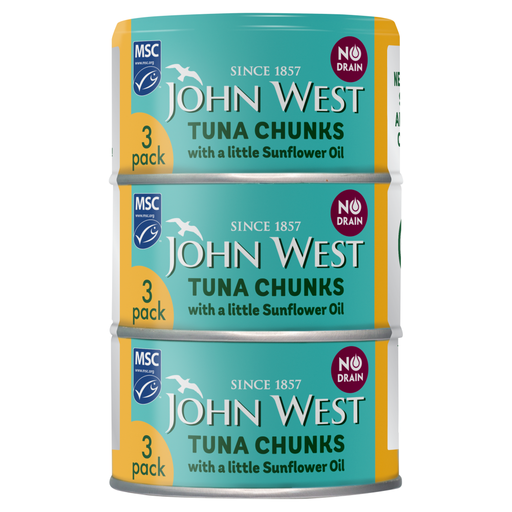 Image unavailable
This no-drain option suits a quick meal when sunflower oil also fits the recipe.
The pack contains three 100g cans. Check its nutrition panel if the oil matters to your meal, and plan a carbohydrate accompaniment separately.
 Image unavailable
A six-can spring-water pack suits plans for several cupboard meals at home.
Each can is labelled 145g net. Check its drained weight when planning portions, and combine the tuna with a carbohydrate food for a ride-related meal.
 Image unavailable
This four-can spring-water pack is an option for preparing several meals.
Each can is labelled 125g net. Check this pack’s draining instructions and drained weight before planning portions; do not assume it uses the John West No Drain format.
 Image unavailable
Choose this sunflower-oil format when the oil suits the dish you are preparing.
The pack contains four 145g cans. Check the drained weight for portion planning and add a carbohydrate food if making a ride-related meal.
Not if you are planning a meal that also needs a carbohydrate component. The cited Princes and Tesco spring-water products list little or no carbohydrate; British Cycling presents tuna with pasta as a meal for after riding or before a big ride.
Choose by how the packing medium fits your recipe, then compare the exact products’ ingredient and nutrition panels. Princes lists all three formats, but the medium alone does not tell you the salt value or usable portion of every tin.
Follow the directions on your pack. Tesco’s cited 400g spring-water tuna instructs consumers to transfer unused contents to a covered, non-metallic container, refrigerate them and use them within two days.
The NHS advises people who are pregnant to eat no more than four cans of tuna or two tuna steaks a week. That limit still matters when tuna is being used as an ingredient in cycling meals.
Yes. In its November 2024 explanation, the Food Standards Agency states that Great Britain has a maximum mercury level of 1.0 mg/kg for tuna and certain other fish species. That product limit does not replace the NHS guidance on tuna consumption during pregnancy.