People making lunch at a desk
If you use tuna in a sandwich, salad or jacket potato, the practical question is whether you can drain a conventional tin where you eat or would rather open a no-drain one.


Choose a conventional four-can pack if several people need lunch tins and draining each can is practical. A John West No Drain 3 x 100g pack is an alternative when there is nowhere convenient to deal with liquid at your desk, though it supplies fewer, smaller cans. Compare can size, drained weight, ingredients and the exact pack’s storage instructions before deciding.
If you use tuna in a sandwich, salad or jacket potato, the practical question is whether you can drain a conventional tin where you eat or would rather open a no-drain one.
Several separate tins can be useful across the working week. Check both the number of cans and their individual size: the cited retailer ranges include 4 x 145g and 4 x 160g packs.
If certification or catch method affects your choice, look for the claim on the exact product rather than assuming it applies to every tuna pack from a brand or retailer.
Choose when: several household members want separate lunch tins and draining a can is practical.
Bear in mind: a desk without a sink or suitable liquid disposal makes preparation less straightforward.
Choose when: opening tuna at your desk without draining it matters more than having four cans.
Bear in mind: the cited John West format has three 100g cans, so check whether it supplies enough lunches.
Choose when: a larger individual can suits a shared meal as well as a desk lunch.
Bear in mind: if you do not use a whole can, follow its instructions for transferring and storing the remainder.
| Priority | What to check | Your needs |
|---|---|---|
| Desk preparation | Check whether the exact variant says No Drain. For a conventional tin, consider where you will drain it and dispose of the liquid. | I eat at a desk and want to open a tin without managing packing liquid. |
| Pack and can size | Compare the can count, grams per can and drained weight. Cited formats include John West No Drain 3 x 100g and retailer four-packs of 145g or 160g cans. | Several of us use the cupboard stock, but I also want each can to suit the meal I am making. |
| Liquid and label | Read the ingredients and nutrition panel for the exact spring-water, brine or oil variant. Compare protein or salt figures only when their per-100g measurement bases match. | I want to know what is packed with the tuna, rather than assuming tins from the same range have identical ingredients. |
| Fish sourcing | Check the particular pack for an MSC claim or a stated catch method. A claim on one retailer product does not establish the sourcing of another. | Certification or catch-method information matters to me, so I want to check the tin I am buying. |
| Leftovers | Read the opened-can storage directions, especially if a larger tin may not be used at once. The cited Sainsbury's and M&S products give different use-within periods. | I may use only part of a can for lunch and need to plan what to do with the rest. |
Three 100g cans, four 145g cans and four 160g cans provide different numbers and sizes of individual tins. Total net weight also includes packing liquid.
Check can count, size per can and drained weight when deciding how many lunches a pack will cover.
Packing liquid needs somewhere to go when you open and drain a conventional spring-water or brine tin.
If that is awkward where you eat, check that the exact product is labelled No Drain rather than relying on the brand name alone.
Sainsbury's and Asda make claims about particular tuna products; these do not establish the certification or catch method of every pack they sell.
Check the current claim and any certification mark on the exact listing and physical pack.
Opened-can instructions differ by product. Sainsbury's cited four-pack says to refrigerate transferred leftovers and use them within one day; the cited M&S pack gives two days.
Transfer any remainder to a non-metallic container and follow the storage period on your pack.
John West has a No Drain spring-water three-pack as well as conventional tuna multipacks.
Tesco lists Princes tuna chunks in a 4 x 145g spring-water format.
Tesco lists own-brand 4 x 145g tuna-chunk packs in spring water, brine and sunflower oil.
Sainsbury's lists a 4 x 145g spring-water pack with a product-specific statement about fisheries certified to the Marine Stewardship Council standard.
Asda lists 4 x 145g own-brand tuna chunks in spring water and in brine.
The cited M&S spring-water four-pack totals 640g, with 160g per can.
These options cover a No Drain three-pack and conventional four- or six-can packs for stocking lunch tins. Check the exact variant if preparation without draining is essential.
 Image unavailable
The No Drain format suits a desk where dealing with packing liquid is awkward. Three 100g cans offer fewer separate lunches than a four- or six-can pack; check the quantity against your household plans.
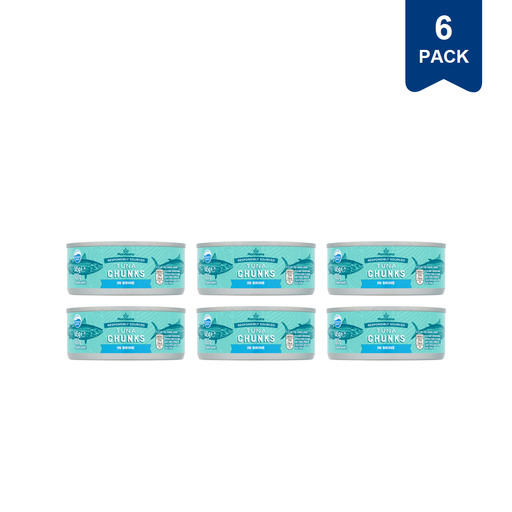 Image unavailable
Six brine-packed cans provide separate tins for household lunches. If you will open one at a desk, plan how to handle the liquid; check the pack’s drained weight when comparing quantities.
 Image unavailable
This six-can spring-water format suits a household using separate tins over several lunches. Check the drained weight for quantity comparisons and make sure you can manage the liquid where you prepare lunch.
 Image unavailable
Four 125g cans give you separate portions for lunch planning. The Joybuy product listing identifies tuna, spring water and salt; check the exact variant before relying on No Drain preparation.
 Image unavailable
This four-can pack offers a sunflower-oil option for household lunches. If comparing its nutrition panel with spring-water or brine tuna, check that the figures use the same per-100g basis.
No. A conventional four-pack suits a household wanting several separate tins when draining is practical. If you cannot conveniently deal with liquid at work, the John West No Drain 3 x 100g format is another option, provided three smaller cans meet your needs.
Drained weight excludes the packing liquid, while total net weight includes it. Check the labelled drained quantity alongside can count and size when comparing how much tuna different packs provide.
Do not assume they have identical ingredients or nutrition. Asda’s cited brine pack lists tuna, water and salt, while its spring-water pack lists tuna and spring water; read the exact variant’s label before choosing.
Follow the instructions on that pack. The cited Sainsbury's 4 x 145g product says to transfer leftovers to a non-metallic container, refrigerate them and use them within one day; the cited M&S product gives a two-day period.
Tuna is fish, so these tuna products are not suitable for someone with a fish allergy. Check the ingredients and allergen information on the exact physical pack each time.