For an office packed lunch, choose tuna whose individual pack carries the blue Marine Stewardship Council (MSC) ecolabel or whose product page explicitly confirms MSC-certified fishery sourcing, rather than relying on a general brand or retailer policy. A no-drain or ready-to-eat tin helps when you cannot dispose of packing liquid at work; plain chunks in spring water or brine suit lunches prepared in advance, provided you check the exact pack’s ingredients, salt, allergens and storage instructions.
Who is each format for?
Shoppers checking sustainability claims
If certified sourcing is your priority, look for the MSC ecolabel or an explicit certification statement for the particular tuna product. A company-wide sourcing policy does not identify the label on every pack.
Workers without a sink
A no-drain pack or a single tin described as ready to eat lets you add tuna to a salad, wrap or crackers without finding somewhere to discard packing liquid.
People preparing lunches at home
Plain chunks in spring water or brine can be portioned into sandwiches or salads before work. Compare the liquid, ingredients and serving size, and follow the pack’s instructions for any leftovers.
What should you check before buying?
Start with the sourcing claim on the exact product, then choose a format that works where you will prepare and eat lunch.
| Priority | What to check | Your needs |
|---|
| Certified sourcing | Look for the blue MSC ecolabel or an explicit statement that the product’s tuna comes from an MSC-certified fishery. Treat a pole-and-line claim as separate information about fishing method. | I want a sustainability claim I can connect to the tin I am buying, not just to the brand. |
| Desk preparation | Check whether the pack says no-drain or ready to eat, and whether its serving size suits one lunch. For liquid-packed tuna, plan where to drain it. | There is no convenient sink where I eat, so I want to add the tuna directly to my lunch. |
| Recipe and ingredients | Compare spring water, brine, oil and flavoured recipes using the exact ingredient and nutrition labels. Check salt per 100g and the allergen declaration. | For a plain sandwich filling, I may prefer chunks without added flavourings; for a flavoured tin, I need to check every ingredient. |
| Leftovers | Read the after-opening storage instructions and check whether you will have access to a fridge. A single-serve tin avoids planning around unused contents. | If I open a larger tin for one lunch, I need a way to store what remains as the pack directs. |
Common buying mistakes
-
Assuming a sourcing policy certifies every tin
Brand and retailer statements can help narrow the choice, but they do not replace the certification details of an individual product.
Check the can for the blue MSC ecolabel or read an explicit product-specific certification statement.
-
Taking a liquid-packed multipack to a desk without a plan
Spring water or brine needs somewhere suitable to go if the tin must be drained.
Choose an explicitly no-drain or ready-to-eat pack, or prepare the lunch at home.
-
Expecting plain and flavoured tuna to have the same ingredients
Recipes and packing liquids differ. Sainsbury’s Dill & Pickle tuna, for example, contains mustard as well as fish.
Read the exact pack’s ingredients, allergen declaration and salt information rather than relying on the word “tuna”.
-
Leaving opened tuna in the can for another lunch
Unused contents need the storage conditions stated for that product; M&S instructs shoppers to refrigerate its spring-water tuna and eat it within two days of opening.
Follow your pack’s instructions for transferring and storing leftovers, or choose a serving you can finish.
Brand and retailer references
Sainsbury’s
Its Dill & Pickle Tuna is an example of a small, flavoured tin with a product-specific sourcing statement.
- Sainsbury’s describes the 80g skipjack tuna as pole-and-line caught, sourced from an MSC-certified fishery and ready to eat without draining.
- It contains mustard and other added ingredients, so check the label if you want plain tuna or need to avoid an ingredient.
John West
Its MSC-labelled No Drain Tuna Chunks in Brine offer a format for lunches assembled away from a sink.
- John West describes the 3 x 100g pack as ready to eat without draining.
- Check the brine pack’s own salt and ingredient information rather than assuming it matches a spring-water version.
Princes
Princes offers conventional tuna chunk multipacks and states that it has completed its commitment to MSC certification for its tuna.
- Its statement describes third-party auditing of fisheries seeking MSC certification.
- Check the individual multipack for its current label, packing liquid and portion size; a brand statement does not describe every detail of a particular can.
M&S
Its Tuna Chunks in Spring Water suit shoppers looking for plain tuna with a stated fishing method.
- M&S describes this product as pole-and-line caught under its Forever Fish sourcing policy.
- Check the can if an MSC ecolabel is essential to your choice. M&S says to refrigerate leftovers and eat them within two days of opening.
Tesco
Tesco’s tuna category lists own-label packs alongside branded products, including MSC-labelled options.
- Its listing identifies a John West MSC-labelled no-drain spring-water multipack.
- A label shown for one listed product does not establish the certification of another Tesco or branded tuna pack.
Asda
Asda publishes a seafood-sourcing policy that shoppers can consider alongside individual product labels.
- Asda says it aims to source wild-caught fish from MSC-certified fisheries or qualifying improvement projects.
- That policy does not confirm MSC certification for a particular tinned tuna product; check its own pack.
Princes tuna multipacks on Joybuy
These Princes multipacks are options for tuna lunches prepared in advance. They differ in packing liquid and quantity; if MSC certification is essential to your choice, check the label on the exact pack.
 No image available
Princes Tuna Chunks in Brine, 4 x 145g
The four-can brine pack is an option when preparing sandwiches or salads before work. If you will open it at your desk, plan how to handle the packing liquid; check the exact pack for MSC labelling.
 No image available
Princes Tuna Chunks in Sunflower Oil, 4 x 145g
For lunches prepared in advance, this four-can pack contains tuna chunks in sunflower oil. Check that the oil and ingredients suit your recipe, and check the exact pack if you require MSC certification.
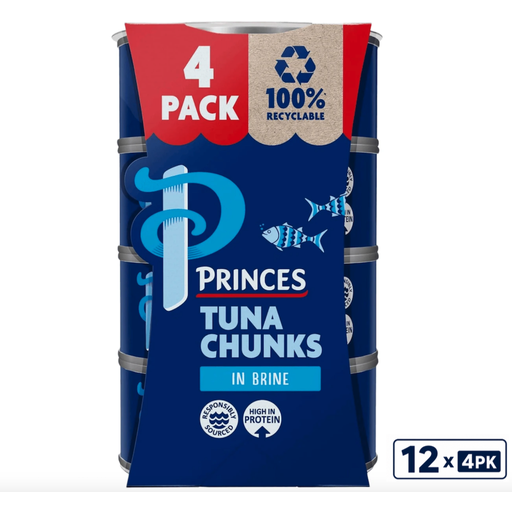 No image available
Princes Tuna Chunks in Brine, 4 x 145g x 12 packs
This brine-packed bundle contains 12 packs of four 145g cans for lunches prepared over time. Check that the quantity suits your storage space, plan for the packing liquid, and inspect the exact pack if MSC certification matters to you.
Office-lunch questions
Does pole-and-line tuna automatically have MSC certification?
No. Pole-and-line describes a fishing method; MSC certification is a separate fishery credential. If certification is your requirement, check the exact product for the blue MSC ecolabel or an explicit MSC-certified sourcing statement.
Which tuna format works at an office without a sink?
Choose a pack explicitly described as no-drain or ready to eat. John West describes its No Drain chunks as ready to enjoy, while Sainsbury’s says its 80g Dill & Pickle tin needs no draining; check the serving size and ingredients as well.
Can I keep leftover tuna for the next day?
Follow the instructions on the tin you open and make sure you can meet its refrigeration requirements. For its spring-water chunks, M&S says to refrigerate unused contents and eat them within two days of opening.
What allergens should I check in flavoured tuna?
Read the full ingredient list and highlighted allergen information on the exact pack, including additions beyond fish. Sainsbury’s Dill & Pickle tuna contains mustard; GOV.UK guidance says regulated allergens in prepacked food must be clearly identified in the ingredients list.
Does an MSC label on some supermarket tuna cover every tin?
No. The Marine Stewardship Council reported that 138 of 271 shelf-stable tuna products available in UK supermarkets in February 2026 carried its ecolabel—51% of the products in that format. That is a measure of product availability, not a certification claim for an unlabelled tin.


