If you prepare lunch at home, standard tuna chunks let you drain and portion the fish before leaving. If you need to open it at your desk without somewhere convenient to drain liquid, consider a pack explicitly labelled no-drain or already drained. Check the usable quantity, packing liquid and storage instructions on the exact product you choose.
Who is each format for?
Regular office lunch packers
If you prepare several lunches at home, a multipack of standard chunks gives you tins to drain and portion before work. Check the drained quantity per tin, rather than relying on the weight printed on the front of the pack.
Desk eaters without a sink or kitchen
If you open your lunch at work, a product explicitly labelled no-drain or already drained removes the step of disposing of packing liquid. Confirm that description on the exact pack: ordinary chunks and no-drain chunks are not interchangeable.
Label-conscious tuna shoppers
Check the fish allergen declaration, salt and protein figures, and any sourcing statement on the product you intend to buy. Compare nutrition figures on the same stated basis, such as per 100g drained.
What should you check before choosing?
Start with where you will open the tin, then compare usable quantity and the label details that matter to your lunch.
| Priority |
What to check |
Your needs |
| Usable quantity |
Check the drained weight per tin as well as the pack size. Compare like-for-like chunks packed in liquid when deciding how much tuna a tin provides. |
I prepare lunches ahead and want to know how much tuna I can portion from each tin. |
| Desk-side preparation |
Look for an explicit no-drain or already-drained description on the exact product. John West describes its No Drain spring-water chunks as ready to use; M&S describes its spring-water tuna steak as already drained. |
There is nowhere convenient to drain a tin when I open lunch at work. |
| Nutrition label |
Compare protein and salt on the same per-100g basis. The checked drained chunk labels list 0.90g salt for Tesco, 0.12g for Sainsbury's and 0.85g for Princes per 100g drained, according to their retailer listings. |
For a lunch I eat regularly, I want to compare the figures on each pack without mixing drained and other nutrition bases. |
| Sourcing statements |
Check which claim appears on the exact pack and what it covers. Sainsbury's describes its checked spring-water chunks as pole-and-line caught; M&S makes that claim for its checked chunks. |
I want to consider the product's stated catch method alongside its format and label. |
| Leftovers |
Read the exact tin's instructions for transferring and refrigerating leftovers. Tesco says to use leftovers from its checked chunks within 2 days; Sainsbury's specifies 1 day for its checked product. |
If I use only part of a tin, I need to know how to store the remainder. |
Common buying mistakes
-
Using net tin weight as the amount of tuna
A tin packed in liquid has a separate drained weight. Net and drained weights answer different questions about how much fish you can put into lunch.
Check the stated drained weight per tin when comparing similar chunks packed in liquid.
-
Choosing no-drain packaging for a lunch prepared at home
No-drain packaging removes a step when you open the pack, but that step may not matter if you can drain and portion standard chunks in your kitchen.
Decide where you will open the pack before choosing between standard, no-drain and already-drained formats.
-
Assuming spring-water chunks have similar salt figures
The checked retailer labels differ: Sainsbury's lists 0.12g, Princes 0.85g and Tesco 0.90g salt per 100g drained for their respective spring-water chunks.
If salt is a deciding label detail, compare the current packs on the same per-100g drained basis.
-
Using one leftovers rule for every tin
Storage instructions differ between the checked products. Tesco specifies 2 days for refrigerated leftovers from its chunks, while Sainsbury's specifies 1 day for its product.
Transfer leftovers to a suitable non-metallic container, refrigerate them and follow the instructions on the exact pack.
Brand and product-line references
These examples describe particular products and formats; a brand name alone does not establish the details of another tin.
Tesco
Tesco's checked own-label 4 x 145g spring-water chunks are a standard format for lunches prepared at home.
- Tesco Groceries lists 24.9g protein and 0.90g salt per 100g drained for this pack.
- The chunks need draining; Tesco instructs users to refrigerate leftovers in a non-metallic container and consume them within 2 days.
Sainsbury's
Sainsbury's checked own-label 4 x 145g spring-water chunks are another standard multipack for preparing lunch before work.
- Its product listing states pole-and-line catch and lists 26.1g protein and 0.12g salt per 100g drained.
- Sainsbury's says to refrigerate leftovers in a non-metallic container and use them within 1 day.
Princes
Princes lists conventional spring-water tuna chunks in several pack sizes, including 145g singles and multipacks.
- Tesco Groceries lists 23.5g protein and 0.85g salt per 100g drained for the checked Princes 4 x 145g spring-water pack.
- Check the exact variant: spring-water chunks and chunks packed in brine have different packing liquids.
John West
John West's No Drain spring-water chunks address the preparation step for tuna opened at a desk.
- John West describes its checked No Drain product as ready to use with a twist-and-pull Smartstrip opening.
- That description applies to the specified No Drain product, not every John West tuna-chunks pack.
M&S
M&S lists both spring-water chunks and an already-drained spring-water tuna steak; choose between them by the format you want to use.
- M&S describes its checked chunks as pole-and-line caught and its checked tuna steak as already drained.
- A tuna steak is a different format from loose chunks, so check its usable quantity and texture for the lunch you plan to make.
Tinned tuna options on Joybuy
These options include no-drain chunks for opening at work and conventional chunks in spring water or brine for lunches prepared ahead. Check the exact pack before treating a standard chunks product as no-drain.
 No image available
John West No Drain Tuna Chunks in Springwater 3 x 100g
The no-drain format suits a lunch opened where draining liquid is inconvenient. This is a 3 x 100g spring-water pack; check the pack label if you need to compare usable quantity or nutrition with drained chunks.
View on Joybuy
 No image available
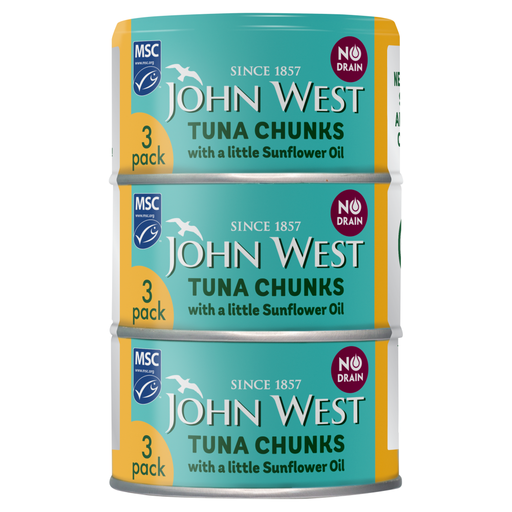
John West No Drain Tuna Chunks in Sunflower Oil 3 x 100g
This no-drain 3 x 100g pack is an option for opening tuna at your desk. It is packed in sunflower oil rather than spring water, so check the exact label if the packing liquid or nutrition basis matters to your choice.
View on Joybuy
 No image available
Morrisons Fad Free Tuna Chunks in Spring Water 6 x 145g
Six spring-water tins suit lunches prepared across several days. Check the drained quantity per tin when planning portions, and confirm the exact pack's opening format if you intend to eat it at your desk.
View on Joybuy
 No image available
John West Tuna Chunks in Springwater 4 x 125g
This four-tin spring-water pack is an option for preparing more than one lunch. Its title does not identify it as a No Drain variant; check the exact pack if opening it without draining is important.
View on Joybuy
 No image available
Princes Tuna Chunks in Brine 4 x 145g
This four-can pack can be portioned for lunches prepared ahead. It contains chunks in brine, and the product information instructs you to drain them before use; check the drained quantity when planning each lunch.
View on Joybuy
Questions about desk-lunch tuna
What quantity should I compare between ordinary tins?
Compare the stated drained weight when you want to know how much tuna you can put into lunch. Also check the quantity per tin: a multipack's total net weight includes the packing liquid in conventional spring-water or brine tins.
When is no-drain tuna useful?
No-drain tuna is useful when you will open the pack without a convenient place to dispose of liquid. John West describes its specific No Drain spring-water chunks as ready to use; check that wording on the pack rather than assuming it applies to all of the brand's chunks.
How should I keep tuna left over from an opened tin?
Follow the exact product's storage instructions. Tesco says to transfer leftovers from its checked chunks to a non-metallic container, refrigerate and consume them within 2 days; Sainsbury's specifies use within 1 day for its checked product.
What should I check on the allergen label?
The checked plain-tuna products declare fish as an allergen. Check the current pack's full label for the product you choose; M&S also states that its checked chunks and tuna steak may contain bones.


