Sandwich and wrap packers
If tuna is going into a filling, think about how easily the pieces will mix with your other ingredients. Chunks offer flexibility across lunches; a finer chunks-and-flakes texture may suit a spreadable filling.


For sandwiches and mixed salads, start by comparing tuna chunks in spring water using the cost per drained weight, not the shelf price or number of tins alone. A no-drain format is worth considering when you assemble lunch without a sink; choose the texture that suits the meal, then check the exact pack for its drained weight, salt and storage instructions.
If tuna is going into a filling, think about how easily the pieces will mix with your other ingredients. Chunks offer flexibility across lunches; a finer chunks-and-flakes texture may suit a spreadable filling.
When there is nowhere convenient to drain a tin, a no-drain or pre-drained format lets you add tuna directly to a wrap, salad or pot. Check the pack size as well as the convenience claim.
A multipack or a lower shelf price does not, by itself, tell you how much tuna you get. Compare the drained-weight unit cost for similar formats, then check whether each portion fits the lunches you plan to make.
Decide how you will prepare lunch first, then compare like-for-like packs by drained weight and the details on their labels.
| Priority | What to check | Your needs |
|---|---|---|
| Edible amount | Compare the displayed unit cost per drained weight for similar formats. Tesco lists some tuna on a per-kilogram drained-weight basis; check the individual portion as well as the multipack total. | I make tuna lunches regularly and want to compare the amount I can use, rather than judging by tin count alone. |
| Desk preparation | Look for an explicit no-drain or ready-to-use description. Check the packing liquid and portion size on the exact product. | If I assemble lunch without a sink, I want to add the tuna straight to a salad or wrap. |
| Texture | Choose between chunks, a finer chunks-and-flakes format and steak pieces according to the meal. Check the product description rather than assuming all tins contain the same size of pieces. | For a sandwich filling, I may want tuna that mixes easily; for a salad, I may prefer more distinct pieces. |
| Label values | Compare salt and other nutrition information on the same stated basis, such as per 100g drained. Check whether the tuna is packed in spring water, oil or brine. | I want the label and packing liquid to fit the lunch I am making, without assuming that similar-looking tins have identical values. |
| Sourcing | If sourcing matters to you, check for an MSC ecolabel or a product-specific sourcing statement on the exact pack. A sourcing label does not replace a drained-weight or nutrition comparison. | I want a sourcing claim I can check on the product I buy, rather than relying on the brand name alone. |
| Leftovers | Read the pack’s instructions for transferring, refrigerating and using opened tuna. Check whether a smaller portion would leave less unused after lunch. | I do not always use a whole tin at once, so storage instructions and portion size affect which pack is practical. |
Packs can contain different amounts of tuna once drained. Tesco’s drained-weight unit pricing gives a basis for comparing conventional tins of different sizes.
Compare similar products by their displayed drained-weight unit cost, then decide whether a convenience format meets a preparation need that matters to you.
Spring-water, oil and brine describe how tuna is packed; they do not establish that different products have identical salt or other label values.
Read the exact pack and compare values on the same stated basis, particularly when switching between conventional and no-drain formats.
A finer mixture may suit a filling, while more distinct pieces may matter in a salad. Paying for a particular format has little practical value if you will break up the pieces anyway.
Choose the format for the lunch you actually prepare; check for an explicit no-drain description if preparation at work is the deciding factor.
Opened-tin instructions can differ between products. For people who are pregnant or trying for a baby, the NHS also advises no more than four cans of tuna or two tuna steaks a week.
Follow the storage directions on your pack. If the NHS guidance applies to you, account for tuna across your weekly meals rather than considering an office lunch in isolation.
These ranges illustrate formats and label checks; a brand’s inclusion here does not mean every product in its range has the same features.
Princes offers conventional spring-water chunks and a drained, ready-to-use format, giving office-lunch buyers different preparation options.
John West provides a no-drain spring-water option for lunch assembled without draining, as well as conventional spring-water chunks in a four-pack.
Tesco’s grocery range provides a reference for comparing conventional spring-water chunks in different pack sizes.
A smaller-portion own-label format is relevant when one tin is intended for one packed lunch.
M&S product information offers a way to check sourcing details and opened-tin instructions on a specific spring-water tuna product.
These packs cover no-drain tuna for desk assembly and chunks in spring water or brine for lunches where draining is manageable. Compare their exact pack details before deciding which suits your routine.
 No image available
The no-drain format suits a lunch assembled without somewhere to tip away liquid. This pack contains three 100g tins; check the drained-weight information on the exact pack when comparing edible amounts.
 No image available
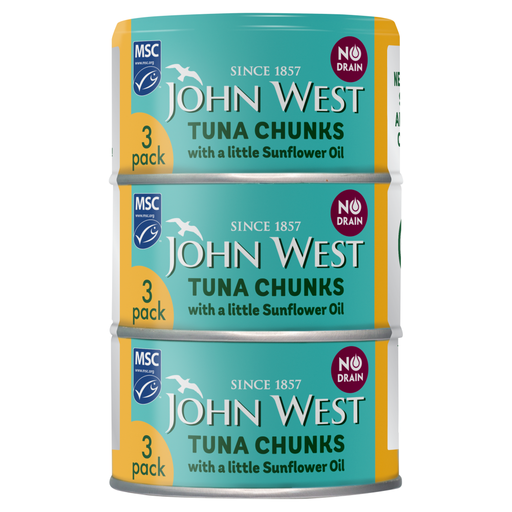
This no-drain option suits desk assembly if tuna packed in sunflower oil fits your lunch. The pack contains three 100g tins; check the label before comparing it with spring-water products.
 No image available
Spring-water chunks offer a format for sandwiches or salads when draining is manageable. This pack contains four 125g tins; check the exact pack if you need tuna that can be used without draining.
 No image available
The six-pack suits a routine of repeated tuna lunches if you expect to use that many tins. Each tin is labelled 145g; compare drained weight and consider how often you will open one.
 No image available
These chunks are an option for sandwiches or salads when brine suits the meal and draining is manageable. The pack contains four 145g tins; check the exact label if packing liquid or salt matters to your choice.
Compare similar formats using the displayed unit cost per drained weight, then check how much drained tuna each portion provides. Tesco displays drained-weight unit pricing for tuna; tin count alone does not account for differences in size or packing liquid.
Chunks are flexible for sandwiches and mixed salads; a finer texture may mix more easily into a filling, while distinct pieces may matter more in a salad. If you assemble lunch without a place to drain the tin, look for an explicit no-drain or ready-to-use format.
Follow the instructions on the exact pack. For its cited spring-water chunks, M&S says to transfer unused contents to a non-metallic container, refrigerate them and eat them within two days; other products may give different instructions.
Yes. The NHS advises people who are pregnant or trying for a baby to have no more than four cans of tuna or two tuna steaks a week. The Food Standards Agency explains that the can used in this guidance is a medium can with around 140g drained weight, so check portion sizes rather than treating every format as identical.
No. An MSC ecolabel is a sourcing credential, not a measure of drained-weight value or nutrition. Check for it on the exact pack if sourcing matters to you, and compare the pack’s format and label details separately.