Quick meal planners
If the main fish and chips meal is already being prepared, tinned tuna can be kept for a sandwich, jacket-potato filling or cold side that needs little preparation.


For a fish and chips night, choose tuna chunks in spring water if you want a plain base for a filling or side, or chunks in brine if you want the packing liquid to contribute seasoning. Oil-packed tuna offers a different preparation option, while a no-drain format reduces liquid handling; whichever you choose, check the drained weight and the nutrition label for the exact tin.
If the main fish and chips meal is already being prepared, tinned tuna can be kept for a sandwich, jacket-potato filling or cold side that needs little preparation.
These shoppers want to check whether a tin contains spring water, brine or oil, and read its salt figure before adding sauces or other accompaniments.
For these shoppers, the choice includes chunks versus larger pieces, whether the tuna needs draining, and which sourcing statement appears on the exact product.
Start with how the tuna will be used alongside the meal, then check the tin's packing liquid, usable quantity and format.
| Concern | What to check | Who this matters to |
|---|---|---|
| Packing liquid and seasoning | Read the ingredients and compare salt and other nutrition values on the same stated basis. | If I am adding tuna to a meal with chips and sauces, I want to decide how much seasoning comes from the tin itself. About 40% of consumers would make packing liquid and label values their primary concern. |
| Usable quantity | Check drained weight rather than relying on the full tin weight when planning portions. | When I am making fillings for several people, I need to know how much tuna remains after draining. For about 30% of consumers, usable quantity would come first. |
| Preparation and texture | Choose between chunks, larger pieces and a product expressly labelled no-drain or drained. | If I need a quick filling, I may prefer less liquid handling; for a side, I may care more about the size of the pieces. About 20% of consumers would prioritise preparation or texture. |
| Sourcing statements | Look for the particular certification or fishing-method statement on the exact tin or product listing. | I want the tuna I choose to carry a sourcing statement I can identify, rather than assuming it applies to every variant from a brand. This would be the primary concern for about 10% of consumers. |
The packing liquid is included in the full weight. Tesco, for example, lists a drained weight of 102g for its 145g Tuna Chunks in Brine tin.
Plan the filling or side using the drained weight shown for the product you buy.
The packing medium changes the ingredients and can affect how you season a filling. Salt and other nutrition figures also differ between individual products.
Read each tin's ingredients and compare nutrition figures only when their stated measurement bases match.
A certification or fishing-method statement may relate to a particular product, range or brand programme.
Check the statement on the exact can or its current product listing.
The NHS says people who are pregnant or trying for a baby should have no more than four cans of tuna a week or two tuna steaks a week because tuna contains higher levels of mercury than other fish.
If that guidance applies, consider tuna eaten across the whole week, not just at this meal.
Its range includes standard tuna chunks and a separately labelled No Drain Tuna Chunks format.
Princes lists tuna chunks in spring water as well as drained-tuna and other tuna formats.
Tesco lists own-brand tuna formats that include a 145g Tuna Chunks in Brine tin.
M&S lists named skipjack-tuna chunks in spring water and in sunflower oil.
These tuna chunks cover brine, spring-water, sunflower-oil and no-drain options for fillings or sides alongside a fish and chips night. All contain fish; check the individual pack for ingredients and drained weight.
 No image available
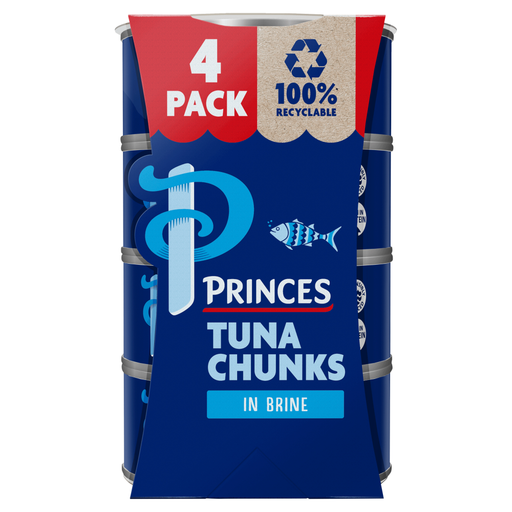
Brine-packed chunks for a sandwich filling or cold side. Check the drained weight on the pack when deciding how many tins to open.
 No image available
A no-drain option when you want to put tuna straight into a filling with less liquid handling. Use the pack's stated basis when comparing its nutrition figures with other tins.
 No image available
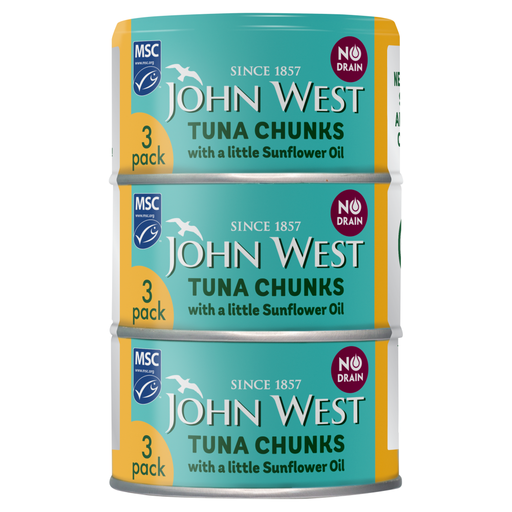
Oil-packed, no-drain chunks for a filling or salad when you prefer this packing medium. Compare the label's stated nutrition basis with any water-packed alternative.
 No image available
Spring-water chunks in a six-tin pack for cupboard fillings or sides. Check the drained weight of an individual tin when planning portions.
 No image available
Spring-water chunks for a mixed filling when you want to add your own seasoning. Use the drained weight on the pack, rather than the full tin weight, to plan the quantity needed.
Choose spring water if you want to add the filling's seasoning yourself; choose brine if you want seasoning from the packing liquid. Check salt on each product's label rather than assuming every spring-water or brine tin has the same figure.
Not necessarily: Tesco lists 102g drained weight for its 145g Tuna Chunks in Brine tin. Look for the drained weight of the exact product when planning a filling or side.
The NHS says people who are pregnant or trying for a baby should have no more than four cans of tuna a week or two tuna steaks a week because tuna contains higher levels of mercury than other fish. Its guidance concerns tuna eaten across the week, not just one meal.
No. The NHS states that fresh and canned tuna do not count as oily fish in its fish-consumption guidance.