Roast-weekend planners
If you want a cupboard ingredient for sandwiches, salads or jacket potatoes after Sunday lunch, compare pack size with drained weight to see how much tuna each tin contains.


For meals after Sunday lunch, choose ordinary tuna chunks when draining a tin is practical, or no-drain chunks when you want to add tuna straight to a sandwich or salad. Spring water, brine and sunflower oil give you different packing liquids; check the exact tin’s salt information, drained weight and opened-storage instructions before choosing.
If you want a cupboard ingredient for sandwiches, salads or jacket potatoes after Sunday lunch, compare pack size with drained weight to see how much tuna each tin contains.
If tuna will be mixed with other ingredients, choose a packing liquid that suits the dish and read salt per 100g on the exact product. Spring-water tins do not all have the same salt content.
No-drain chunks can be added to a cold side, salad or sandwich without the usual draining step. Check whether that convenience matters for the meals you actually make.
Start with the meal you plan to make, then compare the exact tins’ format, nutrition panel and storage instructions.
| Priority | What to check | Your needs |
|---|---|---|
| Usable amount | Compare tin count, can size and drained weight on products packed in liquid. Do not treat the liquid as tuna. | I want enough tuna for several sandwiches, salads or potato toppings after Sunday lunch. |
| Salt and liquid | Read salt per 100g on the exact tin and check whether the figure is for drained tuna. Sainsbury’s lists 0.12g per 100g drained for its cited spring-water four-pack; ASDA lists 0.90g for its cited spring-water four-pack. | When I mix tuna with other ingredients, the packing liquid and salt figure matter more to me than the words “spring water” alone. These figures come from the respective Sainsbury’s and ASDA product listings. |
| Preparation | Check whether the product is labelled no-drain or instructs you to drain it. Confirm that its packing liquid suits a cold dish or cooked topping. | For a quick sandwich or salad, I may prefer tuna that needs no draining; for other meals, an ordinary tin works. |
| Sourcing | Look for an MSC label or a stated catch method on the exact pack rather than assuming the claim applies to every product from a brand. | If sourcing is part of my choice, I want to identify the claim for the tin I am buying. Sainsbury’s describes its cited spring-water four-pack as MSC-certified and pole-and-line caught; M&S states that its cited spring-water chunks are pole-and-line caught. |
| Opened storage | Follow the exact tin’s instructions for transferring, refrigerating and using any leftovers. The stated period differs between the cited products. | If one tin will cover more than one meal, I need a plan for the remainder once it is open. |
The cited Sainsbury’s spring-water chunks list 0.12g salt per 100g drained, while the cited ASDA chunks list 0.90g per 100g drained. The packing liquid alone does not settle the question.
Read the nutrition panel on the exact tin, particularly when tuna will be combined with gravy, cheese or mayonnaise.
John West describes its cited no-drain chunks as ready to use. That preparation difference matters for an immediate sandwich or salad, but may matter less when you are already assembling a larger meal.
Choose the format according to whether draining an ordinary tin would actually interrupt your preparation.
The cited Sainsbury’s product instructs shoppers to transfer leftovers to a non-metallic container, refrigerate and use within one day; the cited ASDA and M&S products give a two-day period. Food Standards Scotland advises following the label.
Transfer and refrigerate unused tuna as directed, then use it within the period printed on that tin.
Tesco lists own-label tuna chunks in spring water as a four-pack and Stockwell & Co chunks in brine as a single tin.
Sainsbury’s describes its cited 4 x 145g spring-water chunks as MSC-certified and pole-and-line caught.
ASDA lists its own-label 4 x 145g tuna chunks in spring water with nutrition figures for drained tuna.
Princes lists spring-water chunks in several pack sizes, including a 4 x 145g pack cited by ASDA.
John West describes its cited no-drain tuna chunks in spring water as ready to use.
M&S states that its cited spring-water tuna chunks are pole-and-line caught under its Forever Fish policy.
These John West and Princes multipacks cover no-drain, spring-water, brine and sunflower-oil formats for sandwiches, salads and other meals after Sunday lunch.
 No image available
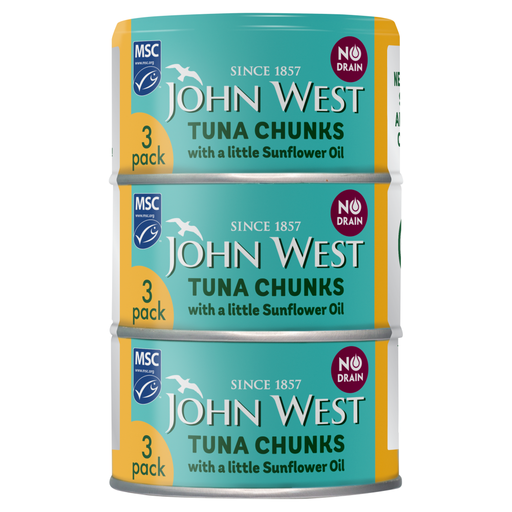
The no-drain format suits a sandwich or salad when you want to skip draining. This pack contains three 100g tins; check the opened-storage instructions if you will use a tin across meals.
 No image available
For quick meals where an oil-packed tuna suits the recipe, this no-drain option comes in three 100g tins. Check whether sunflower oil suits the other ingredients you plan to use.
 No image available
Four spring-water tins provide portions for separate sandwiches, salads or other meals. If skipping the draining step matters, check this exact pack’s instructions rather than assuming it belongs to the No Drain range.
 No image available
Four brined tins can be used across separate cupboard meals. Check the salt figure on this product’s label and drain it according to the pack instructions before adding it to a dish.
 No image available
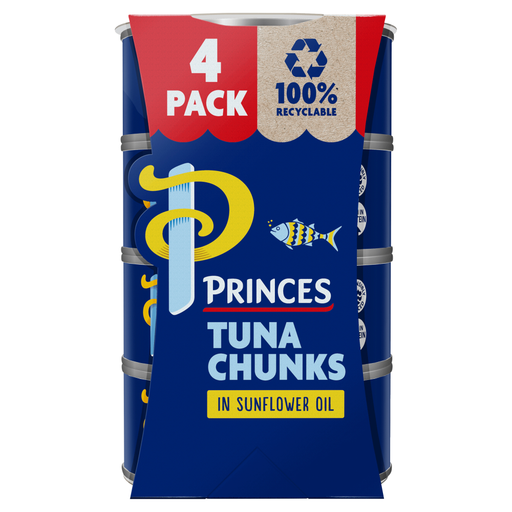
This four-tin option suits meals where sunflower-oil-packed tuna fits the recipe. Follow the pack’s draining instructions and check the nutrition label’s stated basis when comparing it with drained tuna in other liquids.
No. It can be a separate fish option or a cupboard ingredient for sandwiches, salads and jacket potatoes later in the weekend. Choose it for those meals if they suit your household, rather than treating it as a required replacement for the roast.
Follow the exact tin’s instructions. The cited Sainsbury’s product says to transfer leftovers to a non-metallic container, refrigerate and use within one day; the cited ASDA and M&S products specify refrigeration and use within two days. Food Standards Scotland also advises checking the label.
No. NHS guidance says fresh and canned tuna do not count as oily fish, so a tuna tin should not be treated as an oily-fish portion.
Check current NHS pregnancy-specific fish guidance before making tuna a regular choice. The NHS says fish advice can differ during pregnancy, breastfeeding and childhood, so general guidance for other adults may not apply.