Two-person meal planners
If tuna is a regular ingredient in sandwiches, jacket potatoes or pasta, compare the drained quantity across tin and pack sizes. Tesco Groceries and Sainsbury's Groceries list both single tins and multipacks.


For a one- or two-person household, choose tinned tuna by the drained quantity you will use and how often you make meals with it. A multipack suits regular lunches, while a single tin or no-drain format may suit less frequent use or easier preparation. Check the exact pack before treating spring-water, brine and oil variants as interchangeable.
If tuna is a regular ingredient in sandwiches, jacket potatoes or pasta, compare the drained quantity across tin and pack sizes. Tesco Groceries and Sainsbury's Groceries list both single tins and multipacks.
For occasional meals, a single tin or no-drain format may be easier to use than opening a larger tin and storing the remainder.
If the packing medium, nutrition panel or a stated fishing method guides your choice, check those details on the exact variant rather than applying one tin's description to a whole range.
For a smaller household, start with the amount of tuna you expect to use, then decide whether preparation and pack details change the choice.
| Concern | What to check | Who this matters to |
|---|---|---|
| Usable quantity | Compare drained weight as well as tin and multipack size. Consider how many meals you will make from an opened tin. | When tuna goes into regular meals for two, I want a pack size I can use without leaving an awkward remainder; about 50% of consumers put usable quantity first. |
| Portion and preparation | Check whether the tin is single, multipack or explicitly no-drain, and whether its quantity fits the intended meal. | If I make tuna only occasionally, a smaller tin or less draining can matter more than keeping several tins in the cupboard. Around 30% of consumers primarily want that portion and preparation fit. |
| Ingredients and sourcing | Read the exact variant's packing medium and nutrition panel; check the pack for any stated sourcing method. | When a recipe calls for a particular packing medium, or I want to check a sourcing claim, I need the details for the tin I am buying. About 20% of consumers make those pack details their primary concern. |
Tins can contain different amounts of packing liquid, so similarly sized tins may provide different drained quantities.
Compare drained weights where shown, then choose an amount your household is likely to use.
The NHS says fresh and canned tuna do not count as oily fish in its general fish guidance.
If you are checking the oily-fish part of that guidance, consider a separate choice such as sardines, mackerel or salmon.
Spring-water and sunflower-oil tuna can have different nutrition figures. Marks & Spencer lists different energy and fat figures for its spring-water and sunflower-oil chunks.
Read the panel on the exact tin, using the same per-100g or per-serving basis when comparing variants.
A larger tin may leave unused tuna. Marks & Spencer instructs buyers of its spring-water chunks to transfer leftovers to a non-metallic container, refrigerate them and eat them within two days.
Plan another meal for any remainder and follow the storage instructions on the tin you open.
Tesco Groceries lists own-brand tuna in single tins, multipacks and larger formats.
Sainsbury's Groceries lists own-brand tuna across spring-water, brine and oil variants, including multipacks.
Princes offers conventional tuna chunks and other formats, with spring-water chunks in several pack sizes.
John West offers conventional chunks alongside no-drain and other convenience formats.
Marks & Spencer lists spring-water and oil-packed chunks alongside steak and fillet formats.
These tins cover branded multipacks, an explicitly no-drain three-pack and a single spring-water tin. Choose the format that fits how often you open tuna and how much you use at once.
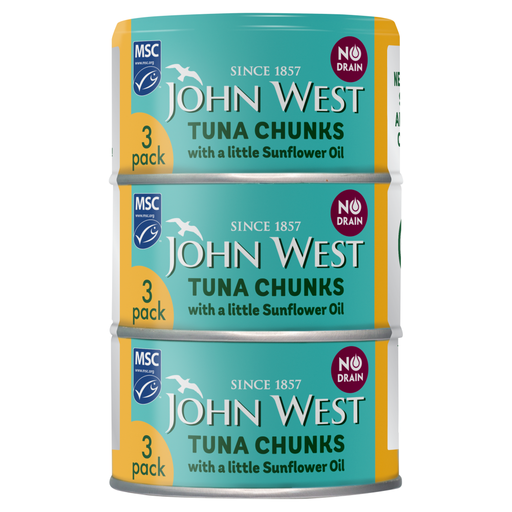 Image unavailable
Consider this three-tin pack when you want tuna chunks without a draining step. It is packed in sunflower oil; check the nutrition panel and whether each 100g tin fits the meal you have planned.
 Image unavailable
Four separate tins suit households that use tuna chunks across several meals. This is a sunflower-oil variant, so check its label when choosing the packing medium for a recipe.
 Image unavailable
Choose this four-tin format if spring-water chunks feature in your regular meals. Each listed tin is 125g; check the pack's drained quantity and do not assume this variant is no-drain.
 Image unavailable
This four-tin pack is an option for repeat meals when you prefer brine-packed chunks. Check the exact label for drained quantity and nutrition details rather than using figures from a spring-water variant.
 Image unavailable
A single listed tin may fit occasional use when you do not want a multipack in the cupboard. It contains spring-water tuna chunks; its 145g net weight should not be treated as a stated drained weight or serving size.
Drained weight describes the tuna remaining after the packing liquid is removed, while tin sizes and liquid contents can differ. Use it alongside the pack size to judge how much tuna your household can use.
No. Choose between spring water, brine and oil according to the recipe, the amount you will use and the exact variant's ingredients and nutrition panel. A packing medium alone does not settle the whole choice.
No. The NHS says fresh and canned tuna do not count as oily fish in its general fish guidance; examples of oily fish include salmon, sardines and mackerel.
Follow the instructions on the exact product. For its spring-water chunks, Marks & Spencer directs buyers to transfer unused contents to a non-metallic container, refrigerate them and eat them within two days; instructions for another tin may differ.
Not necessarily. Marks & Spencer describes a specific spring-water product as pole-and-line caught, while J Sainsbury plc's 2023 statement concerned its own-label canned tuna range. Check the current packaging of the product you intend to buy.