Hosts planning several meals
If tuna is going into shared lunches, pasta bakes, jacket potatoes or sandwiches, work out how much usable tuna the meals call for before choosing a multipack.


For several Easter meals, start by choosing a standard multipack with enough drained tuna for the dishes you have planned. A smaller pack or no-drain format makes more sense when portion handling or quick assembly matters more; check the exact pack’s liquid, ingredients and labels before deciding.
If tuna is going into shared lunches, pasta bakes, jacket potatoes or sandwiches, work out how much usable tuna the meals call for before choosing a multipack.
For sandwiches, salads or a picnic-style spread, the handling of each tin may matter as much as the number in the pack. A no-drain format is worth considering when you want to assemble food without draining liquid first.
If liquid medium, salt, fish allergen information or sourcing claims affect your choice, compare the labels of the exact products rather than treating every tuna pack from one brand as equivalent.
Plan the meals and portions first, then decide whether preparation time or a particular product label changes the pack you need.
| Concern | What to check | Who this matters to |
|---|---|---|
| Usable quantity | Compare pack quantities on the same net or drained-weight basis, particularly when the tins contain different liquids. | For a larger Easter shop, I want enough tuna for the dishes planned, not just more tins in the cupboard. About 36% of consumers put comparable usable quantity first. |
| Pack fit | Match the number and size of tins to the planned meals; check whether the product is chunks or a finer sandwich-tuna mix. | If I am making one pasta bake as well as sandwiches, I need a pack that divides sensibly between those meals. Around 29% of consumers make meal and pack fit their primary concern. |
| Quick serving | Check whether the exact product is labelled no-drain rather than assuming all branded chunks are ready to use. | When lunch needs assembling quickly, I would rather open a tin without draining it first. About 21% of consumers prioritise that serving convenience. |
| Product labels | Read the exact pack for liquid medium, ingredients, fish allergen information and salt; look for the blue MSC ecolabel if that certification matters to you. | For a meal shared with others, I need to check ingredients and any sourcing label before choosing the tuna. Roughly 14% of consumers put label fit first. |
Salt and ingredients vary by exact product. Asda lists 0.90g salt per 100g drained for its brine chunks, while M&S lists 0.75g per 100g for its spring-water chunks; those figures do not describe every variant.
Check the ingredients and nutrition panel of the particular can, especially when choosing between liquids for a planned dish.
John West’s no-drain format is designed to be used without draining, but its smaller tins may call for more openings when preparing a group dish.
Count the portions you need before choosing between a no-drain pack for quick lunches and standard chunks for a larger recipe.
A retailer’s sourcing policy and an ecolabel on a particular can are different things. Neither tells you which label appears on every other tuna product in the range.
If MSC certification is part of your decision, look for the blue MSC ecolabel on the exact pack you intend to buy.
These brands offer different pack formats and label information. Compare individual products rather than assuming a characteristic applies across a whole range.
Own-label standard tuna chunks include 145g singles, a 400g can and four-tin spring-water or brine packs.
Own-label four-tin, 145g-per-tin options include spring water, brine, sunflower oil and olive oil.
Its standard tuna chunks include a four-pack of 145g brine tins.
Princes lists spring-water chunks in 145g singles and multipacks, alongside a finer chunk-and-flake sandwich-tuna format.
John West offers standard chunks and a No Drain spring-water format for meals where draining is inconvenient.
M&S describes its 160g spring-water chunks as pole-and-line caught under its Forever Fish policy.
These packs cover standard chunks for planned meals and a smaller no-drain option for quick assembly. Check each pack’s quantity and liquid against your Easter meal plan.
 No image available
The four-tin format suits a plan involving several tuna meals, such as sandwiches, salads or pasta. Check the pack’s drained quantity when comparing it with tins of another size; tuna contains fish.
 No image available
This four-tin brine pack offers chunks for several planned meals. Its stated ingredients include tuna, water and salt; check the exact label for the drained quantity and fish allergen information.
 No image available
The no-drain format suits sandwiches or salads assembled without a draining step. This pack contains three 100g tins, so check that the quantity fits a group dish; tuna contains fish.
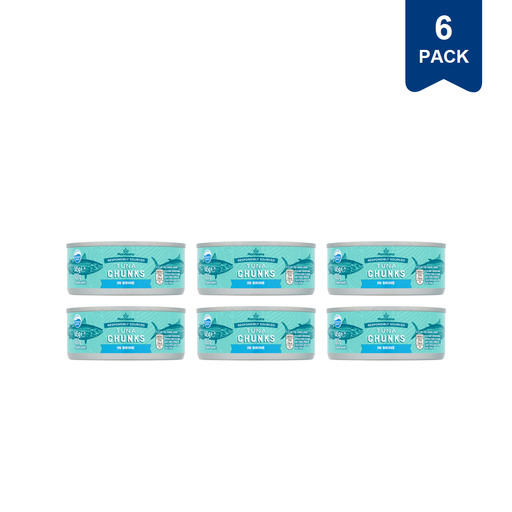 No image available
Brine-packed chunks are an option for sandwiches, salads or pasta dishes. The title indicates six packs and the description gives a 145g net quantity; confirm the total contents and drained quantity for the pack before planning portions.
 No image available
These spring-water chunks can be considered for planned lunches or pasta dishes. The title indicates six packs, while the description gives a 145g net quantity; check the combined and drained quantities before relying on it for several meals.
Start with the number of meals and portions you intend to make, then compare the packs’ stated quantities on a consistent net or drained-weight basis. A greater number of tins does not, by itself, tell you how much drained tuna you will have for a recipe.
Choose the liquid that fits the dish and check the ingredients and nutrition panel on that exact variant. Salt figures differ between products: Asda lists 0.90g per 100g drained for its checked brine chunks, while M&S lists 0.75g per 100g for its checked spring-water chunks.
Follow the instructions on the pack you buy. Asda and M&S instruct shoppers on their checked products to transfer unused tuna to a suitable non-metallic container, refrigerate it and use it within two days.
Tuna is fish, so check the ingredients and allergen declaration on the exact can before it is used in a shared meal. Do not rely on the label of another flavour or pack from the same range.
No. A retailer’s sourcing statement does not establish that a particular tin carries the blue MSC ecolabel. If that label matters to your choice, check for it on the exact product.