MSC-first festival campers
If independently certified sourcing is your priority, check the exact tin for the blue MSC ecolabel. Broad sustainable-seafood wording does not establish that a particular product carries it.


If independently certified fishery sourcing is your priority, look for the blue MSC ecolabel on the exact tin; the Marine Stewardship Council says it applies to wild seafood from fisheries certified to its Fisheries Standard. For a festival with limited washing-up or no dependable refrigeration, choose a format you can open with little mess and a portion you can finish. Check the packing liquid, drained quantity and post-opening directions rather than assuming a larger tin or a retailer-wide sourcing policy meets every need.
If independently certified sourcing is your priority, check the exact tin for the blue MSC ecolabel. Broad sustainable-seafood wording does not establish that a particular product carries it.
If draining liquid and handling wet waste will be awkward, look for a product explicitly described as no-drain or drained-and-ready.
If you are feeding several people or planning more than one meal, compare usable quantity and portion sizes. Check how any opened leftovers must be stored before choosing a larger tin.
For festival camping, decide what matters most on the exact tin: certified sourcing, low-mess handling, a portion you can finish, or a format that fits the meal.
| Concern | What to check | Who this matters to |
|---|---|---|
| Certified sourcing | Look for the blue MSC ecolabel on the exact tin; do not substitute a catch-method claim or retailer policy for it. | If I want an independently certified fishery sourcing signal, a general sustainability statement is not enough. About 33% of consumers put that certification check first. |
| Low-mess use | Check whether the pack explicitly says no-drain or drained-and-ready, and how it opens. | With little space to prepare food or dispose of liquid, I want to open the tuna and add it to a cold meal without draining it. For about 27% of consumers, avoiding that handling is the primary need. |
| Leftovers | Read the post-opening storage directions and choose a portion you can finish if refrigeration is unavailable. | If I cannot keep opened food refrigerated at the campsite, I need a tin I can finish or share straight away. That is the main concern for about 20% of consumers. |
| Meal and portion fit | Compare the packing liquid and stated net or drained quantity; use a consistent per-100g or per-serving basis for nutrition comparisons. | For a planned cold meal or a group, I need the right amount of tuna and a liquid medium that suits how we will serve it. About 20% of consumers prioritise that match. |
According to the Marine Stewardship Council, its blue ecolabel identifies wild seafood from fisheries certified to the MSC Fisheries Standard. Pole-and-line wording or a retailer's wider seafood policy does not establish that the particular tin carries the label.
If MSC certification is essential to your choice, check for the ecolabel on the physical pack.
The cited M&S and Princes product directions require opened leftovers to be refrigerated and used within two days. An unopened tin's storage directions do not continue to apply once it has been opened.
Choose a portion you can finish, or share a larger tin when you open it, if you cannot refrigerate leftovers. Follow the directions on your exact pack.
Without suitable storage, unused tuna may have to be discarded.
A drained-and-ready portion, a standard tin in spring water and tuna in oil need not provide the same amount of tuna or suit the same preparation plan.
Check the stated drained quantity where available, as well as ingredients and the packing liquid. Compare nutrition figures on the same per-100g or per-serving basis.
Fish is an allergen, and cited tuna products warn that bones may remain. The cited Princes product information also says not to consume a swollen or damaged tin.
Read the ingredients and allergen declaration for the exact variant, inspect the tin before use and take a suitable utensil for opening and eating.
John West offers No Drain tuna in spring-water and sunflower-oil formats. Its cited spring-water product is identified as MSC-labelled.
Princes lists MSC tuna chunks in several packing liquids, including spring water, brine and sunflower oil.
Sainsbury's lists a 120g Tuna Drained & Ready Water product for shoppers seeking a spring-water portion without a draining step.
M&S describes its cited tuna steak and spring-water chunks as pole-and-line caught.
Tesco lists standard tinned-tuna formats and has published a tuna-sourcing policy.
Asda publishes a seafood-sourcing approach and lists branded tuna products, including a Rio Mare olive-oil tuna product identified as MSC-certified.
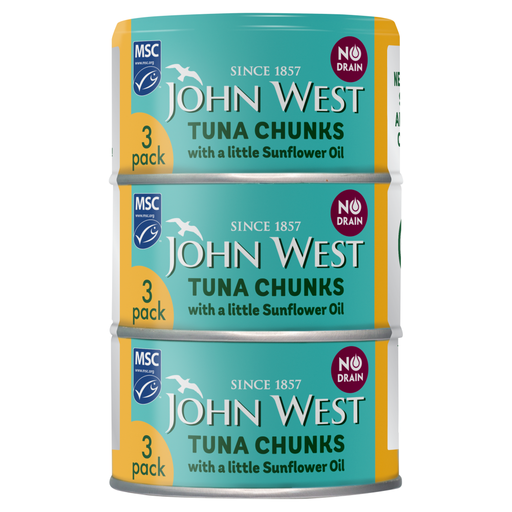
These John West multipacks offer separate no-drain tuna portions for cold festival meals. Choose between sunflower oil and springwater according to the meal you plan, and check the exact pack for the blue MSC ecolabel if certification is essential.
 No image available
The separate no-drain tins suit meals where you want to open one portion at a time without disposing of packing liquid. This variant is packed in sunflower oil; check its ingredients and nutrition information against your meal plans. The product information identifies fish as an allergen, warns that bones may remain, and directs you to refrigerate opened leftovers and use them within two days. Check the physical pack for the blue MSC ecolabel if certification is a requirement.
 No image available
The three separate no-drain tins suit cold meals when draining facilities are limited and you want to open portions as needed. This variant is packed in springwater. Its product information identifies fish as an allergen and directs you to refrigerate opened leftovers and use them within two days. John West identifies a matching spring-water No Drain product as MSC-labelled; check the ecolabel on the exact pack before relying on that certification.
Look for the blue MSC ecolabel on the exact tin. The Marine Stewardship Council says the label applies to wild seafood from fisheries certified to its Fisheries Standard; pole-and-line wording or a retailer's sourcing policy alone does not establish that the product carries it.
Choose a pack explicitly described as no-drain or drained-and-ready if you want to avoid disposing of liquid. John West's cited No Drain product and Sainsbury's cited Drained & Ready product are examples; check the exact pack for its other details, including storage directions.
Do not plan to keep opened leftovers at ambient temperature: the cited M&S and Princes product directions require refrigeration and consumption within two days. If refrigeration is unavailable, choose a portion you can finish when you open it and follow its own label directions.
Read the ingredients and fish-allergen declaration for each variant, and allow for product warnings that bones may remain. Inspect each tin before use; the cited Princes product information says not to consume a swollen or damaged tin.