Family-batch meal planners
If tuna goes into pasta bakes, sandwiches, jacket potatoes or salads throughout the week, the amount available after draining and the number of meals a pack covers matter more than an individual serving format.


For tuna mixed into family pasta, sandwiches or jacket potatoes, start by comparing chunk multipacks by their drained weight and the amount each meal needs. A no-drain pack makes more sense for quick individual lunches, while steaks or fillets are worth considering when the fish will remain prominent on the plate. Check the exact tin for salt, preserving liquid and sourcing claims rather than assuming those qualities follow from a premium label.
If tuna goes into pasta bakes, sandwiches, jacket potatoes or salads throughout the week, the amount available after draining and the number of meals a pack covers matter more than an individual serving format.
For packed lunches and quick meals, a smaller no-drain tin can remove a preparation step. John West describes its No Drain spring-water chunks as ready to eat without draining.
If certification or fishing method guides your choice, compare claims on the exact product. The products described by Sainsbury’s and M&S include pole-and-line-caught tuna, while certification statements vary by tin.
Choose the format around the meals you plan to make, then compare usable quantity and the exact label. A larger multipack, a no-drain tin and a fillet serve different purposes even when all are sold as tinned tuna.
| Concern | What to check | Who this matters to |
|---|---|---|
| Usable quantity | Compare net and drained weights, tin sizes and the amount needed for each planned meal. Check a no-drain pack on its usable-weight basis. | If several people need tuna in the same pasta bake or round of sandwiches, I need to know how much fish the pack provides after opening. About 36% of consumers put usable family-meal quantity first. |
| Texture and serving format | Check whether the tin contains chunks, steaks, loins or fillets, and whether its preserving liquid suits the dish. | When tuna will stay visible in a salad or plated lunch, I may care about its format more than I would in a mixed filling. Texture and presentation come first for about 29% of consumers. |
| Nutrition and liquid | Read the ingredients and salt per 100 g on a comparable basis; note whether the tuna is in spring water, brine or oil. | For repeated household meals, I want to choose the preserving liquid and compare the salt shown on each exact tin. About 21% of consumers make label details their primary concern. |
| Sourcing claims | Look for certification and fishing-method statements on the exact product, rather than relying on the brand name. | If I am choosing tuna partly for its sourcing credentials, I need those claims to apply to the tin I buy. Product-specific sourcing is the main concern for about 14% of consumers. |
A standard chunk tin, a no-drain tin and a fillet tin can provide different amounts of usable tuna. Four tins do not necessarily cover more meals than another format.
Check the net and drained weights, individual tin sizes and the portions your planned recipes require.
The published labels for Sainsbury’s and Asda spring-water chunk multipacks list 0.12 g and 0.90 g salt per 100 g drained respectively. The liquid alone does not tell you the salt figure.
Compare the nutrition panels on the same stated basis and check the label of the exact product you select.
Certification and fishing-method statements can apply to a particular product rather than every tin from a brand or retailer.
Check the selected tin for its certification logo, species and stated fishing method where these affect your decision.
Storage instructions can differ between products. The cited M&S, Sainsbury’s and Asda product information directs shoppers to transfer leftovers to a non-metallic container and refrigerate them.
Follow the storage instructions and use-by period printed on your exact pack after opening.
These ranges offer different formats and product-specific labels to examine; a feature of one tin should not be assumed to apply across its brand.
Its No Drain spring-water chunks offer a convenience-focused alternative to standard drained chunks.
Its tuna range includes chunks, steaks and sandwich tuna for different meal formats.
Its own-brand range includes spring-water chunks in multipack and larger-tin formats, alongside tuna steaks.
Its spring-water skipjack chunk multipack has a product-specific pole-and-line and MSC-certified fishery statement.
Its own-brand spring-water skipjack range includes an MSC-labelled 4 × 145 g multipack.
Its range spans everyday chunks and M&S Collection fillets and loins.
These Joybuy selections include chunk multipacks for shared meals in spring water, sunflower oil or brine, plus a smaller no-drain spring-water pack for quick lunches. Choose by the recipe and check each pack’s contents before planning portions.
 Image unavailable
Four tins of spring-water chunks offer a format for pasta, sandwiches and other shared meals. Check the drained weight when working out how much tuna a recipe will yield; this is not identified as a No Drain pack.
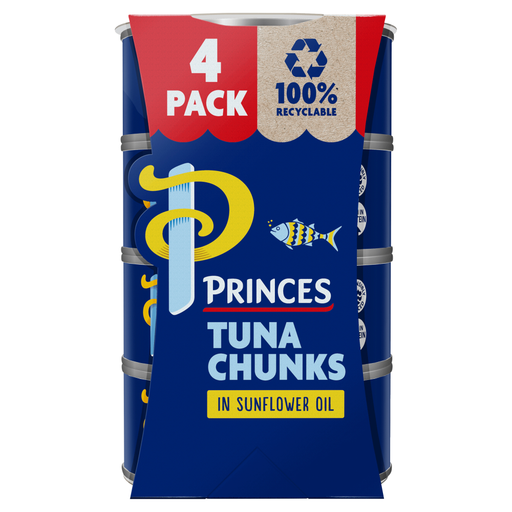 Image unavailable
This four-tin chunk pack is an option for family meals where sunflower oil suits the recipe. Check the drained weight for portion planning, and compare nutrition only when the labels use the same stated basis.
 Image unavailable
Four tins of brine-packed chunks can be used in family pasta, salads or sandwiches. If the preserving liquid matters to your recipe, note that this is brine rather than spring water, and check the drained quantity for the portions you need.
 Image unavailable
For quick individual lunches, the No Drain format removes the usual draining step. This three-tin pack contains smaller tins than the four-tin multipacks above, so check how many you would need for a shared meal.
 Image unavailable
Spring-water chunks are a format to consider for meals that mix tuna with other ingredients. The title identifies a six-pack and gives 145 g, but confirm the number and size of individual tins on the pack before planning a large batch.
Start with the amount of tuna your recipe needs, then compare tin sizes and drained weights where applicable. A no-drain tin and a standard drained tin should be assessed by the usable amount, not tin count alone.
No. The published labels for the cited Sainsbury’s and Asda spring-water chunks list 0.12 g and 0.90 g salt per 100 g drained respectively. Check the exact product and compare figures on the same basis.
Follow the storage instructions on the exact pack. The cited M&S, Sainsbury’s and Asda product information directs shoppers to transfer leftovers to a non-metallic container, refrigerate them and use them within the product’s stated period.
The NHS advises pregnant people not to eat more than four cans of tuna or two tuna steaks a week because tuna can contain pollutants, including mercury. That guidance concerns consumption, not whether one brand or format is preferable.
Tuna is fish, and the cited product labels identify fish as an allergen. Read the ingredient and allergy information on the exact pack rather than assuming a plain-looking tin has no relevant allergen information.