For a meal for one, choose the amount of tuna you expect to use before deciding whether a premium-style tin earns its place. A no-drain portion suits a quick sandwich or salad; compact chunks suit a lighter dish, while a larger steak tin makes more sense if the recipe calls for more tuna. Check the exact pack’s drained weight, liquid and sourcing claims rather than assuming its presentation tells you those things.
Who these formats suit
Quick solo lunch makers
If you add tuna to a sandwich, salad or jacket potato, a smaller can may provide the amount you need without opening a larger tin. John West describes its No Drain range as ready to use without draining; check that the claim appears on the particular pack you choose.
One-person cooks planning a fuller dish
Compare the tin’s net weight with its drained quantity and stated servings. A steak format or larger tin may fit your recipe, but the word “steak” does not establish how much tuna you will use.
Buyers checking sourcing claims
If catching method or certification affects your choice, inspect the exact pack. Princes and M&S make sourcing and traceability statements, while an MSC ecolabel is a separate credential to look for on a product.
What to check before choosing
For meals for one, start with the portion your dish needs, then decide which other consideration matters most to you.
| Concern |
What to check |
Who this matters to |
| Preparation and leftovers |
Check the individual can size and whether the exact pack says no draining is required. |
If I am assembling a quick lunch, I want to open only the tuna I will use and avoid a draining step. About 36% of consumers put that convenience and portion fit first. |
| Amount and texture |
Compare net and drained weights, stated servings and chunks versus steak pieces. |
For a fuller dish, I need enough tuna for the recipe and may prefer larger pieces. About 29% of consumers make the amount and format their primary concern. |
| Sourcing |
Look for the specific catching-method or traceability statement, or an MSC ecolabel, on the exact pack. |
When sourcing influences my purchase, I want to know precisely what the tin claims rather than rely on its appearance. About 21% of consumers prioritise a stated sourcing credential. |
| Liquid and label |
Check whether the tuna is packed in water, brine or oil, then compare ingredients and nutrition on the same stated basis. |
If the packing liquid changes how I will use the tuna, I want to inspect the ingredients and per-can or per-100g figures. About 14% of consumers put that label comparison first. |
Common buying mistakes
-
Assuming the tin’s net weight is your usable portion
Liquid and serving suggestions affect portion planning. Sainsbury’s lists its 3 × 80g spring-water chunks as 3 × 56g drained, while Asda describes its 3 × 110g brine-steak pack as six servings.
For a one-person recipe, compare the drained quantity where stated with the amount you intend to use, especially before choosing a multipack.
-
Treating water, brine and oil packs as interchangeable
The nutrition panel depends on the exact product and the basis used. Asda lists 0.6g fat per drained 80g chunk can; Joybuy lists 6.5g fat per 60g can for John West’s sunflower-oil No Drain steak.
Choose the liquid that fits your dish, then compare ingredients and nutrition per can or per 100g rather than drawing a general conclusion from the liquid alone.
-
Taking premium presentation as a sourcing credential
A retailer’s responsible-sourcing statement, a pole-and-line claim and an MSC ecolabel convey different information. Princes and M&S make sourcing claims for their ranges or named products; those statements should not be carried across to every tin.
If certification or catching method is decisive, check the wording or ecolabel on the exact product you intend to buy.
Brands to consider for tinned tuna
John West
Its No Drain steak and chunk formats are relevant when a small, ready-to-assemble meal is the priority.
- John West describes its No Drain steak in spring water as ready to eat without draining.
- Check the exact liquid and nutrition panel: the 60g sunflower-oil steak listed on Joybuy declares 6.5g fat per can.
Princes
Its tuna range includes chunks, sandwich tuna and steaks, giving buyers several formats to compare.
- Princes says its canned tuna can be traced back to the boat; its 160g brine steak lists tuna, water and salt as ingredients.
- Nutrition figures for that brine steak do not describe every Princes tin. Check the variant and label before comparing portions.
Tesco
Tesco’s own-brand 3 × 80g chunks and 110g steak tins offer compact formats to consider alongside branded products.
- The listed individual tin sizes give you a starting point for planning a meal for one.
- Check the particular product’s drained weight rather than assuming its net weight is the amount of tuna in the dish.
Sainsbury's
Its own-brand 3 × 80g spring-water chunks are a compact option for lighter one-person meals.
- Sainsbury’s lists that multipack as 3 × 56g drained, a useful distinction when planning portions.
- Use the drained figure for that named product, not as an assumption about other tins in the range.
Asda
Its researched range includes 80g spring-water chunks and 110g brine-steak tins.
- Asda lists 14g protein per drained 80g chunk can and describes its three-can brine-steak pack as six servings.
- Those quantities belong to different products; compare each exact tin’s label with the portion your meal needs.
M&S
Its researched 160g spring-water chunks and 200g sunflower-oil steak are larger formats with stated sourcing details.
- M&S describes these named products as traceable and pole-and-line caught.
- Check the claim on the exact tin and consider whether its size fits one meal or calls for a plan for unused tuna.
Joybuy tinned tuna selections
These Joybuy options cover no-drain multipacks and single tins of chunks or steaks for meals for one. Choose by the portion and packing liquid your dish calls for.
 Image unavailable
John West No Drain Tuna Chunks in Sunflower Oil, 3 × 100g
Consider this multipack if you want to open one can for a meal without a draining step. Each can is labelled 100g; check whether that amount fits your dish and inspect the exact pack if an MSC ecolabel matters to you.
View on Joybuy
 Image unavailable
John West No Drain Tuna Chunks in Springwater, 3 × 100g
This is another one-can-at-a-time option for assembling a meal without draining. The multipack contains three 100g cans; check the pack if your recipe needs a particular drained quantity.
View on Joybuy
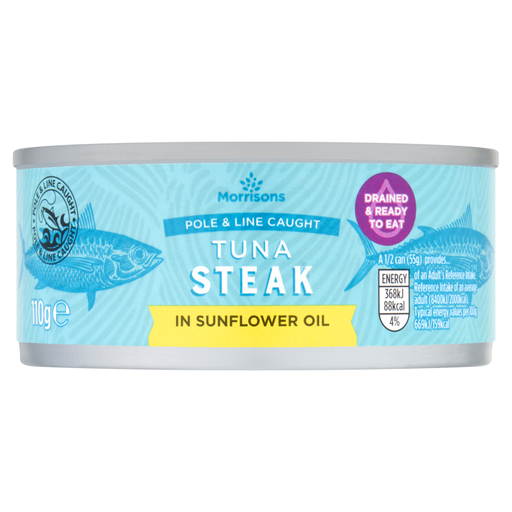 Image unavailable
Morrisons Drained Tuna Steaks with Sunflower Oil, 110g
The 110g steak-format tin is worth considering when your dish calls for more tuna than a mini portion. Its name says “Drained”, while its description says no draining is needed; check the exact pack’s preparation instructions and drained weight before relying on either detail.
View on Joybuy
 Image unavailable
Morrisons Fad Free Tuna Chunks in Spring Water, 145g
Consider this single 145g can when your recipe can use a larger amount of spring-water tuna chunks. Check its drained quantity against the portion you need; the product description advises refrigerating unused contents and using them within two days.
View on Joybuy
 Image unavailable
Tropical Sun Tuna Steaks in Sunflower Oil
This steak-format, oil-packed option may fit a dish where you want tuna in larger pieces. Check the pack’s drained quantity for portion planning; its description says to drain the oil if heating the tuna and to refrigerate unused contents for use within 24 hours.
View on Joybuy
Questions about tinned tuna for one
Is tinned tuna suitable if I have a fish allergy?
Tuna is fish, so a tuna product is not suitable for someone avoiding fish as an allergen. Check the ingredients and allergen statement on the exact pack each time, particularly for flavoured products.
Does “no drain” apply to every tin of tuna?
No. Expect to skip draining only when the exact product says so. John West makes that claim for its No Drain Tuna Steak in spring water; for other water-, brine- or oil-packed tins, follow the pack instructions and your recipe.
Is a responsible-sourcing claim the same as an MSC ecolabel?
No. Princes and M&S make sourcing or traceability statements, while an MSC ecolabel identifies a distinct certification. If certification is part of your decision, look for the label on the exact tin rather than assuming a sourcing statement means the same thing.


