Plain tuna chunks in spring water suit a toddler dinner when you plan to mash or mix the fish into a meal, but compare the ingredients and salt declaration on the exact can. Steak or fillet-style tinned tuna offers larger pieces if you want that texture; flake it to suit the child and inspect it for bones before serving. Tuna contains fish, an allergen, and the NHS says fresh and canned tuna do not count as oily fish.
Who is choosing?
Parents introducing fish
For a first introduction, the exact ingredients and allergen information matter more than the shape of the tuna. The NHS advises introducing foods that can trigger allergies one at a time; tuna is fish, but shellfish should not be assumed to be an ingredient.
Parents making a mixed meal
Chunks can be flaked or mashed into pasta, potato or rice. Check whether the chosen can contains just tuna and water or also contains salt or other ingredients.
Families wanting larger pieces
Steak or fillet-style tinned tuna gives you larger pieces to prepare for the meal. Break them up to suit the child and inspect for bones: a John West product listing warns that some may remain.
What matters when buying?
For a toddler dinner, settle the allergen and label questions before choosing between chunks and larger pieces. The groups below reflect consumers’ primary buying concerns for this meal.
| Concern | What to check | Who this matters to |
|---|
| Fish allergy |
Read the ingredients, fish-allergen declaration and any advisory statement on the exact pack. |
If fish is new to my child, I need to introduce it carefully; if my child has a diagnosed fish allergy, tuna is not an option. About 36% of consumers put this label and allergy question first. |
| Ingredients and salt |
Compare the ingredient list and salt per 100g on the same stated basis. |
For a meal mixed with other foods, I want to know what the tuna contributes rather than judge it by the words ‘spring water’. Roughly 29% of consumers make the recipe and salt declaration their primary concern. |
| Texture and bones |
Choose a format you can break up appropriately, and inspect the fish for bones. |
If I want larger tuna pieces on the plate, I still need to flake them to suit my child’s eating ability. About 21% of consumers put preparation and texture first. |
| Sourcing information |
Look for a sourcing statement on the exact product rather than assuming it applies across a brand. |
Once I have a suitable format, I may want to compare what each pack says about how its tuna was caught. For approximately 14% of consumers, that is the primary selection concern. |
What should you avoid assuming?
-
‘Spring water’ means no added salt
The packing medium alone does not tell you the full ingredient list or salt declaration. Products labelled as tuna in spring water can list different ingredients.
Read the exact can and compare salt values using the same per-100g basis.
-
Larger pieces are ready to serve
A steak or fillet-style name describes the format, not whether it is free of bones or prepared to suit a toddler. A John West listing warns that some bones may remain.
Inspect the tuna, remove any bones and break it into pieces the child can manage.
-
Tuna counts as oily fish
The NHS says fresh and canned tuna do not count as oily fish.
Do not treat a tuna dinner as an oily-fish serving when planning other fish meals.
-
All tinned tuna contains fish and shellfish
Tuna is fish; shellfish is not automatically an ingredient. Other ingredients or advisory warnings depend on the product.
Check the selected pack’s allergen information. Do not serve tuna to a child with a diagnosed fish allergy.
Brands to consider
John West
Its listed tinned-tuna formats include spring-water chunks and larger-piece options.
- Chunks and no-drain formats give shoppers different preparation options.
- A spring-water chunks listing warns that some bones may remain; inspect each serving.
Princes
Its range includes spring-water chunks and drained tuna steak.
- Princes lists tuna and spring water as the ingredients of its checked spring-water chunks.
- Check the individual format and pack label rather than applying the chunks’ ingredients to other variants.
Tesco
Tesco Groceries lists tinned-tuna formats, including branded larger-piece products.
- Its listings provide a place to compare chunks with steak-style formats.
- Ingredients and allergen information need checking on the specific product.
Sainsbury's
Its own-label range includes tuna chunks in spring water.
- The checked 145g product lists skipjack tuna and spring water.
- Check the selected can’s nutrition and sourcing statements; they should not be assumed to apply to every variant.
Tuna chunks on Joybuy
These are spring-water tuna chunks for meals where you plan to flake or mix the fish. They are not a selection of steak or fillet-style products; whichever format you choose, check the pack and prepare each serving for the child.
 Image unavailable
Morrisons Fad Free Tuna Chunks in Spring Water, 6 × 145g
Chunks can be flaked into a mixed meal. The product description lists tuna, spring water and salt, with 1.0g salt per 100g drained, and identifies fish as an allergen. Inspect the fish for bones and check the exact pack before serving.
 Image unavailable
John West Tuna Chunks in Springwater, 4 × 125g
Flake these chunks for a mixed dinner. The product description lists tuna, spring water and salt, with 0.80g salt per 100g drained, and identifies fish as an allergen. A listing for this John West format warns that some bones may remain.
 Image unavailable
John West No Drain Tuna Chunks in Springwater, 3 × 100g
The no-drain chunks can be broken up for a meal without a separate draining step. The product description lists tuna, water and salt, with 0.80g salt per 100g drained, and identifies fish as an allergen. Inspect and flake the fish before serving.
 Image unavailable
Morrisons Fad Free Tuna Chunks in Spring Water, 145g
This single can offers chunks to flake into a mixed dish. Its product description lists tuna, spring water and salt, with 1.0g salt per 100g drained, and identifies fish as an allergen. Check the pack and inspect the fish before serving.
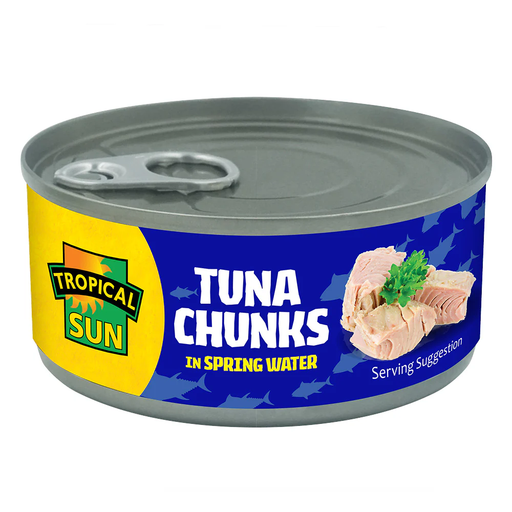 Image unavailable
Topical Sun Tuna Chunks in Springwater, 160g
Drain and flake these chunks for a mixed meal. The product description identifies fish, notes possible traces of soybeans and wheat, and advises checking for small bones. Check the exact pack’s allergen information and the basis of its salt declaration before comparing it with drained-weight values.
Questions about toddler dinners
Can I use tinned tuna in a toddler dinner?
Tinned tuna can be one ingredient if the child does not have a fish allergy and you prepare a texture they can manage. Check the can’s ingredients and salt declaration, then flake or mash the fish and inspect it for bones.
Should I buy chunks, steak or fillet-style tinned tuna?
Choose chunks to mash or mix into a dish; choose steak or fillet-style tinned tuna when you want larger pieces to break up yourself. Neither format name guarantees bone-free fish, so inspect each serving.
Does tinned tuna count as oily fish?
No. The NHS says fresh and canned tuna do not count as oily fish, so do not use a tuna dinner as a substitute when considering oily-fish meals.
Does tinned tuna contain shellfish?
Tuna is fish, not automatically shellfish. Read the exact product’s ingredients and allergen or advisory statements for any additional information; a child with a diagnosed fish allergy should not be served tuna.
What should I do with tuna left after opening a can?
Follow the storage and use-after-opening instructions on that can. Check them before opening a larger can or multipack, since instructions can differ between products.


