Organic-first meal planners
If you want an organic ingredient in a tuna tin, check exactly which ingredient carries the claim. Fishing-method and sustainability wording answer a different question.


If organic ingredients matter to you, check what the organic claim covers: organic olive oil in a tin does not, by itself, establish that the whole tuna product is organic. For quick family meals, also compare the ingredients, drained weight, packing medium and opened-tin directions. If you are pregnant or trying for a baby, NHS tuna guidance applies regardless of the organic claim.
If you want an organic ingredient in a tuna tin, check exactly which ingredient carries the claim. Fishing-method and sustainability wording answer a different question.
For meals assembled with little preparation, the ingredients, packing medium, drained weight and directions for opened leftovers can matter as much as the number of tins in a pack.
If someone eating the tuna is pregnant or trying for a baby, NHS guidance on tuna intake belongs in meal planning. It is not a limit that automatically applies to every new parent.
For new-parent meals, start with the requirement you would not want to compromise: an organic claim, pregnancy-related intake planning or a format that makes quick meals and leftovers manageable.
| Concern | What to check | Who this matters to |
|---|---|---|
| Organic claim | Check whether the claim applies to the tuna product or a named ingredient, such as olive oil. Read fishing-method claims separately. | If I want an organic ingredient in the tin, an MSC or pole-and-line claim will not settle that choice; about 42% of consumers put a verifiable organic claim first. |
| Pregnancy-related intake | If pregnant or trying for a baby, plan tuna across meals using NHS guidance; check the drained weight when comparing cans. | When I am pregnant or trying for a baby, I need tuna meals to fit the NHS guidance. About 33% of consumers make that intake planning their primary concern. |
| Quick meals and leftovers | Compare ingredients, packing medium and drained weight, then follow the opened-tin storage directions on the product. | On busy days, I want a tin I can use without leaving more tuna than I can store as directed; roughly 25% of consumers put meal preparation and leftover handling first. |
MSC certification, pole-and-line fishing and dolphin-friendly wording concern sourcing or catch methods. They do not establish that a tuna product meets UK organic-labelling conditions.
If organic status is essential, inspect the claim and ingredients on the individual product. The Department for Environment, Food & Rural Affairs says organic food labelling depends on production rules, the proportion of organic agricultural ingredients and certification by an approved control body.
An organic ingredient does not remove the pregnancy-related tuna limit given by the NHS. The limit applies specifically to people who are pregnant or trying for a baby.
Count tuna meals across the formats you use. The NHS advises no more than four cans of tuna or two tuna steaks a week for this group; the Food Standards Agency explains that the canned figure uses a medium-sized can of around 140g drained weight.
Opened-tin directions can differ by product, so a storage routine that suits one tin should not automatically be used for another.
Follow the individual label. For example, Asda directs buyers of its Tuna Chunks in Brine 4 x 145g to transfer unused contents to a suitable non-metallic container, cover and refrigerate them, and use them within two days.
A reference point when an organic packing ingredient and a stated catch method are priorities.
An own-label option to examine when planning repeat meals with a brine-packed multipack.
An own-label brine option for shoppers comparing pack format and directions for opened leftovers.
A branded range to consider when comparing tuna formats and stated sourcing information.
A branded option when the packing medium and whether draining is needed affect meal preparation.
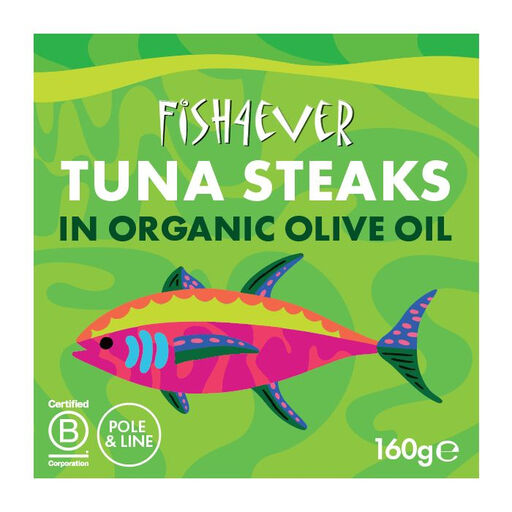
This tuna-steaks tin offers an organic olive-oil packing ingredient for quick meals. Check the product’s own labelling if you need an organic claim for the whole tin.
 No image available
For a quick meal where an organic packing ingredient matters, this is a 160g tuna-steaks tin in organic olive oil. Confirm the whole product’s organic labelling if that is your requirement, and check its drained weight and opened-tin directions when planning portions or leftovers.
No. Those claims concern sourcing or fishing methods, not organic status. For food labelled organic in the UK, the Department for Environment, Food & Rural Affairs sets production and certification conditions, including a requirement that at least 95% of agricultural ingredients are organic. Check what the claim on the specific tuna product covers.
The NHS advises no more than four cans of tuna or two tuna steaks a week for people who are pregnant or trying for a baby. The Food Standards Agency says the canned figure is based on medium-sized cans of around 140g drained weight. The guidance is not a universal limit for every new parent.
Follow the directions on that product rather than assuming every tin has the same storage period. Asda’s Tuna Chunks in Brine 4 x 145g directions say to transfer unused contents to a suitable non-metallic container, cover and refrigerate them, and use them within two days.