Who is this for?
The useful format depends on how many portions you need and which label details matter alongside carbohydrate.
Keto meal-prep shoppers
If you use tuna in repeated salads or lettuce wraps, look at the drained amount you can use across meals, not just the size printed on the can. Check any sauces and accompaniments separately when assessing the finished meal’s carbohydrate content.
Shoppers comparing salt
Spring-water tuna does not have one standard salt figure. Tesco Groceries lists 0.90g salt per 100g drained for its checked spring-water tuna, while Sainsbury’s lists 0.12g for its checked 145g can; compare the exact products’ labels.
Convenience and sourcing-led shoppers
Smaller cans, a particular opening format or a stated catch method may decide the choice after you have checked the nutrition panel. Treat sourcing and packaging statements as specific to the product, not every can from the brand.
What matters when choosing?
For a keto-friendly meal, establish what the exact tuna label says about carbohydrate, then choose a usable portion and check any other features important to you.
| Concern |
What to check |
Who this matters to |
| Carbohydrate |
Read the exact can’s carbohydrate declaration per 100g; account separately for sauces and accompaniments. |
If I am planning a keto-friendly meal, I need to know what the tuna contributes before adding anything else. About 42% of consumers put predictable carbohydrate content first. |
| Usable portion |
Compare net and drained weights, then choose a can or multipack size you can use within its storage instructions. |
When preparing several meals, I want enough drained tuna without leaving an opened can unused. Usable quantity is the primary concern for about 33% of consumers. |
| Salt and product features |
Compare salt per 100g on the same label basis; check the exact can for sourcing statements or an opening format you want. |
I may need to weigh the salt declaration against a preferred catch-method statement or a more convenient can. About 25% of consumers put one of those features first. |
Relevant tuna brands for reference
These examples illustrate differences between specific spring-water products; the details should not be assumed to apply to an entire brand range.
Tesco
Tesco lists spring-water tuna in single cans, multipacks and a 400g can, giving shoppers different ways to divide portions.
- Its checked products declare 0g carbohydrate per 100g drained, according to Tesco Groceries.
- The checked products declare 0.90g salt per 100g drained, so compare that figure if salt affects your choice.
Sainsbury’s
Its checked 145g spring-water can offers a single-can format. Sainsbury’s describes this product as pole-and-line caught and MSC-certified.
- The checked label states less than 0.5g carbohydrate and 0.12g salt per 100g drained.
- Check the exact can’s details rather than extending its nutrition or sourcing statements to other products in the range.
John West
The checked 4 x 125g spring-water multipack is an option for dividing tuna between meals; its listing describes a SmartStrip opening design.
- Sainsbury’s lists less than 0.1g carbohydrate per 100g drained for that multipack.
- John West pack formats vary, so check the variant’s portion size, opening design and nutrition panel.
Princes
Princes offers spring-water tuna in different formats. Its checked 4 x 145g pack carries an MSC certification statement.
- Tesco Groceries lists less than 0.1g carbohydrate per 100g drained for the checked multipack.
- That pack declares 0.85g salt per 100g drained; check other Princes variants separately.
M&S
M&S describes its checked spring-water tuna chunks as pole-and-line caught under its Forever Fish policy.
- The checked product states 0.0g carbohydrate per 100g.
- Confirm the nutrition and drained quantity on the can you select rather than applying this product’s details across the range.
Spring-water tuna on Joybuy
These single cans and multipacks let you choose a spring-water tuna format for individual meals or several planned portions. Check each product’s nutrition panel and drained quantity before deciding which fits your meal.
 No image available
Morrisons Fad Free Tuna in Spring Water, 6 x 145g
A six-can format to consider when you have several tuna meals planned. The stated 145g is the size of each can; check its drained quantity and nutrition panel for the portions you intend to use.
View on Joybuy
 No image available
John West Tuna Chunks in Spring Water, 4 x 125g
Four separate cans may suit meals planned on different days. Check the drained amount per can and the exact pack’s nutrition label before comparing portions with other formats.
View on Joybuy
 No image available
Morrisons Fad Free Tuna in Spring Water, 145g
A single can may suit one planned meal rather than a series of portions. Check its drained weight, carbohydrate declaration and salt declaration on the exact label.
View on Joybuy
 No image available
John West No Drain Tuna in Spring Water, 3 x 100g
The no-drain format may matter if you want less preparation when assembling a meal. This pack contains three 100g cans; check the nutrition label’s measurement basis when comparing it with drained-weight figures on other tuna.
View on Joybuy
 No image available
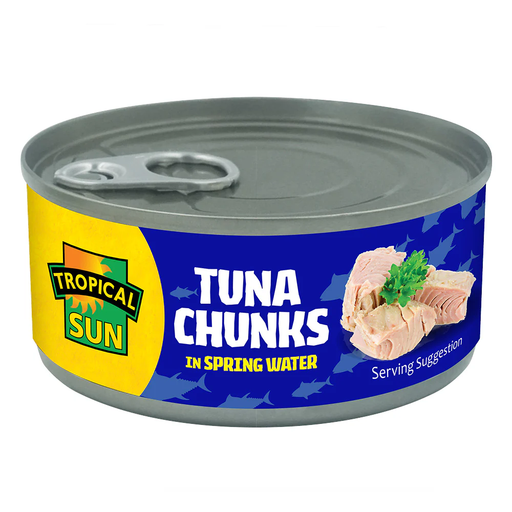
Topical Sun Tuna Chunks in Spring Water, 160g
Consider this single 160g can if its portion suits your meal. Compare the drained amount and the basis used for nutrition figures on its label before setting it alongside other cans.
View on Joybuy
Questions about tinned tuna
Can spring-water tuna be part of a keto-friendly meal?
It can be a low-carbohydrate base if the exact product’s label fits your plans. The checked plain spring-water products declare between 0g and less than 0.5g carbohydrate per 100g on their stated label bases; sauces, vegetables and side dishes contribute separately to the finished meal.
Why check drained weight as well as can size?
Drained weight tells you how much tuna remains after the packing liquid is removed. For example, Tesco Groceries states that its 400g spring-water can contains 280g drained tuna, a more useful figure when planning portions.
How should I handle tuna left after opening?
Follow the instructions on the exact can. Tesco Groceries says to refrigerate unused tuna from its checked 400g can and use it within two days; other checked products give different time limits, so do not apply one can’s instructions to another.
Does a sourcing label tell me about salt or portion size?
No. A stated catch method or MSC certification does not replace the nutrition panel or drained-weight declaration. Check those details on the particular can, even when sourcing is your main reason for considering it.


