Low-carbohydrate meal planners
If tuna is the base for a salad, lettuce wrap or meal with mayonnaise, compare the carbohydrate value of the exact tin and consider the other ingredients in the meal too.


Choose plain tuna in spring water if you want a low-carbohydrate base and prefer to add fat separately: the cited Princes, Tesco and M&S products list 0.0g or less than 0.1g carbohydrate per 100g drained. Brine and no-drain formats may suit quicker preparation, while oil-packed tuna includes oil in the finished dish; whichever you choose, check the exact variant’s ingredients, carbohydrate value, salt and portion size.
If tuna is the base for a salad, lettuce wrap or meal with mayonnaise, compare the carbohydrate value of the exact tin and consider the other ingredients in the meal too.
If preparation time matters, a no-drain format may appeal. Check its packing liquid, salt value and can size rather than choosing on convenience alone.
If species or fishing method affects your choice, read the statement for the particular product. Do not assume it applies to every tin from the same brand.
For a keto-style storecupboard, choose a packing liquid that suits how you will use the tuna, then compare the exact product label. A no-drain format is a separate convenience choice: tuna packed in water or oil can also carry that description.
Choose it when: You want plain tuna and prefer to select any added oil or mayonnaise at mealtime.
Bear in mind: Salt still varies between products, so compare the exact labels.
Choose it when: You want a water-based alternative, including a no-drain option if the exact pack offers one.
Bear in mind: The cited John West no-drain brine product lists 0.90g salt per 100g; compare salt on the same nutrition basis before choosing.
Choose it when: You want the oil packed with the tuna to be part of the dish.
Bear in mind: Check which oil the exact variant contains rather than assuming oil-packed tuna suits every keto-style meal.
| Concern | What to check | Who this matters to |
|---|---|---|
| Carbohydrate | Read carbohydrate per 100g drained and the ingredients of the exact variant, particularly if it has sauce or flavourings. | If tuna is the base of a keto-style meal, I want to know how much carbohydrate the tin contributes before adding other ingredients. About 40% of consumers would put carbohydrate content first. |
| Preparation | Check whether the pack explicitly says no-drain, its packing liquid and its salt value. | For a quick lunch, I want tuna I can use with little preparation. Roughly 30% of consumers would make ease of use their primary concern. |
| Ingredients and sourcing | Look for the species, ingredient list and any sourcing statement on the exact product. | When choosing a cupboard staple, I want to know what is in the tin and what sourcing information applies to it. About 20% of consumers would prioritise those details. |
| Portions and storage | Compare the amount you will use per opening and follow that pack’s instructions for leftovers. | If I rarely use a whole tin at once, I need a pack size that works with my meals and leftover plans. Around 10% of consumers would put portion and storage needs first. |
The cited plain spring-water products have very little listed carbohydrate, but that does not establish the values for tuna in sauce or for the complete meal.
Check the exact tin’s ingredients and carbohydrate value, then account for whatever you serve with it.
The cited John West no-drain brine product lists 0.90g salt per 100g, while the cited Princes, Tesco and M&S spring-water products list 0.75g to 0.85g per 100g drained. The label bases should match before you make a direct comparison.
If salt matters to your choice, check both the value and whether it refers to drained tuna.
The cited Tesco and M&S products instruct shoppers to move leftovers to a non-metallic container, refrigerate them and consume them within two days.
Match can size to the portions you use and follow the storage instructions on your own pack.
Tuna left unused beyond the pack’s opened-storage period may be wasted.
A tin’s carbohydrate figure does not establish whether it fits a prescribed ketogenic diet. The British Dietetic Association says medical ketogenic diet therapy should be implemented and monitored by an experienced ketogenic diet team.
If the diet is part of treatment, ask that team about the exact product rather than relying on general shopping guidance.
Princes lists spring-water tuna chunks in single cans and multipacks.
The cited Tesco spring-water chunks come as a 4 x 160g multipack.
The cited M&S product is a 160g tin of tuna chunks in spring water.
The cited John West product is a no-drain brine format for shoppers who want less preparation.
These tins cover spring-water, sunflower-oil and brine options for keto-style storecupboard meals. Compare each pack’s own label before treating its nutrition values as directly comparable with another tin.
 Image unavailable
A spring-water choice for meals where you want little draining. The pack contains three 100g tins; check the current label’s nutrition basis before comparing it with per-100g-drained values.
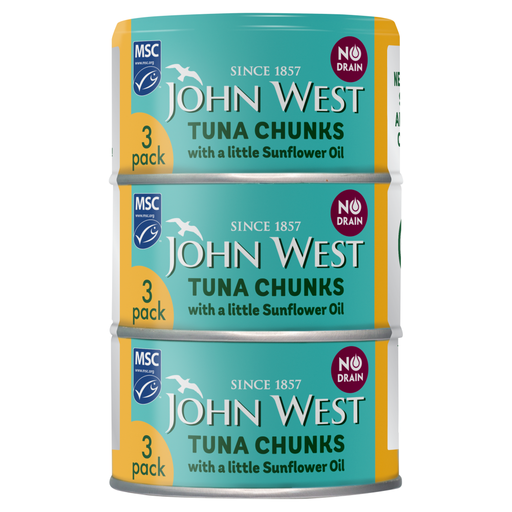 Image unavailable
For meals in which you want sunflower oil packed with the tuna and a no-drain format. The pack contains three 100g tins; check the current label before comparing its nutrition values with drained tuna.
 Image unavailable
A four-tin spring-water pack for planning cupboard portions. If avoiding draining matters to you, check this exact pack rather than assuming it has the No Drain format.
 Image unavailable
A six-tin spring-water pack for households planning several tuna meals. Consider whether a 145g tin matches the amount you will use after opening, and compare salt on the current label.
 Image unavailable
A four-tin brine option for cupboard portions. It is not labelled as no-drain; check its salt value against spring-water alternatives if that affects your choice.
Plain tuna in spring water can be a low-carbohydrate base: the cited Princes, Tesco and M&S products list 0.0g or less than 0.1g carbohydrate per 100g drained. Check the exact tin and include sauces, dressings and other meal ingredients when assessing the whole dish.
Choose spring water if you want to add your own oil or dressing; consider brine if its salt value and preparation suit you, or oil-packed tuna if you want that oil in the dish. Check the exact variant’s ingredients and nutrition panel rather than relying on the packing liquid alone.
For the cited Tesco and M&S products, move unused tuna to a non-metallic container, refrigerate it and consume it within two days. Follow the instructions on the particular pack you buy.
No: a general low-carbohydrate product choice cannot establish whether a food fits an individual treatment plan. The British Dietetic Association says medical ketogenic diet therapy should be implemented and monitored by an experienced ketogenic diet team; ask that team about the exact product.