Lower-sugar meal planners
You want tuna for a pasta bake or loaded jacket potato, while checking the sugars in both the tin and the ingredients you add.


For a winter pasta bake or jacket potato, start by checking the total-sugars figure on a plain tin rather than seeking a reduced-sugar claim: Princes Tuna Chunks in Brine lists 0.0g sugars per 100g drained, and M&S Tuna Chunks in Spring Water lists 0.0g per 100g. Compare salt, texture and the ingredients added to the finished meal separately; a tin with no listed sugars does not settle those choices.
You want tuna for a pasta bake or loaded jacket potato, while checking the sugars in both the tin and the ingredients you add.
You are choosing between brine and spring water, or between chunks and a softer filling, and want to compare the exact products' nutrition and ingredients.
Fish allergy, pregnancy guidance, possible bones or instructions for storing leftovers may affect whether a tin suits your household.
For winter comfort meals, assess the tuna and the other ingredients separately. If someone has a fish allergy, do not choose tuna, regardless of its nutrition panel.
| Concern | What to check | Who this matters to |
|---|---|---|
| Total sugars | Read “of which sugars” per 100g and the ingredients list on the exact tin. NHS food-label guidance classifies 5g of total sugars or less per 100g as low. | If I am watching the sugar added to a pasta bake, I want to establish what the tuna contributes before choosing a sauce. About 45% of consumers put checking the tin's total sugars first. |
| Meal texture | Choose chunks for distinct pieces or consider a chunks-and-flakes format for a softer filling; check the packing liquid separately. | For a jacket potato or toastie, I may care most about how the tuna works in the filling. About 27% of consumers make the meal format their primary concern. |
| Salt and energy | Compare salt and energy per 100g on a like-for-like basis, including whether figures refer to drained tuna. Consider the other ingredients in the dish. | When adding cheese or stock to a warming meal, I want to assess more than the tuna's sugar figure. About 18% of consumers prioritise these wider nutrition comparisons. |
| Household safety | Check the allergen label and any warning about bones. Follow the tin's storage instructions; NHS tuna-intake guidance applies if you are pregnant or trying for a baby. | If an allergy or pregnancy guidance affects my household, that condition comes before recipe convenience. About 10% of consumers put a specific safety requirement first. |
Princes and M&S each list 0.0g sugars per 100g for the plain-tuna examples described here. A sauce, baked-bean topping or chutney can change the finished dish's total-sugars figure.
Check the labels and portions of the ingredients you add, not just the tuna.
Spring water and brine identify how the tuna is packed; neither name tells you the salt figure of every product. M&S lists 0.75g salt per 100g for its spring-water chunks, while Princes lists 0.9g per 100g drained for its brine chunks.
Read the salt figure and its measurement basis on each tin you are considering.
Tuna is unsuitable for someone with a fish allergy. The NHS also gives a tuna-intake limit for people who are pregnant or trying for a baby, and some product information warns that small bones may remain.
Check the allergen and product instructions before serving, and apply the NHS pregnancy guidance where relevant.
Princes lists both Tuna Chunks in Brine and Sandwich Tuna in Spring Water, the latter described as a mix of chunks and flakes.
M&S Tuna Chunks in Spring Water is a plain option to consider for a pasta bake or jacket potato.
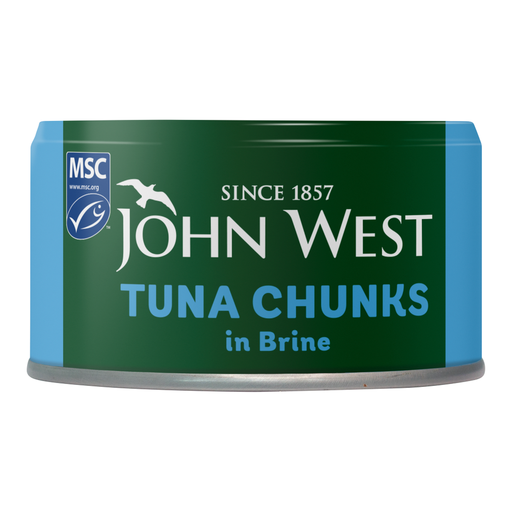
John West presents its tuna chunks in brine as an option for sandwiches, salads and pasta bakes.
These tins offer chunks in brine or spring water for meals such as pasta bakes, jacket potatoes, soups and casseroles. Use each current pack label to check sugars, salt and any storage instructions before deciding.
 No image available
Consider this single tin for a pasta bake when you want chunks in the filling.
Check the current label's sugars and salt figures, including whether its per-100g values refer to drained tuna.
 No image available
Choose this pack if spring-water chunks suit the tuna filling you plan to make.
The pack contains four 125g tins. Compare the current drained-nutrition figures with those of other tins if salt matters to your choice.
 No image available
These brine-packed chunks are an option when a cooked pasta dish calls for distinct pieces of tuna.
The pack contains four 145g tins. Check the exact pack's nutrition and any warning about bones before serving.
 No image available
Consider this spring-water option for a pasta dish or jacket potato when you want chunks rather than flakes.
It is a 145g tin. Compare its current sugars and salt figures with other products on the same per-100g basis.
 No image available
Consider these spring-water chunks when planning tuna for a soup or casserole.
It is a 160g tin. Check the current pack's nutrition figures and whether they refer to drained tuna before comparing it with another tin.
Not necessarily: compare the total-sugars figure on the tin you intend to buy. Princes Tuna Chunks in Brine lists 0.0g per 100g drained, while M&S Tuna Chunks in Spring Water lists 0.0g per 100g. The NHS distinguishes the total-sugars figure on a food label from free sugars, so read the figure as labelled rather than treating the two terms as interchangeable.
No conclusion about salt follows from the packing-liquid name alone. M&S lists 0.75g salt per 100g for its spring-water chunks, and Princes lists 0.9g per 100g drained for its brine chunks; check each current pack and compare figures given on the same basis.
Follow the instructions for that particular product. For its John West Tuna Chunks in Brine 4 x 125g listing, Joybuy says to refrigerate after opening and consume within two days.
The NHS says that people who are pregnant or trying for a baby should have no more than four cans of tuna a week because tuna contains higher levels of mercury than other fish. Apply that guidance when planning tuna meals for someone in either group; it is not a limit stated for every shopper.