For a secondary-school packed lunch, plain tuna in spring water is a useful starting point when you want a clearly declared sugars figure: the checked Princes, Tesco, Sainsbury’s, Asda and John West tins declare between 0g and less than 0.5g sugars per 100g drained. Compare the exact tin and any ingredients added to the filling separately. Tuna contains fish, and a prepared tuna lunch needs to be kept cool.
Who is this choice for?
Parents comparing sugars in lunch fillings
A plain tuna tin gives you a starting figure to check on the nutrition panel. If the lunch also includes mayonnaise, sauce or a prepared tuna filling, read those labels too rather than treating the tin’s figure as the figure for the whole lunch.
Students who need a practical portion
A smaller tin or a no-drain format may make preparation easier. John West’s checked No Drain springwater product is ready to use without draining, but tuna added to a sandwich, wrap or pasta pot still needs cool storage until lunch.
Households managing fish allergy
Tuna is not an option for a pupil with a fish allergy. Check the ingredients and allergen information on the exact pack, including any precautionary statement when shellfish cross-contact is a concern; do not assume shellfish is either present or absent from the word “tuna”.
What should you check?
Choose the filling first, then compare the exact pack’s nutrition and ingredients before deciding how it will be prepared and carried.
| Priority | What to check | Your needs |
|---|
| Declared sugars |
Compare sugars per 100g on the same drained or as-sold basis. Read the number rather than assuming “reduced sugar” means zero sugars. |
I want to compare the tuna itself using the nutrition panel. In the Food Standards Agency and Ipsos Northern Ireland’s 2024 survey of 611 people interviewed from 16 September to 23 November, 49% reported actively using traffic-light labelling when shopping for food generally; that figure does not describe tuna or packed-lunch shoppers specifically. |
| Added ingredients |
Read the tin’s ingredient list, then check mayonnaise, prepared tuna paste, sauces and other additions separately. Princes lists sugar among the mayonnaise ingredients in its checked Tuna & Mayonnaise Paste. |
If I make a sandwich filling, I need to consider everything mixed with the tuna, not just the sugars declared on a plain tin. |
| Fish allergen |
Check the exact pack’s fish declaration and any precautionary allergen statement. Check other ingredients mixed into the lunch as well. |
For a pupil with a fish allergy, I need a filling other than tuna. If shellfish cross-contact matters, I need the specific product’s allergen information rather than an assumption about tuna generally. |
| Pack and preparation |
Check the number and size of tins, whether draining is needed, and how much tuna the planned lunch uses. A no-drain label describes preparation, not the sugars in every no-drain product. |
For one lunch, a convenient portion matters; for repeated lunches, I want to know what will be left after opening a tin. |
| Chilling and leftovers |
Follow the exact pack’s instructions after opening. For a prepared tuna lunch, plan how to keep it cool; Norfolk and Norwich University Hospitals NHS Foundation Trust’s lunchbox guidance suggests a cool bag and ice pack or frozen drink. |
If I prepare lunch the night before or carry it to school, I need a way to keep the prepared filling cool and store any unused tuna as directed. |
| Salt alongside sugar |
Read salt per 100g using a comparable nutrition basis. The checked Tesco 4 x 160g spring-water listing declares 0.8g salt per 100g drained, even though it declares less than 0.1g sugars on that basis. |
I do not want a small sugars figure to distract me from other values I intend to compare on the label. |
What is easy to overlook?
-
Assuming every tuna filling has the same ingredients
Plain spring-water tuna and a prepared tuna paste are different products. Princes’ checked Tuna & Mayonnaise Paste includes mayonnaise ingredients containing sugar and declares 0.4g sugars per 100g.
Check the label of the finished filling or each ingredient you add, as well as the tuna tin.
-
Choosing by a “reduced sugar” phrase alone
That phrase does not tell you the product’s actual sugars figure or establish that it is sugar-free. Figures stated as “less than” are upper bounds, not exact amounts.
Compare the declared sugars per 100g on a like-for-like basis and read the ingredient list for the exact pack.
-
Missing the fish allergen
The checked tuna products identify fish. A lower sugars figure does not make tuna suitable for a pupil with a fish allergy, and fish on an ingredient list does not settle whether a particular pack has a shellfish precautionary statement.
Choose a non-tuna filling for a fish-allergic pupil, and read the exact pack’s allergen information where other allergies or cross-contact are relevant.
-
Leaving opened tuna or a prepared lunch warm
Storage instructions apply after a tin is opened, while a prepared sandwich or salad also needs to stay cool on its way to school. The checked Tesco listing instructs refrigeration after opening and use within two days.
Follow the chosen pack’s instructions for leftovers. Norfolk and Norwich University Hospitals NHS Foundation Trust recommends a cool bag with an ice pack or frozen drink for a packed lunch.
Relevant brand and own-label references
These examples describe specific checked products, not every tuna product sold under each name.
John West
Spring-water multipacks include a conventional 4 x 125g product and a No Drain 3 x 100g format.
- Asda’s checked 4 x 125g listing declares 0g sugars and 25g protein per 100g drained; its checked No Drain 3 x 100g listing declares 0g sugars per 100g.
- Both checked listings identify fish and give instructions for unused tuna after opening. Check the exact pack for its storage and allergen information.
Princes
Plain spring-water tuna and prepared tuna fillings need separate label checks.
- Princes’ checked plain spring-water tuna listing names tuna and spring water and declares less than 0.1g sugars per 100g drained.
- Its checked Tuna & Mayonnaise Paste has additional ingredients, including sugar within the mayonnaise ingredients, and declares 0.4g sugars per 100g.
Tesco
The checked own-label spring-water product comes as a 4 x 160g multipack.
- Tesco’s listing names skipjack tuna and spring water and declares less than 0.1g sugars per 100g drained.
- The same listing declares 0.8g salt per 100g drained and instructs refrigeration after opening.
Sainsbury’s
The checked own-label spring-water tuna is a single 145g tin.
- Sainsbury’s lists skipjack tuna and spring water, with less than 0.5g sugars and 0.12g salt per 100g drained.
- Use the nutrition and ingredients on the pack you buy when comparing it with a multipack or prepared filling.
Asda
The checked own-label tuna in spring water comes in a 4 x 145g pack.
- Asda lists tuna and spring water and declares less than 0.5g sugars per 100g drained for this pack.
- The listing also declares 0.90g salt per 100g drained. Compare that value as well as sugars if both matter to your choice.
Joybuy tuna options
These options cover no-drain and conventional spring-water tuna, plus one plain tuna-in-brine multipack, for preparing a secondary-school lunch. Check the exact pack’s label and plan how to keep a prepared lunch cool.
 No image available
John West No Drain Tuna Chunks in Springwater 3 x 100g
The no-drain format avoids a draining step when preparing a sandwich or salad. Joybuy’s listing declares 0g sugars per 100g and identifies tuna, water and salt; the product contains fish. Check the pack’s allergen and after-opening instructions.
View on Joybuy
 No image available
John West Tuna Chunks in Springwater 4 x 125g
Four separate tins offer portions for lunches prepared on different days. Joybuy’s listing declares 0g sugars per 100g drained and names tuna, spring water and salt; this is not the No Drain variant. It contains fish, so check the pack’s allergen and storage instructions.
View on Joybuy
 No image available
Morrisons Fad Free Tuna Chunks in Spring Water 145g, 6-pack
The six-pack provides separate 145g tins for lunches made on different days. This is tuna in spring water and contains fish; read the exact pack for its sugars declaration, allergen information and instructions for opened leftovers.
View on Joybuy
 No image available
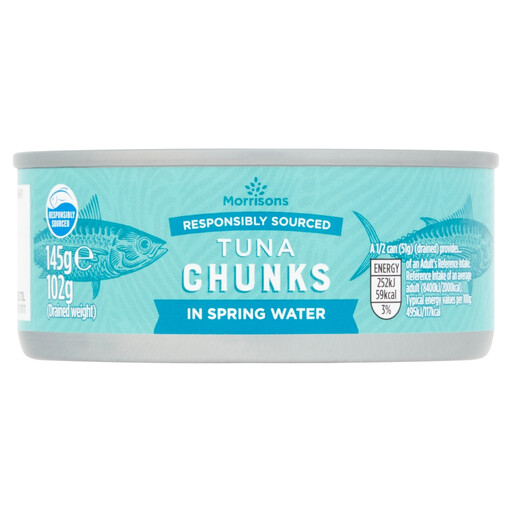
Morrisons Fad Free Tuna Chunks in Spring Water 145g
The single 145g tin is an alternative to buying a multipack when planning one preparation. It contains fish; compare the pack’s sugars declaration on the stated nutrition basis and follow its instructions if any tuna is left after opening.
View on Joybuy
 No image available
Princes Tuna Chunks in Brine 4 x 145g
This four-pack is tuna in brine, not spring water. If considering it for the same lunch, compare the exact pack’s sugars and salt declarations with the spring-water options on the same nutrition basis. Tuna contains fish.
View on Joybuy
Common questions
Does “reduced sugar” mean tinned tuna is sugar-free?
No. The phrase alone does not give you an actual sugars figure. Read the exact product’s nutrition panel and compare sugars per 100g on a like-for-like basis; the checked plain spring-water tins declare figures from 0g to less than 0.5g per 100g drained, which does not describe every prepared tuna filling.
Does a fish declaration mean tuna also contains shellfish?
No: a fish declaration does not establish whether shellfish is present or whether cross-contact is noted for a particular product. Tuna is unsuitable for someone with a fish allergy. Read the exact pack’s ingredients and any precautionary allergen statement when shellfish is also a concern.
How should tuna be packed for a school lunch?
Follow the tin’s instructions once it is opened, and keep a prepared tuna sandwich, wrap or salad cool until lunch. Norfolk and Norwich University Hospitals NHS Foundation Trust’s lunchbox guidance suggests a cool bag with an ice pack or frozen drink and refrigerating a lunch overnight if it is made in advance.


