If the tuna itself must be organic, check for an explicit organic claim and certification details on the exact tin; an MSC label is not a substitute. If certified fishery sourcing matters more, check that product’s MSC label or stated catch method, then choose larger steak pieces in olive oil for a visible serving or spring-water chunks when the recipe supplies its own dressing or sauce.
Who is this for?
Organic-claim verifiers
If organic certification of the tuna is essential, look for that claim on the product itself. GOV.UK sets out rules for organic food labelling, while Soil Association Certification describes organic aquaculture standards for farmed aquatic foods. An MSC fishery label or pole-and-line statement answers a different sourcing question.
Occasion-led dinner planners
If the tuna will be visible on the plate, the choice between chunks and steak pieces matters to the presentation. Marks & Spencer describes its tuna steak in olive oil as rich and flaky; spring-water chunks leave more of the dish’s flavour to its dressing or sauce.
Sourcing-first cooks
If certified fishery sourcing takes priority, check the label of the tin you plan to serve. The Marine Stewardship Council describes its ecolabel in terms of certified fisheries, while individual product listings may also state a catch method. Neither detail establishes organic status.
What matters when choosing tuna?
For an anniversary dinner, settle the requirement you would not want to compromise on before comparing packing liquids or pack sizes.
| Concern |
What to check |
Who this matters to |
| Organic claim |
Find an explicit organic claim and its certification or control details for the exact tuna product. Do not use an MSC logo as proof of organic status. |
If organic tuna is a firm requirement for the meal, a sourcing claim alone will not meet it. About 36% of consumers put verification of the organic claim first. |
| Serving format |
Check whether the tin contains steak, fillets or chunks, and whether it is packed in oil or spring water. |
When tuna is served in recognisable pieces, its format affects how the dish can be plated. Larger pieces and the packing medium are the primary concern for about 29% of consumers. |
| Fishery sourcing |
Look for the MSC ecolabel on the exact product and read any specific catch-method statement. |
If wild-caught fishery sourcing matters more than an organic claim, a product-level label gives me something specific to check. Roughly 21% of consumers put sourcing evidence first. |
| Ingredients and leftovers |
Read the ingredient list and compare salt on the same per-100g drained basis. Check the tin’s after-opening instructions. |
If the recipe already contains strongly flavoured ingredients, I want to check what the tuna adds and plan for any remainder. Ingredient, salt and leftover considerations come first for about 14% of consumers. |
Mistakes to avoid
-
Treating MSC and organic as the same claim
The Marine Stewardship Council’s label concerns a certified fishery; organic certification concerns a different production framework. Substituting one for the other could leave an organic-only dinner requirement unmet.
Check the precise tin for an explicit organic claim and certification details if organic tuna is essential. Otherwise, describe an MSC-labelled choice as a fishery-sourcing choice.
-
Assuming spring-water tuna has a uniform salt content
Spring water describes the packing medium, not the finished product’s salt value. The reviewed Tesco, Asda and Sainsbury’s spring-water products have different nutrition listings.
Compare current labels on the same per-100g drained basis, particularly if the dish also contains capers, olives or cheese.
-
Planning one dish without checking the opened-tin instructions
A multipack or larger tin may leave tuna unused after dinner. The reviewed product labels give different periods for using refrigerated leftovers.
Choose a pack size that fits the recipe. Transfer any remainder to a non-metallic container, refrigerate it and follow the period on that product’s label.
Tuna left over beyond its stated storage period may have to be discarded.
Brands to consider
John West
Consider its spring-water formats when assembling a salad or pasta dish. John West describes a no-drain tuna-chunks product as MSC-labelled, and Sainsbury’s lists a separate John West MSC spring-water product.
- No-drain and conventional spring-water formats offer different preparation options.
- Check the label of the chosen tin; an MSC claim does not establish that its tuna is organic.
Princes
Princes offers tuna in spring water, brine and oil. Princes Group said in February 2026 that its branded tuna sourcing had reached its MSC-certified goal; an Asda listing also identifies an MSC-labelled Princes spring-water multipack.
- The identified spring-water multipack gives shoppers a product-level MSC claim to inspect.
- The brand announcement is not an organic claim for an individual tin.
Tesco
Tesco’s 3 × 80g tuna chunks in spring water are listed as coming from a fishery certified to the Marine Stewardship Council’s standard.
- The small-tin multipack may suit a recipe that calls for portions from separate tins.
- Its product information describes purse-seine fishing on free schools, not pole-and-line fishing; check the exact pack if method matters.
Sainsbury's
The identified 145g spring-water tuna chunks are described by Sainsbury’s as pole-and-line caught and sourced from an MSC-certified fishery.
- The product listing states both a catch method and a fishery-certification claim.
- Confirm the current listing and pack before relying on those details for the dinner.
Asda
Asda lists a 4 × 145g spring-water tuna-chunks multipack with an MSC-certified seafood claim.
- The multipack format may suit a dish requiring several tins.
- Check its nutrition panel against other spring-water tins rather than assuming the packing medium determines salt content.
M&S
Marks & Spencer lists both spring-water chunks and tuna steak in olive oil, giving shoppers a choice between tuna to mix into a dish and pieces to serve visibly.
- Marks & Spencer describes its olive-oil steak as rich and flaky and its spring-water chunks as pole-and-line caught.
- These descriptions apply to the identified products; neither establishes an organic claim for the tuna.
Joybuy tuna for an anniversary dish
This tuna-steak option suits a dish in which the tuna will be served in visible pieces and olive oil fits the recipe. Check the exact tin separately if organic certification of the tuna or a particular fishery-sourcing claim is essential.
 No image available
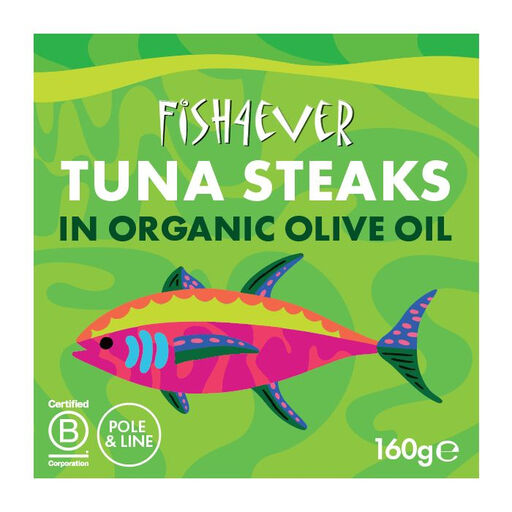
Fish4ever Tuna Steaks in Organic Olive Oil 160g
The tuna-steak format is worth considering when the pieces will be visible in a salad or pasta dish.
This is a 160g product packed in organic olive oil. The organic wording concerns the olive oil; verify any organic claim for the tuna itself on the exact tin. Check the pack for an MSC label or catch-method statement if either matters to your choice.
View on Joybuy
Questions about choosing tinned tuna
Is MSC-certified tinned tuna organic?
No. The Marine Stewardship Council’s certification concerns fisheries, whereas GOV.UK’s organic food rules concern an organic claim on the food. If organic tuna is essential, check the precise product for an explicit claim and certification details rather than relying on MSC, pole-and-line or responsible-sourcing wording.
Should I choose tuna chunks or steak for an anniversary dinner?
Choose steak or fillet pieces when you want the tuna to remain visible on the plate; choose chunks when you intend to mix them into a dressing, sauce or filling. Olive oil also becomes part of the finished dish, so check that its flavour suits your recipe.
Does tuna in spring water always contain less salt?
No. Spring water identifies the packing medium, not a fixed salt content. Compare the current products’ nutrition panels using the same per-100g drained basis before choosing.
What should I do with tuna left after dinner?
Follow the storage instructions on the tin you opened. The reviewed retailer labels call for leftovers to be transferred to a non-metallic container and refrigerated, but their stated periods for using the tuna differ, so check your product’s label.


