Choose tuna in organic olive oil if that named organic ingredient is your priority, spring-water tuna if you want to add your own dressing, or a ready-to-eat flavoured tin if preparation time matters most. Organic olive oil does not, by itself, establish that the tuna is organically produced: check the exact claim, then compare ingredients, salt and nutrition on the tins you are considering.
Who is choosing?
Organic-claim checkers
If the organic claim drives your choice, look for the ingredient it describes rather than assuming it covers the fish. The Department for Environment, Food & Rural Affairs sets requirements for food marketed as organic; an ingredient identified as organic is a narrower claim.
Everyday lunch planners
For sandwiches, salads or grain bowls, compare the packing liquid, ingredients and nutrition on the exact tin. An oil-packed tuna product and a flavoured single-serve tin can have different serving sizes and salt declarations, so compare like with like.
People who are pregnant or trying for a baby
Tuna frequency matters regardless of whether a tin contains organic olive oil, spring water or flavourings. The NHS advises no more than four cans of tuna or two tuna steaks a week for people who are pregnant or trying for a baby.
What matters when choosing?
Decide first whether your priority is a specifically identified organic ingredient, control over what you add to the tuna, or a tin that needs little preparation. Then read the exact product label: the packing medium alone does not tell you its salt content or the scope of an organic claim.
| Concern |
What to check |
Who this matters to |
| Scope of the organic claim |
Read the product wording and ingredient list together; identify what is marked organic and any stated certification information. |
If organic wording shapes my lunch choice, I need to know whether it describes the tuna or only its packing oil; about 46% of consumers put the scope of the organic claim first. |
| Ingredients and nutrition |
Compare the packing liquid, salt and nutrition per 100g and per serving, checking whether the stated figures use drained weight. |
For regular lunches, I want to know what comes in the tin before adding anything else to the meal; around 36% of consumers put ingredients and nutrition first. |
| Tuna frequency |
If pregnant or trying for a baby, count tuna eaten during the week against NHS guidance, including tuna in prepared meals. |
If I am pregnant or trying for a baby, I need to keep track of tuna across my meals; roughly 18% of consumers put pregnancy-related tuna frequency first. |
What is easy to misread?
-
Assuming organic olive oil makes the tuna organic
The Fish4Ever product identifies organic olive oil in its ingredients. That does not establish an organic-production claim for the fish; UK requirements for marketing food as organic are set out by the Department for Environment, Food & Rural Affairs.
Check precisely which ingredient or product the organic wording describes, rather than relying on a short search-result title.
-
Choosing spring water without checking salt
Water-packed describes the packing medium, not the finished tin’s salt content. The Morrisons spring-water tuna listing on Joybuy declares 1.0g salt per 100g drained.
Read the salt declaration on each tin you are comparing, alongside its ingredients and serving size.
-
Reading fishing claims as organic certification
Pole-and-line and MSC statements concern fishing or sourcing. They answer a different question from whether the food or an ingredient is described as organic under UK rules.
If both claims matter to you, check the organic wording and the fishing information separately on the exact product.
-
Counting tuna as oily fish
The NHS says fresh and canned tuna do not count as oily fish. Its guidance also limits tuna to four cans or two tuna steaks a week for people who are pregnant or trying for a baby.
Keep those distinctions in mind when planning fish choices across the week, whichever tuna format you buy.
Brands and product lines to consider
These examples illustrate different tuna formats and claims, not a ranking of the brands. Check the label of the particular tin you intend to buy.
Fish4Ever
An option when the specifically named organic ingredient you want is olive oil.
- Fish4Ever describes its skipjack tuna steaks as packed in organic first cold-pressed olive oil and pole-and-line caught.
- The organic olive-oil claim does not establish that the wild tuna itself is organically produced.
John West
A reference point for standard and no-drain tuna formats in Tesco’s tinned-tuna listing.
- The Tesco listing includes John West tuna in spring water, including a no-drain format.
- Those listed formats do not, on their own, establish an organic claim for a particular tin.
Princes
A reference point for tuna in brine, spring water or sunflower oil.
- Tesco lists these packing formats, while Princes separately makes an MSC certification claim about its tuna sourcing.
- An MSC sourcing claim is not an organic-food claim; assess either statement on its own terms.
Tesco
Own-label chunks and steaks provide examples of different packing liquids.
- Tesco’s listing includes own-label chunks in spring water and brine, and steaks in sunflower oil.
- Those format listings do not verify an organic claim for the own-label examples.
Sainsbury's
Its Dill & Pickle Tuna is an example of a ready-to-eat, no-drain flavoured tin.
- Sainsbury’s describes the 80g tin as ready to eat and lists 14.7g protein and 0.80g salt per can.
- Its stated fishing and MSC information should not be read as organic certification.
Tuna in organic olive oil on Joybuy
This selection is for lunches where a specifically identified organic olive-oil ingredient matters. Compare its label with spring-water or ready-to-eat flavoured tuna if those formats better fit how you prepare lunch.
 No image available
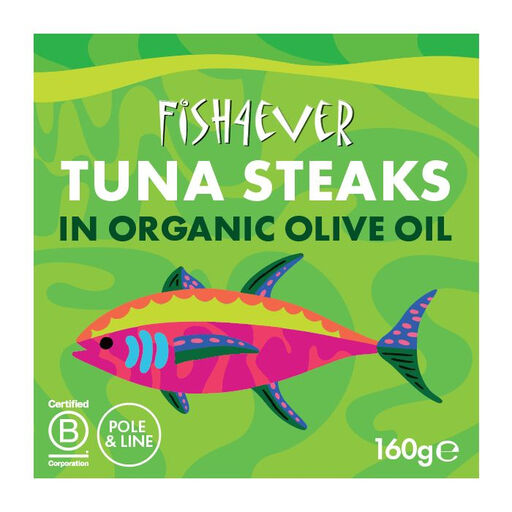
Fish4Ever Tuna Steaks in Organic Olive Oil 160g
Consider this tin if you want olive oil included in the tuna for a salad or grain bowl, while recognising that the organic claim identifies the oil rather than establishing an organic claim for the fish.
Joybuy lists skipjack tuna (65%), organic olive oil (33.5%) and sea salt (1.5%). Its listed nutrition is 30.9g protein, 5.9g fat and 0.9g salt per 100g. Check whether the nutrition figures refer to the drained or whole product before comparing them with another tin.
View on Joybuy
Common questions
Does organic olive oil mean the whole tuna tin is organic?
No: identifying organic olive oil does not by itself establish that the tuna is organically produced. The Fish4Ever ingredient list names skipjack tuna and organic olive oil; check the scope of the claim on the exact pack. The Department for Environment, Food & Rural Affairs sets separate requirements for food marketed as organic in the UK.
Does canned tuna count as oily fish?
No. The NHS says fresh and canned tuna do not count as oily fish, so do not count a tuna lunch as an oily-fish portion when planning other fish meals.
How often can I have tuna if I am pregnant or trying for a baby?
The NHS advises no more than four cans of tuna or two tuna steaks a week for people who are pregnant or trying for a baby, because tuna can contain higher mercury levels than other fish. Count tuna in sandwiches and prepared meals as well as tins eaten on their own.
What should I do with tuna left after opening a tin?
Follow the instructions on your tin. Joybuy’s Fish4Ever product information says to refrigerate it and consume it within two days of opening; its Morrisons spring-water tuna information also says to transfer unused contents to a non-metallic lidded container before refrigerating.


