For a lower-sugar working-from-home lunch, start with the nutrition panel rather than looking only for a reduced-sugar claim: plain spring-water and brine tuna examples listed by Princes, Tesco, Asda and John West have 0g or less than 0.5g sugars per 100g drained. Choose a plain spring-water tin for a simple lunch base, or a no-drain format if avoiding preparation matters more. Check the exact tin’s ingredients, salt, portion size and storage instructions, particularly when choosing a flavoured product.
Who this is for
Shoppers checking sugar
If you want a lower-sugar lunch base, compare the sugars and ingredients on the exact tin. Plain tuna examples listed by Princes, Asda, Tesco and John West have little or no sugar per 100g drained; a flavoured tin or the rest of your lunch needs its own check.
People with short lunch breaks
If you are assembling lunch between meetings, a no-drain or ready-to-use tin may save a preparation step. John West describes its No Drain tuna as ready to eat, while Princes describes its drained line as ready to use.
Regular tuna eaters
If tuna is a frequent lunch choice, check salt, fish allergen information and instructions for leftovers as well as sugars. For pregnancy, the NHS also sets a weekly limit on tuna intake.
What matters when choosing
Start with sugars and ingredients, then compare salt and usable quantity on the same weight basis; choose the opening format that fits your lunch break.
| Concern | What to check | Who this matters to |
|---|
| Sugars and ingredients |
Read ‘of which sugars’ per 100g drained and check for sauces or flavourings. |
If I want a lower-sugar lunch base, I need to know what is in the tin rather than rely on its front label. About 33% of consumers put that sugar check first. |
| Salt |
Compare salt per 100g drained, then consider the amount you will eat. |
A plain tin can meet my sugar preference while containing more salt than I expected. Keeping salt and ingredients in view is the primary concern for about 25% of consumers. |
| Lunch-break preparation |
Look for an explicit no-drain or ready-to-use description and check the opening format. |
Between meetings, I would rather assemble lunch without draining a tin. Speed and less mess come first for about 25% of consumers. |
| Usable quantity |
Compare the number of tins and their drained weights; check storage instructions if you may have leftovers. |
When planning several lunches, I want tin sizes that fit the portions I will actually use. Pack sizing is the main concern for about 17% of consumers. |
Buying pitfalls
-
Assuming a low sugar figure settles every label choice
Plain tuna examples list little or no sugar, but their salt figures differ. Tesco lists 0.8g salt per 100g drained for its spring-water chunks, while Asda lists 0.90g for its spring-water product.
Compare both sugars and salt on the same per-100g drained basis, then consider your intended portion.
-
Comparing tins by total pack weight alone
A tin packed in liquid has a net weight and a drained weight; the total weight does not tell you how much tuna remains after draining.
Check drained weight and tin count, and note whether the format needs draining at all.
-
Leaving leftovers in an opened tin
Storage instructions matter if one tin covers more than one lunch. The Asda and Tesco product guidance calls for unused tuna to be transferred to a suitable container and refrigerated.
Follow the instruction on your pack; those products specify using refrigerated leftovers within 2 days.
-
Assuming tinned tuna has no pregnancy-specific limit
The NHS advises limiting tuna during pregnancy because it can contain mercury. Being tinned does not remove that consideration.
If you are pregnant, follow the NHS limit of no more than four cans of tuna or two tuna steaks a week.
Brands to consider
John West
Its range includes plain spring-water tuna, No Drain tuna and flavoured options, so the format matters as much as the brand name.
- Asda lists 0g sugars and 25g protein per 100g drained for John West spring-water chunks. Its No Drain product is described as ready to eat.
- John West lists 12g fat and 205kcal per 100g for its chilli-and-garlic olive-oil tuna; do not use the plain tin’s nutrition figures for that variant.
Princes
Princes offers spring-water and brine chunks alongside a drained, ready-to-use line.
- Princes lists 0.0g sugars per 100g drained for its brine chunks.
- The same brine product lists 0.9g salt per 100g drained. Check each variant’s label rather than applying that figure across the range.
Tesco
Its own-label spring-water multipack provides a plain-tuna option for comparing drained-weight nutrition.
- Tesco lists less than 0.1g sugars and 23.5g protein per 100g drained for its spring-water chunks.
- That product lists 0.8g salt per 100g drained. Check the current pack label when choosing a tin.
Asda
Its own-label spring-water tuna offers a plainly labelled multipack for comparing portions and nutrition.
- Asda lists less than 0.5g sugars and 25g protein per 100g drained for its 4 x 145g product.
- It also lists 0.90g salt per 100g drained and instructs shoppers to refrigerate unused contents and use them within 2 days.
M&S
M&S describes its spring-water chunks as pole-and-line caught under its Forever Fish policy.
- That sourcing description applies to the stated M&S product line.
- It is the brand’s own sourcing claim, not a comparison with other tins; check the current nutrition label for sugars and salt.
Tinned tuna on Joybuy
These tins offer plain spring-water or no-drain formats for a working-from-home lunch. Compare their pack sizes and the nutrition basis printed on each label before choosing.
 Image unavailable
John West No Drain Tuna Chunks in Springwater, 3 x 100g
The no-drain format suits a lunch you want to assemble without tipping away liquid. The listing gives 0g sugars per 100g, but check the label’s nutrition basis before comparing it with figures stated per 100g drained.
View on Joybuy
 Image unavailable
Morrisons Fad Free Tuna Chunks in Spring Water, 6 x 145g
The six-pack suits lunches planned across several days. Its listing states 0.0g sugars per 100g drained and names tuna, spring water and salt as ingredients. If you use only part of a tin, follow its instructions for refrigerating leftovers.
View on Joybuy
 Image unavailable
John West Tuna Chunks in Springwater, 4 x 125g
This plain spring-water four-pack can provide a base for sandwiches or salads. Its listing states 0g sugars per 100g drained and names tuna, spring water and salt as ingredients. It is not identified as a No Drain product.
View on Joybuy
 Image unavailable
Morrisons Fad Free Tuna Chunks in Spring Water, 145g
The single tin suits a lunch when you do not need a multipack. Its listing states 0.0g sugars per 100g drained and names tuna, spring water and salt as ingredients. Check the pack instructions if any tuna remains after lunch.
View on Joybuy
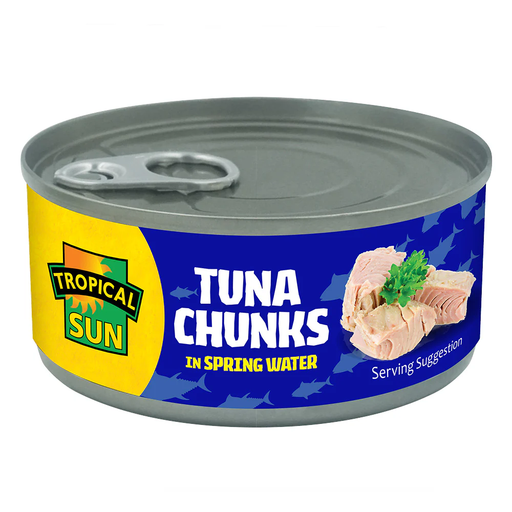 Image unavailable
Topical Sun Tuna Chunks in Springwater, 160g
This listing describes a 160g spring-water tin, but its title says Topical Sun while its description says Tropical Sun. Confirm the brand and pack label before relying on the description’s nutrition, ingredient or allergen details; its per-100g nutrition basis also needs checking.
Purchase link unavailable
Questions about tinned tuna
Do I need a reduced-sugar tuna tin for lunch?
Not necessarily: plain spring-water and brine examples listed by Princes, Tesco, Asda and John West have 0g or less than 0.5g sugars per 100g drained. Read the exact tin’s nutrition panel and ingredients, particularly if it contains flavourings or sauce.
Is spring-water tuna always lower in salt than brine tuna?
No. Tesco lists 0.8g salt per 100g drained for its spring-water chunks and Asda lists 0.90g for its spring-water product; Princes lists 0.9g for its brine chunks. Compare the products you are considering on the same per-100g drained basis.
What should I do with tuna left over from an opened tin?
Follow the instructions on that tin. The Asda and Tesco product guidance calls for transferring unused tuna to a suitable non-metallic container, refrigerating it and using it within 2 days.
Can I eat tinned tuna during pregnancy?
Yes, within the NHS limit of no more than four cans of tuna or two tuna steaks a week during pregnancy. The NHS gives this limit because tuna can contain mercury.
Does a tinned tuna lunch count as oily fish?
No. The NHS says fresh and canned tuna do not count as oily fish, so a tuna lunch should not be counted as an oily-fish portion.


